
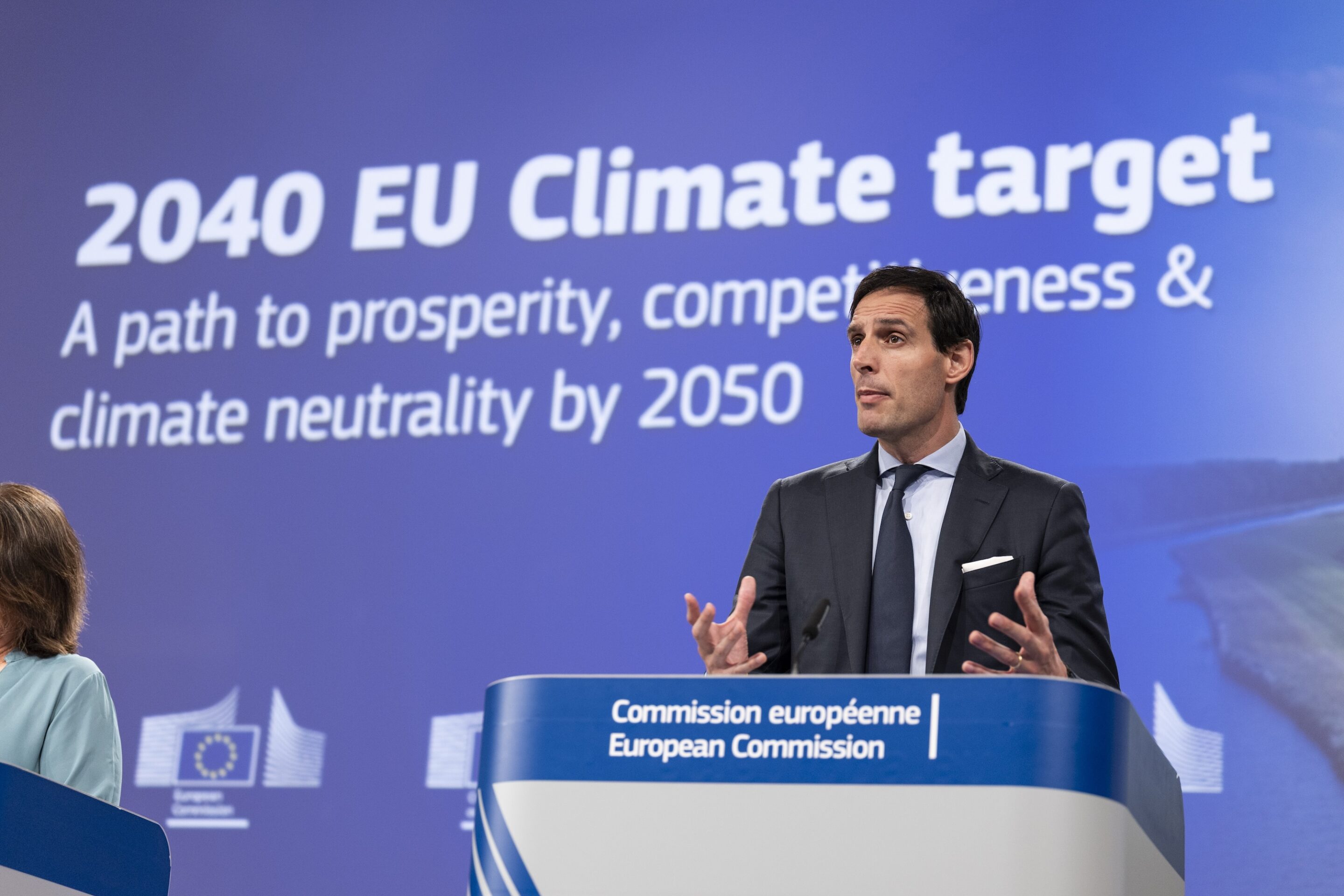
The European Commission has spelled out its plans for how to drag the Union towards carbon neutrality in 2050 with a new target. But it has already been criticised for including too many loopholes.
In order for the EU to neutralise its greenhouse gas emissions by 2050 then it somehow has to bridge the gap between its 55% emissions reduction target in 2030 and mid-century.
The European Commission has been working on a 2040 milestone for a long time and finally published its plan earlier this week. As rumoured, the target will be a 90% cut, which should make the 2050 benchmark achievable.
Ninety percent is just about in keeping with what the EU’s scientific advisory board said should be included. Its recommendation was a 90-95% cut, so on this particular aspect maybe we can cut the Commission some slack.
After all, the EU executive is not just a technocratic civil service, it must take political feasibility into account when making policy. It is likely that a 95% target would have been laughed out of the room by governments and a big portion of MEPs.
But it is one of the finer details of the proposal that is proving to be the most controversial and that is the inclusion of international carbon credits as an option to meet some of the 90% requirement.
Under the draft plan, the Commission will allow countries to buy credits as of 2036 and to meet up to 3% of the cuts in this way.
Carbon credits are essentially emission cuts generated by projects like reforestation schemes, renewable energy buildout, electric vehicle rollout and so on. But instead of those cuts being claimed by the country in which they happen, they are credited to a client.
For example, if France spends €10 million in Gabon on planting trees and that results in effective emission cuts tallying 50,000 tonnes of CO2, then those savings would be marked against France’s climate results.
It is a controversial way to fight climate change for a number of reasons. The first being that many of these projects have been revealed in the past to be ineffective or bogus.
If replanted forests burn down, then have those emissions been saved? If a city’s bus fleet is electrified, then can you legitimately claim that it would not have happened without the investment in question?
There is also the ethical question of removing those emission savings from the ledgers of the countries where they happen. If Germany electrifies Namibia’s power grid with wind power, then that country will have less low-hanging fruit from which to make emission cuts.
Additionally, it could also mean that countries spend more on these quick wins and less on domestic initiatives. In the mid-2030s, it is expected that lots of difficult and expensive decisions will have to be made, so this could be a distraction.
But ok, again, maybe the Commission requires some slack to be cut. If the 90% cut gets political support because of this measure being included, then one could make the case that it is a climate compromise worth making.
Now policymakers will have to be watchful that the inch given by the Commission is not turned into a mile by governments. That 2036 start date and 3% upper limit might be brought forward and increased, respectively, if the Council is allowed free rein.
The robustness of these carbon credits will also have to be gold-plated. Countries like Switzerland and Norway are already signing agreements of this nature with countries in the Global South, so the EU will have to keep tabs on those cases to see if they work.
Ultimately, it is good news that the Commission has finally got this target down on paper and that a 2035 midpoint target can now be negotiated. Get the details right as well and some real progress can be made.
Want more updates and analysis of what is happening in the world of energy and climate? Interested in finding a job in the sector or more information about public tenders? Sign up to our Energy Rundown newsletter here!
