
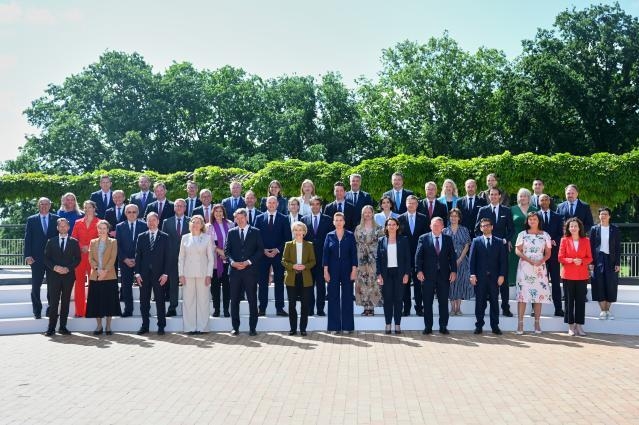
Denmark took over the rotating EU Presidency from Poland on 1 July and will chair it until 31 December 2025 when it will hand it over to Cyprus. During this six-month period, Denmark will lead the work of the Council of the European Union, building co-operation and agreement between the member states.
The official launch of the Danish EU Presidency was marked last Thursday (3 July) when the Danish government led by Prime Minister Mette Frederiksen welcomed European Commission President Ursula von der Leyen, her College of Commissioners and Ukrainian President Volodymyr Zelenskyy to Aarhus, the second-largest city in Denmark.
Aarhus University, where the opening ceremony took place, captures what makes Denmark so special, said von der Leyen: “The ability to blend style and practicality, to unite tradition with modernity, to stand strong and independent. Aarhus embodies those same values; gothic spires rise beside biotech labs, green innovation flourishes next to cobbled streets.”
It is the eighth time Denmark assumes the EU Presidency (last time was 2012) but it has never faced such a difficult task. “Our task is crystal clear, we must steer Europe through the most challenging times in our history,” the Danish prime minister said at a joint press conference with the Commission President.
“A stronger Europe is the answer to all challenges,” she said, listing Russia’s war of aggression against Ukraine, the situation in the Middle East which has escalated to a new level, and the consequences of migration, climate change and global competitiveness. “This will be guiding principle of our presidency. If we are not willing to stand up for our continent, who else will do it?”
Supporting Ukraine
Rearming Europe and boosting support to Ukraine dominated the discussions. “Europe needs to be rearmed by 2030,” Frederiksen said. “Ukraine is part of the European family and is fighting for all of us.” The Danish EU Presidency will also do everything it can to help Ukraine on its way towards EU membership, she promised. She is also in favor of Ukraine becoming a member of NATO.
She does not believe that Putin intends to end the war. “We must strengthen Ukraine. And we must weaken Russia. The former by increasing military support. Ukraine is essential to Europe’s security. Our contribution to Ukraine is also a protection of our freedom. The latter, we will achieve with sanctions. We must increase pressure on Russia.”
Asked about the lack of unanimity on advancing the accession negotiations with Ukraine, she replied that the majority of EU Member States are on the same page on enlargement and Ukraine. It will be challenging to agree on concrete steps forward but Denmark is working on it. “For me, it’s extremely impressive that a country at war is making progress in its path towards EU membership.”
President Zelenskyy thanked Denmark, the “vast majority of EU countries” and the European institutions for their support. Ukraine has already done everything to start accession negotiations and to open the fundamentals cluster in the acquis (EU law), he said, and will be ready for the other clusters later this year. The main obstacle is Hungary’s veto against opening the cluster and starting the negotiations.
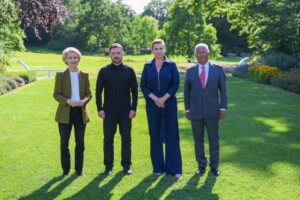
Ursula von der Leyen, Volodymyr Zelensky, Mette Frederiksen, and António Costa, from left to right, credit: EU, 2025
Commission – EU Presidency roles
In her press remarks at the press conference, Commission President von der Leyen tasked the Danish EU Presidency with ensuring the implementation of SAFE, EU’s €150 billion programme for joint procurement in defence. Member States should provide an estimate of their needs by the end of the month. The Commission on its part will present a roadmap to the European Council in October.
Asked what the EU can do to support more Ukraine if the US would reduce its support, von der Leyen replied that it is sending a strong message by SAFE. Joint procurement can be used to invest in the defence industry in both EU Member States and Ukraine, where only 60 % of the capacity is used. “I can only recommend to use SAFE now.”
Frederiksen admitted that it would be a serious setback if the US would not provide what is needed for Ukraine’s defence and hoped that the transatlantic partnership will stay on. “Ukraine is producing weapons faster and cheaper than the rest of us but we should also invest in other countries.” The EU needs to change its mindset, she added. By delivering weapons to Ukraine, the EU is rearming itself.
Von der Leyen agreed that the EU must put pressure on Russia so that it comes to the negotiation table. “Therefore, the 18th package of sanctions, will be one of the first deliverables in the Danish Presidency. Achieving just and lasting peace in Ukraine remains a key priority.“ However, Slovakia is opposing the adoption of the sanctions package.
Implementing migration pact
Frederiksen is a hardliner as regards migration and did not describe it as a humanitarian issue. Security is also about migration, she said, and claimed that the current asylum system is broken, with smugglers deciding who can enter the EU which leads to uncontrolled or irregular migration. “People who commit serious crimes and don’t respect our values don’t have a place in Europe.”
During the Danish EU Presidency proposals on “return hubs” and processing of asylum applications outside the EU will be discussed.
Von der Leyen referred to the Pact on Asylum and Migration, a legal framework which already has been adopted. “That is good. Now we have to implement it. However, we also know that this will not be enough to solve the challenges we face. That is why we have worked on the operational side. Under your Presidency we can make progress on our return proposal, the safe third country concept and the safe countries of origin.”
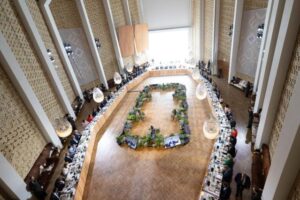
Opening of Danish EU Presidency, general view, credit: EU, 2025
The Commission visit started at Aarhus University with a meeting between the Commission and the Danish government, followed by the press conference. Afterwards, the King and Queen of Denmark met them at the art museum ARoS. In the afternoon the Commission and the Danish government toured Aarhus harbour on a site visit focusing on the green transition in the shipping sector.
In the evening an official opening ceremony was held at Aarhus City Hall. Concurrent to the ceremony at the City Hall, Aarhus hosted a public European street festival in the City Hall Park with concerts, debate, and communal dining.
Different Presidency style
Will the Danish EU Presidency differ in style from previous presidencies? For those who listened to the Danish Prime Minister, she appeared as tough and outspoken and will likely make her mark on the Danish EU Presidency. She has changed political views during her political carrier and is now, as leader of the Social Democrat party, head of a coalition government with two centre – liberal parties.
“I have always admired Denmark's fast and focused approach,“ the Commission President said in Aarhus. “You know how to get things done. And that is exactly the kind of spirit that we need right now.”
Under the slogan ‘A strong Europe in a changing world’, the Danish Presidency will work for a secure Europe as well as a competitive and green Europe. For the Danish EU Presidency Programme, click here.
“The EU Presidency offers Denmark a unique opportunity to strengthen the European agenda, and we are ready to seize it,” commented Marie Bjerre, Danish Minister for European Affairs, who has visited all EU Member States and candidate countries since she became minister. “In today’s shifting geopolitical landscape, Europe must become significantly stronger, both economically, politically, and militarily.”
“That is why we have set out an ambitious presidency programme aimed at enhancing the EU’s defence and security, providing support to Ukraine, and tackling irregular migration. All agendas where Denmark has already taken a leading role within the EU. At the same time, we will work to improve the conditions for European businesses by reducing regulatory burdens, while maintaining our commitment to the green transition. This will strengthen Europe’s long-term competitiveness.”
