
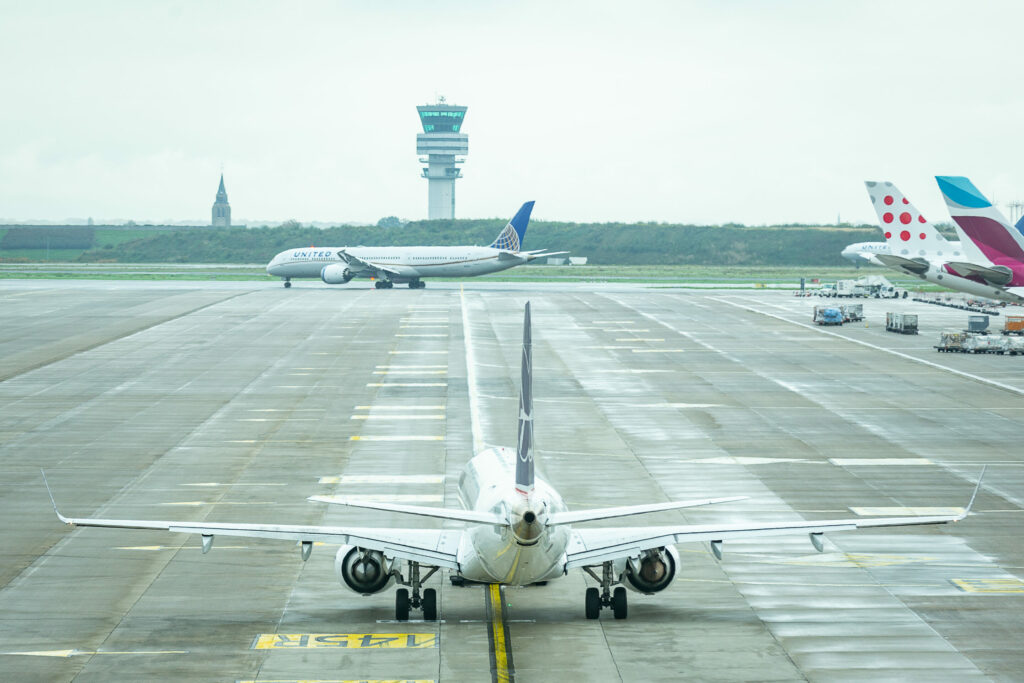
Nearly a quarter of people living near Brussels Airport are in favour of an outright ban on night flights.
A survey of 1,416 local residents conducted by a polling firm on behalf of the DHL air freight group showed 22% of respondents wanted a full ban on night flights operating from the airport in Zaventem.
Aircraft noise at night is a persistent problem in Brussels. In May, Brussels Airport released a ‘noise contours’ study which suggested that over 100,000 people living near Brussels Airport have their sleep “seriously disturbed” by aircraft taking off and landing.
According to the study, the greatest noise nuisance is experienced in the City of Brussels and Schaerbeek.
In the DHL survey, 26% of respondents said they experienced "a little" aircraft noise at night, while 9% said they heard "quite a lot to very much".
There are regional differences in attitudes to bans on night flights. While 32% of Brussels residents want night flights to be stopped, only 17% of Flemish respondents were in favour of an outright ban.
Most night flights operating from Brussels Airport are cargo flights, and DHL operates approximately half of all night flights from the airport. The other half are passenger flights arriving late at night or early in the morning.
DHL says it sends short-life medicines, urgent machine parts, and Belgian biotech products around the world from its Zaventem hub, which is the largest in Europe after Leipzig. It claims night flights are necessary "to get time-critical shipments to their destinations within 24 hours".
Impact on health and wellbeing
Aviation noise can impact people’s health and wellbeing in a variety of ways. A 2020 report by the European Parliament examining the impact of aircraft noise on residents of large cities said that night-time noise from transportation “produces both instantaneous and long-term health effects due to the alteration of sleep, leading to arousal and awakening”.
The report noted that high levels of aircraft noise are associated with an “increased risk of stroke, coronary heart disease, and cardiovascular disease”. A direct link has also been found between overhead flights and self-reported "severe annoyance" - considered an early warning of adverse health effects associated with an increased risk of depression and anxiety.
Concerns about the impact of airport noise on people living near Brussels Airport has been a political hot potato for decades thanks to the airport's rapid expansion and the concurrent suburbanisation of the surrounding area.
Former Federal Mobility Minister Georges Gilkinet dubbed it"one of the most complicated issues in Belgian politics", with several regions and communities affected by noise connected to the airport.
A report published last year by the Superior Health Council (HGA) confirmed that almost 164,000 people living around Brussels Airport are subject to noise levels that far exceed the World Health Organisation (WHO) standards of 45 dB(A).
Of the almost 235,000 aircraft movements in 2019, more than 17,000 took place between 23:00 and 06:00.
In 2023, a total ban on night flights between 23:00 and 06:00 was put forward in the Belgian Parliament. Brussels Airport, Brussels Airlines and the Flemish network of companies Voka called the proposal irresponsible, arguing that it would put thousands of jobs at risk.
Airport noise has 'already decreased significantly' in recent years
A spokesperson for Brussels Airport told the Brussels Times that the airport "is aware that there is a noise impact due to airport activities", and is seeking to improve the quality of life for residents living near the airport, while "safeguarding activities and jobs".
According to the spokesperson, noise from the airport has "already decreased significantly" in recent years, with a reported 57% reduction in aircraft noise between 2000 and 2019.
"The environmental impact report, as part of the new licence, shows that the number of potentially highly impacted people in the vicinity of the airport will decrease further by 12% in the coming years," said the spokesperson." Night flights are already severely limited, there are a maximum of 16,000 night slots per year."
