
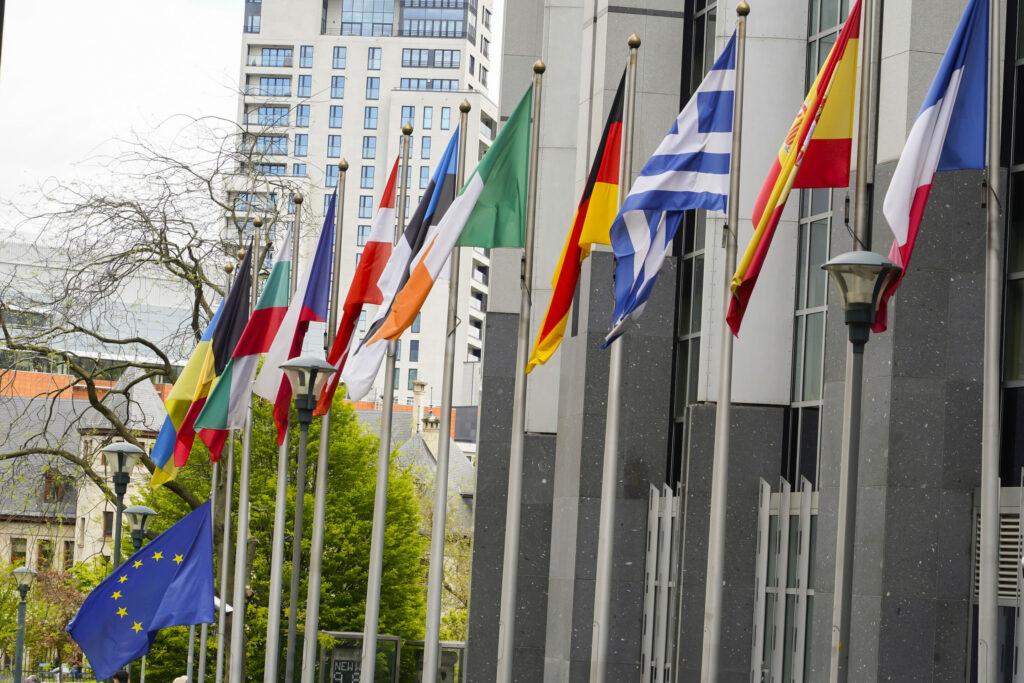
The European Union has 24 official languages and must provide translations of all crucial legislation in those native tongues. It is a mammoth but necessary task.
There are 27 EU members and 24 official languages.
They are: Bulgarian, Croatian, Czech, Danish, Dutch, English, Estonian, Finnish, French, German, Greek, Hungarian, Irish, Italian, Latvian, Lithuanian, Maltese, Polish, Portuguese, Romanian, Slovak, Slovenian, Spanish and Swedish.
Each EU citizen is entitled by law to read official legislation in their native tongue. That means a lot of translation is needed.
Luxembourgish is not counted among the official list, as it is long-standing policy of the Grand Duchy’s government not to seek official status for the language. Austrians speak German and Cypriots speak Greek.
Interestingly, the Cypriot government has flirted with the idea of pushing for Turkish to be accepted as an official language of the EU, but that idea has always turned out to be rather impossible once exposed to the vagaries of politics.
After Brexit, there were some calls for English to be dropped as an official language, but that rather ludicrous idea forgot that it is de facto the lingua franca of the Union, not to mention that it is an official language in both Ireland and Malta.
Irish was initially under a derogation, where only certain top-level legislation was required to be translated into that language. But it has since been lifted, meaning every single one of the 24 tongues have equal status.
Official translations are handled by the various translation departments of the respective European institutions. The Commission’s does a lot of the heavy lifting, translating mostly from English into the 21 other language combinations.
Technology is playing an increasingly important role in translation, as large language models are becoming more sophisticated day by day.
Machine translation is never perfect but for some language combinations can do most of the work, simply requiring post editing by a qualified translator before it can be published.
Experts are divided about how good machines will actually get at translation. Some languages are very poor fits for one another and there is not much material for algorithms to pull from.
For example, the body of translated work between Croatian and Estonian is probably very limited indeed.
English, French and German are the working languages of the EU but every bit of official legislation has to be translated at some point.
For newer member states like Croatian and Bulgarian, that meant employing a whole team of translators to sift through all the existing legislation from the last seventy-odd years of Union activity.
There is also the interesting question of what will happen when the Union adds another member in the future. At the moment there are 552 possible language combinations, if you add one more country, that shoots up to 600.
Would new countries insist on having their language be an official tongue? Montenegrin and Serbian, for example, are extremely similar to Croatian, so would separate translation departments have to be set up?
The politics of language are fascinating and it is one aspect of multilingualism that will not be replaced anytime soon by technology.
