

The Belgian train conductor who greeted passengers with "goeiedag, bonjour" on a train in the Flemish city of Vilvoorde at the end of last year, was indeed in the wrong. A passenger had filed a complaint after the conductor greeted passengers in both Dutch and French too early.
Train conductor Ilyass Alba is known by many commuters for his posts on social media about daily life on the railways. He was the subject of an investigation by the Permanent Committee on Language Monitoring after a complaint by a passenger, who felt Alba had broken the rules when greeting passengers in both Dutch and French while the train was near Vilvoorde – just a few minutes outside Brussels.
According to Belgium's language rules, Alba should have spoken exclusively in Dutch on the part of the route where he was at the time – as the train was still in Flanders. Now, the Committee confirmed this.
In Belgium, train conductors must adhere to location-specific linguistic guidelines. In Flanders, all announcements and information on the digital boards inside trains must be in Dutch. In Wallonia, this must all be in French. Only once the train crosses into Brussels (and not a minute sooner, as Alba now discovered), conductors may switch to bilingual announcements in French and Dutch.
'What a country'
At the time, Alba stressed in a social media post that he did not make any official announcements in French while still in Vilvoorde, but only greeted all passengers in both languages when entering a compartment to check their tickets. This is not against the rules.
In an advisory opinion to Belgian national railway operator SNCB/NMBS, the Permanent Committee on Language Monitoring now confirmed that conductors must address passengers only in Dutch as long as a train is travelling in Dutch-speaking areas. French is only allowed if a passenger addresses the conductor in French first.
"What a country," said Alba on social media, after learning about the fact that the complaint had been upheld.
"I can understand a passenger complaining about this in order to protect their mother tongue. But for a Committee to agree with them, when passengers come to visit Belgium from all over the world, is a sign of narrow-mindedness on the part of a small Flemish elite," he added.
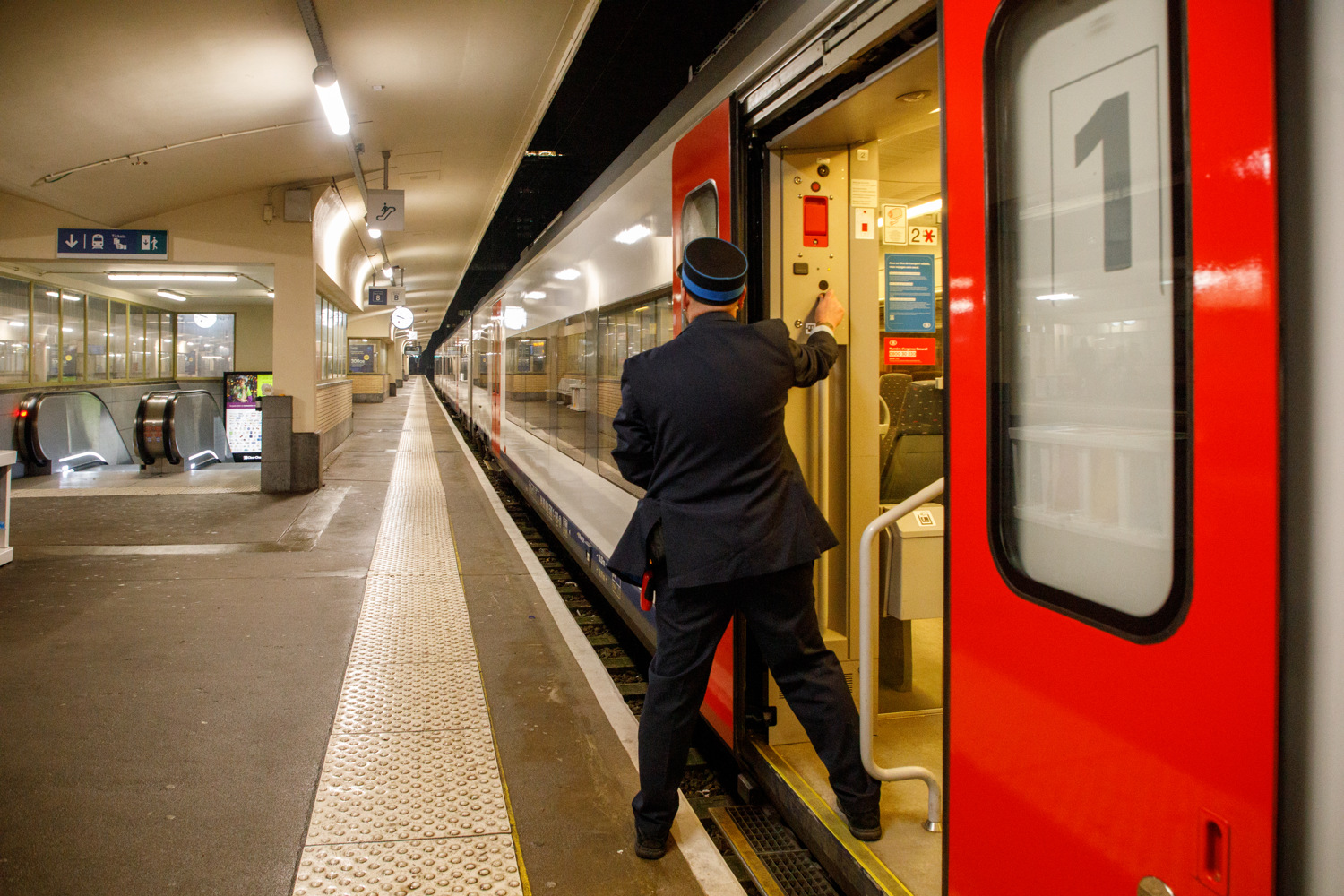
A train conductor boards a train. Credit: Belga/Hatim Kaghat
Alba wondered how a train conductor could be prohibited from welcoming customers and passengers in two languages. "What is going on to make people think like this? Can we not show a little open-mindedness? Will part of Flanders manage to break away from Belgium's unilingual past?"
"Is the Committee aware that 100% of trains coming from Wallonia cross Flanders to return to Brussels? How respectful is this to French speakers when the train crosses Flanders? Can we not greet everyone in both languages directly?"
The consequences of the decision for Alba are minimal. The Committee only issues an opinion to SNCB/NMBS and to the person who filed the complaint. For SNCB/NMBS, it is primarily intended as a warning to properly apply the language rules on trains and in stations.
Customer-oriented
The railway operator said it complies with the decision, but repeated its plea for more flexible, customer-friendly language rules. "This is about a train conductor who wanted to warmly welcome all passengers, out of enthusiasm and customer focus. Something that we attach great importance to," SNCB/NMBS spokesperson Dimitri Temmerman told The Brussels Times.
He stressed that the use of the correct languages in accordance with legislation is covered during the training for train conductors. "And of course, we want to respect that legislation. But strict application of it sometimes overlooks the needs of train passengers."
"So if a train conductor wants to use multiple languages on board their train, given the audience, that is the kind of customer-oriented approach that we can and will only applaud," Temmerman stressed.
Alba added that he had received many messages of support, particularly from people in Flanders, following the decision by the Committee.
"It is time to change this law. Trains move," he said. "Whatever happens, long live Belgium! Let's continue to say 'goeiedag, bonjour' in Antwerpen, Charleroi, Namur, Brugge, Zottegem, Mons, Tournai, Sint-Truiden, Arlon and Hasselt."
