
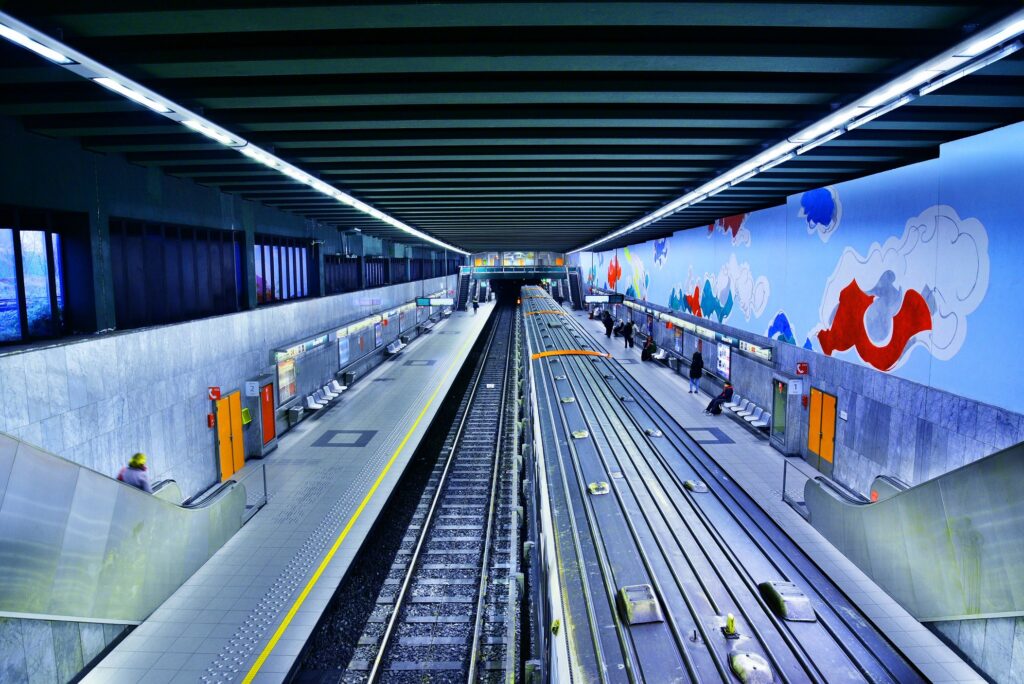
The metro car was packed with schoolchildren laughing and flirting, backpacks slung over one shoulder like little flags of the future. I was probably the oldest person there, wedged between them and the closing doors, anonymous among the noise. Then the speaker crackled:
Prochaine Station: Brel
Most of the kids didn’t react. One or two looked up briefly. I wondered if they knew who he was. Would they ever really know Brel — the man, not just the name on a sign. I believe they will.
One day, one of them will hear Le Plat Pays and something will stir. A quiet ache. A remembered tenderness. And suddenly Belgium — all of it, the greyness, the beauty, the contradictions — will open to them as it once did to me.
That day on the metro I drifted somewhere between sleep and memory back to the fall of 1968. When we first arrived in Brussels from Morocco, we lived on the Chaussée de Ninove, number 201. A long exhausted road beginning at Porte de Ninove in Molenbeek stretching toward the old town.
Behind our house stood a train station, now Weststation. Just beyond the tracks lived a railwayman who raised pigeons. I would watch him from my window, calling to his birds in short guttural syllables that sounded like a language no one else spoke.
Across the street stood the neighborhood café run by Madame Jeanine. Late sixties. Crown of gray hair. Oversized glasses. Always in control.
On weekends her café transformed, filled with music, movement, shouting, laughter, spilled beer, and the occasional fight. Men came right after payday, cash still warm in their hands, only to lose it all to the ruthless jackpot machine in the corner. Eventually the government banned it.
I was new to all of this. My village near Tangier had goats, sun-bleached walls, prayer calls. Brussels had trams, neon, smoke, and glass. I didn’t understand it, but I watched and listened.
Over time I began running errands for Jeanine. She paid me in frites with mayonnaise and the occasional twenty francs bill. I liked her. Everyone did. She was kind without ever being soft. Always respected. She loved music, especially Jacques Brel.
Thanks to her I discovered both Belgian fries and Brel. A sublime pairing. One night she told me with a gleam in her eyes that Brel used to stop there.
Before he became famous he worked at his father's cardboard factory called vannest and brel in Anderlecht, just minutes away on the Rue Verheyaden. He’d sometimes stop in for a beer. Jeanine said he never stayed long but always looked thoughtful, even then.
At first I didn’t understand Brel’s lyrics. My French was poor and he was fast. But even before the words came clear, I heard the emotion. He didn’t just sing. He inhabited his songs. Over time the lyrics unfolded just like Brussels did to me:
“C’était au temps où Bruxelles bruxellait”
Brel didn’t romanticize Brussels. He mourned it. But even in mourning he found melody. In Jeanine’s café this made sense. There was joy, dancing, music — but also despair. Vanished salaries. Heavy drinking. The jackpot machine swallowing dreams one coin at a time. Still the city sang.
Brel had a gift for saying little and meaning everything.
Avec la mer du Nord pour dernier terrain vague / Et des vagues de dunes pour arrêter les vagues, With the North Sea as the last empty lot / And waves of dunes to stop the waves
Once I understood those lines they lifted me. They spoke of emptiness and resistance. Of countries defined as much by absence as by presence. Though I never met him I felt a kinship.
Brel was a storyteller, like my mother in our Molenbeek kitchen, spinning tales of love and home in a voice that hovered between song and speech.
But Brel wasn’t just a singer. He was something fiercer. Watch him perform and you’ll see it — sweat-soaked, eyes blazing, as if the stage were the only place he could survive.
He was criticized, especially by the Belgian bourgeoisie. Too dramatic. Too intense. But time answered them. Brel endures not despite his emotion, but because of it. He dared to feel without apology. He loved Belgium and he questioned it. Fought with it.
That ambivalence rang true for me. Loving Belgium was never easy. Brel made that clear though few wanted to hear it.
This wasn’t a passing fascination. My admiration for Brel became lifelong. Not only for the music but for the humanity behind it. The ache of being in between — language, countries, selves.
In 2016 I was interviewed on National Public Radio in the United States. The subject was terrorism in Molenbeek. But before we spoke of fear or politics I spoke of Jeanine’s café. Of the music that filled it. The segment opened with Ne Me Quitte Pas. That moment felt sacred. As if Brel himself had brushed the air just briefly.
Now I live in Mashpee, Massachusetts, land of the Wampanoag. On quiet nights I still listen to Brel. Not for nostalgia, but for memory that breathes. His voice remains a companion. Raw. Unguarded. Each syllable still feels like a confession. A flare in the dark.
I think of Jeanine. Of the Chaussée de Ninove. Of the child I was, standing in a foreign doorway, hearing a language I didn’t yet know but somehow already understood.
And somewhere, maybe even near the Chaussée de Ninove, someone is still singing Brel. A schoolkid on the metro. A woman closing her café. A man with coins in his hand.
And that’s enough.
