
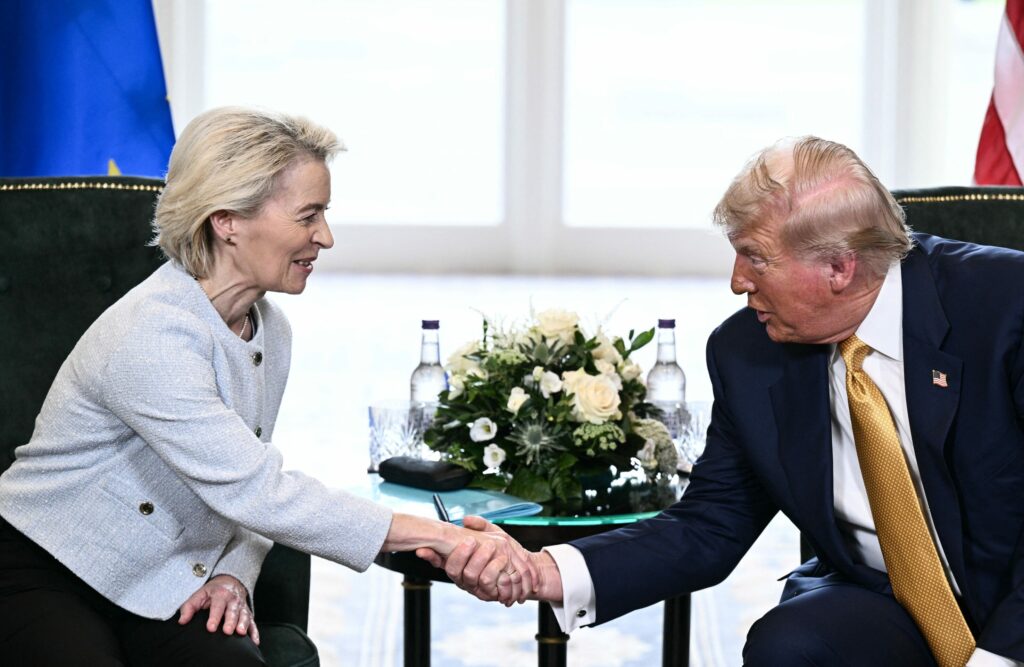
Belgium's Prime Minister Bart De Wever (N-VA) reacted cautiously positively on Sunday evening to the trade agreement between the European Union and the United States.
The EU and the US reached an agreement on trade tariffs of 15% on Sunday. On social media, De Wever praised European Commission President Ursula von der Leyen for her role in the negotiations, but stressed that there are still some loose ends.
"As we await full details of the new EU–US trade agreement, one thing is clear: this is a moment of relief but not of celebration. Tariffs will increase in several areas, and some key questions remain unresolved," he said.
"Still, I commend President Von der Leyen and her team for their hard work and dedication over recent months, focused on preserving transatlantic ties and ensuring trade remains as stable as possible under challenging circumstances."
De Wever added that he "sincerely hope" that the United States will "turn away again from the delusion of protectionism in due course and once again embrace the value of free trade – a cornerstone of shared prosperity."
As we await full details of the new EU–US trade agreement, one thing is clear: this is a moment of relief but not of celebration. Tariffs will increase in several areas and some key questions remain unresolved.
Still, I commend President @vonderleyen and her team for their hard… — Bart De Wever (@Bart_DeWever) July 27, 2025
In the meantime, Europe "must continue to deepen its internal market, cut unnecessary regulation, and forge new partnerships to diversify our global trade network," he stressed. "May Europe become the beacon of open, fair, and reliable trade the world so urgently needs."
Meanwhile, French Minister for European Affairs Benjamin Hadded said on Monday that the EU-US trade deal brings "temporary stability," but is "unbalanced." He added that Europeans must "wake up" by, among other things, reducing European regulations.
Haddad is positive that the agreement protects "key sectors for the French economy (such as aviation, alcohol, and medicine)," "makes no concessions for sensitive agricultural sectors," and maintains "European regulations on digitalisation and public health."
Still, he added that "the situation is not satisfactory and cannot continue in the long term." He believes the US is "choosing economic coercion and complete disregard for the rules of the World Trade Organisation."
Loose ends
On Monday morning, several details of the agreement appear to remain unclear: US President Donald Trump and European Commission President Ursula von der Leyen offered differing interpretations, including regarding pharmaceutical products – a hotly debated topic.
After reaching an agreement, Trump stated Sunday evening that the deal does not include pharmaceuticals, which seemingly implies that these products will be subject to a higher tariff than 15%.
Von der Leyen, however, offered a different interpretation of the agreement's content at a press conference on Sunday evening. The 15% tariff "applies to most sectors, including cars, semiconductors, and pharmaceuticals," she said. "That 15% is a clear ceiling. No piling up. All-inclusive."
Senior US officials told the financial news agency Bloomberg that the two sides have agreed on a 15% tariff on pharmaceuticals.
A separate Section 232 investigation (in which the US Department of Commerce assesses whether the import of a product poses a national security risk, and can take measures if so) into pharmaceutical products will be launched in the next three weeks, but the EU's 15% tariff will remain, they said. The US has launched a similar investigation for other products, particularly those related to aerospace and semiconductors.
Differences also appear to exist in other parts of the agreement: Trump says the 50% tariff on steel and aluminium "will remain as is." Von der Leyen, meanwhile, says those tariffs will be reduced and a quota system will be introduced.
Bloomberg's sources say the deal does not cover EU steel and aluminium exports, which will therefore remain subject to 50%.
Trade agreements typically involve years of negotiations, and the agreement itself can run to thousands of pages. Von der Leyen emphasised that Sunday's deal is a "framework" that requires further negotiations.
On Monday morning, the European stock markets opened higher after the agreement on trade tariffs: the Bel20 index was up 0.90% at 9:15, fifteen minutes after the opening of trading: 19 of the 20 stocks in the index are up, with only AB Inbev (-0.37%) currently going against the tide.
Frankfurt, London, Paris, and Amsterdam also saw gains at the opening, up to 1.2%.
