
The green transformation of Europe’s economy can only succeed if it includes its most vulnerable actors. The EU-funded GreenBoost4WISEs project has proven that work integration social enterprises (WISEs) are uniquely positioned to lead this challenge.
A work integration social enterprise can be defined as an institutional mechanism of supported employment that favours workers discriminated against by conventional enterprises and provides them with appropriate on-the-job training [1].
Many WISEs offer work integration pathways for persons with disabilities, long-term unemployed, older persons, migrants, NEETs, former convicts, and other groups who are at risk of exclusion from the labour market, defined as workers with support needs.
By directly involving people who, for diverse reasons, are perceived by employers of the open labour market as less productive than other workers, WISEs support their work integration, contribute to overcoming their disadvantages and have a role in advocating for the rights of these workers by encouraging a change in the mindset of society [2].
Launched in 2023, GreenBoost4WISEs set out to support WISEs across Ireland, Austria, and Italy in embedding environmental sustainability into their core missions. Through tailored training, peer exchange, and strategic guidance, the project enabled these socially driven enterprises to strengthen their ecological practices—ranging from circular economy models and waste reduction to energy efficiency and sustainable procurement.
The project has been co-funded by the European Union and was coordinated by ENSIE, in collaboration with national partners arbeit plus and Re-Use Austria from Austria, the Irish Social Enterprise Network from Ireland, Consorzio EVT and Consorzio Idee in Rete from Italy.
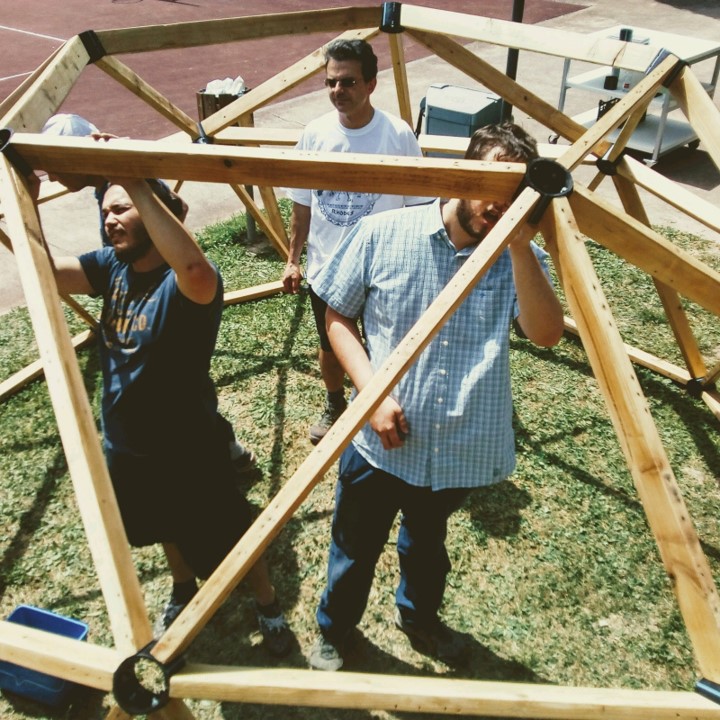
Workers at Fondazione Irpea, one of the WISEs participating to the GreenBoost4WISEs Final Conference - Credit: Fondazione Irpea
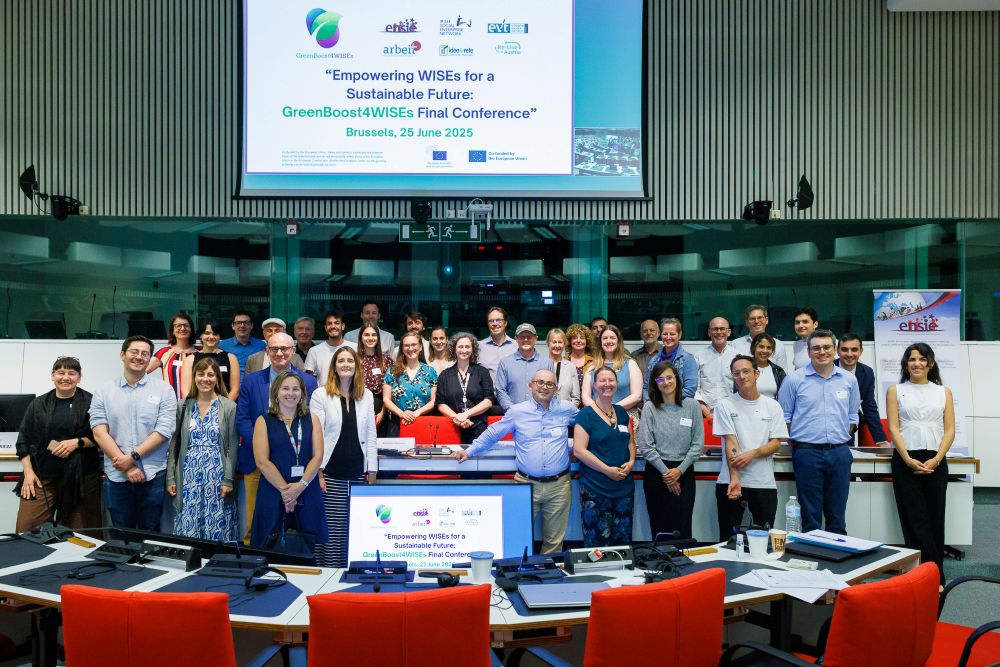
GreenBoost4WISEs demonstrated that social inclusion and green innovation can go hand in hand, and that WISEs are key actors in delivering a just transition that leaves no one behind. This vision came to life during the project’s final conference in Brussels, titled “Empowering WISEs for a Sustainable Future,” held at the European Economic and Social Committee on 25 June 2025, where more than 50 practitioners, policymakers, and researchers gathered to reflect on the achievements of the past two years and to advocate for the continued recognition and support of WISEs within the EU’s green and industrial strategies.
GreenBoost4WISEs gave WISEs the tools to integrate environmental goals into their social missions—making them more resilient, impactful, and aligned with Europe’s climate ambitions. From energy audits to eco-design strategies, the project helped WISEs become real-world models of a green and inclusive economy. Its final conference offered a platform to showcase this potential—and to call for continued support at all policy levels.
At the closing conference in Brussels, a diverse group of WISEs presented how they had turned the GreenBoost4WISEs vision into tangible environmental action. Their stories offered a compelling view of how inclusive enterprises can drive sustainability at the local level—often with limited resources but powerful social commitment.
Several initiatives focused on reducing environmental impact through smarter resource use. Birrificio Vecchia Orsa, part of Italy’s L’Arca di Noè, adopted a solar-powered water system and improved waste separation, while Ireland’s Third Space café trained its staff to monitor energy, water, and waste, reducing single-use plastics and engaging suppliers in sustainable sourcing. In Czechia, FairBio Roastery combined fair trade with green innovation by switching to reusable packaging and conducting a full lifecycle analysis, discovering that the largest share of emissions came from coffee production itself rather than transport.
Strategic planning also played a vital role. In Italy, COOB’s Melograno Cooperative embedded sustainability into its cooperative values, integrating energy efficiency and responsible procurement into daily operations and involving staff and beneficiaries throughout.
Others prioritised education and behavioural change. Austria’s Bildungszentrum Salzkammergut incorporated green practices into vocational training, building a framework focused on staff engagement, internal communication, and daily eco-actions. At Rise at The Cove, a social café in Ireland, even small changes, like LED lighting and equipment upgrades, became part of a broader awareness effort connecting energy use with social integration.
Earlier in the day, Irpea, Deaf Enterprises, and SAUM shared how they expanded social farming, circular economy models, and internal sustainability training. Together, these enterprises proved that WISEs, when equipped with the right tools, can lead the just green transition by combining environmental innovation with inclusive, community-based impact.
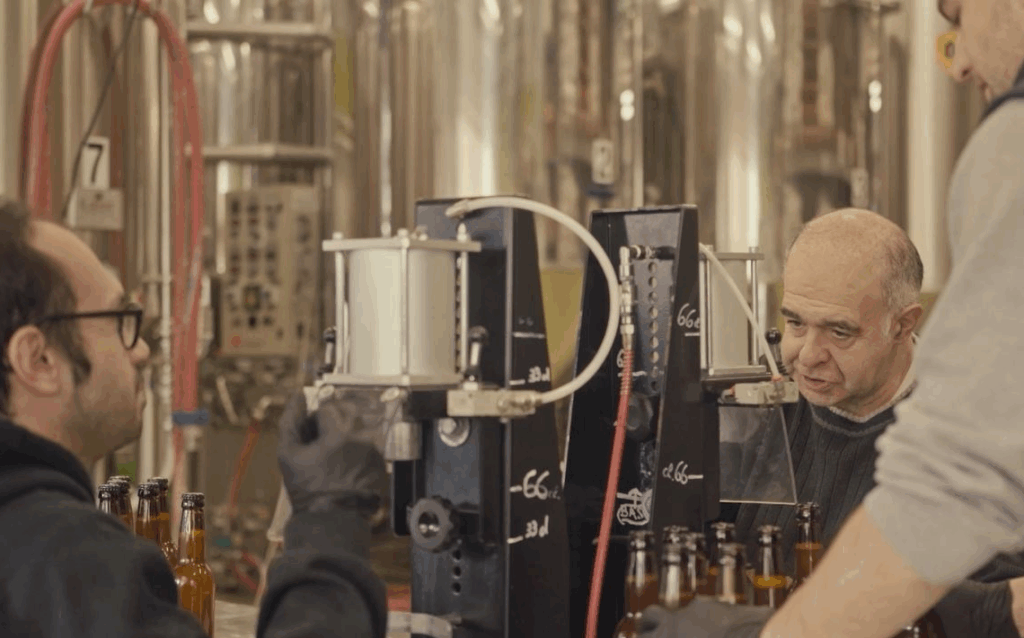
Workers at the Birrificio Vecchia Orsa, part of "L'Arca di Noè" consortium, one of the WISEs participating to the GreenBoost4WISEs Final Conference - Credits: Birrificio Vecchia Orsa / L'Arca di Noè
The conference also featured a powerful keynote by Sébastien Morant, researcher and co-founder of Polygones, who introduced the audience to the concept of "robustness" as a resilience model for small and mission-driven enterprises. Drawing on analogies from the natural world, Morant proposed four pillars for organisational robustness: moderating performance peaks, contributing to the common good, allowing flexibility through margins, and strengthening synergies with the surrounding ecosystem. His address resonated with the WISE community’s vision of long-term sustainability grounded in values, rather than short-term competitiveness.
A panel discussion featuring MEP Lynn Boylan (The Left), Neva Nahtigal (Director of RREUSE), and Coralie Helleputte (UC Louvain, coordinator of the WISESHIFT project) emphasised the central role WISEs can play in the just transition. Boylan, a long-time environmental advocate, stressed the importance of safeguarding inclusive approaches within EU sustainability policies. She also warned of a worrying trend: the retreat of political momentum from both the Green Deal and social economy support, exemplified by the withdrawal of DG GROW’s direct engagement with the sector.
At the end of the conference, and as the GreenBoost4WISEs project moves towards its final phases and activities, participants left energised and aligned on a shared message: the green transition cannot succeed without the social economy. To build a just and sustainable Europe, WISEs must be recognised not only as beneficiaries of policy—but as strategic partners in shaping the future.
[1] Borzaga, C., & Loss, M. (2006). Profiles and Trajectories of partecipants in European Work integration Social Enterprises. In Social Enterprise. At the crossroads of market, public policies and civil society (pp. 169-194). Routledge.
[2] Galera, G. et al. (2022). Report on trends and challenges for work integration social enterprises (WISEs) in Europe. Current situation of skills gaps, especially in the digital area. B-WISE project, Brussels: https://www.bwiseproject.eu/en/results
