
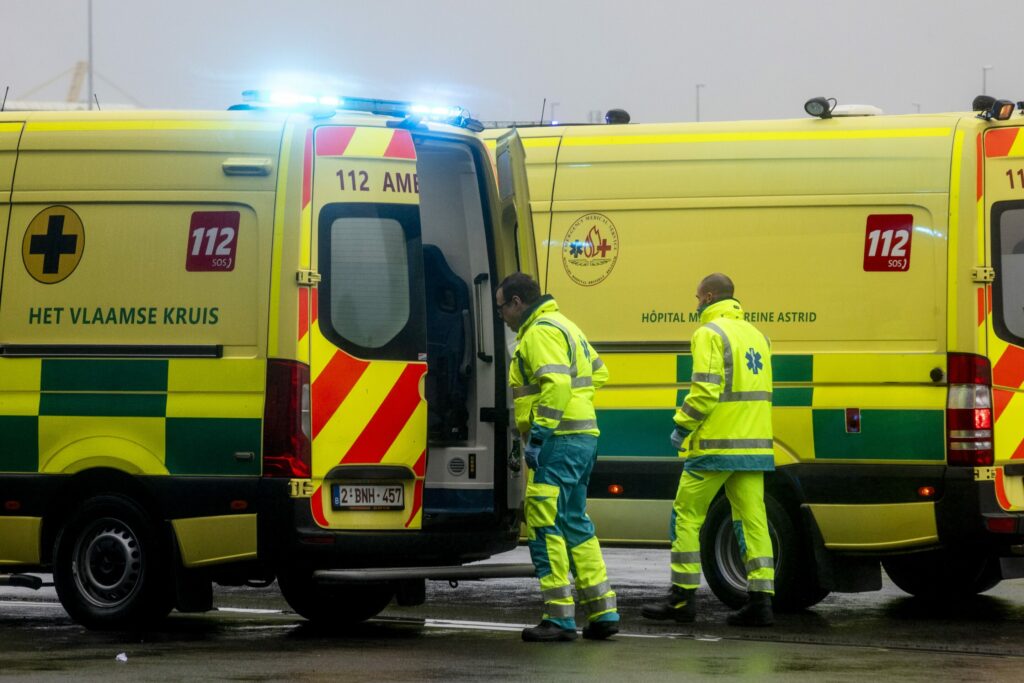
Last Saturday, a traffic accident between an ambulance and a car that did not hear the sirens, has raised protests about the new sound regulations in Brussels, with emergency workers saying they put people "in danger".
Since 1 January 2025, emergency vehicles in Brussels are no longer allowed to exceed 100 decibels. This recent regulation also lowers the limit to 90 decibels at night. The previous limit was set at 117 decibels.
There were no serious injuries in last Saturday's accident, but the emergency vehicle was sent to the garage with extensive damage, just four days after it was put into service. Some in the sector believe that this accident could have been avoided, if it not were for the new sound regulations in the Brussels-Capital Region.
"They really put the patient at risk, when every minute counts. For example, in the event of a cardiac arrest, we have very little time to get to the scene, so every minute counts in order to save the patient," explains Thibaut Mayeres, a paramedic, speaking to RTL.
Several dozen vehicles belonging to the Brussels Fire Brigade are already equipped with the new sirens. This usually occurs when a vehicle goes in for maintenance. All vehicles registered since 2025 are also compliant.
"We don't have any objective data, but the ambulance crews tell us they can feel the difference. People hear them less, especially with the soundproofing in cars," says Brussels Fire Brigade spokesperson Walter Derieuw to La Derniere Heure (DH). Firefighters, speaking to DH, have also reported that they are often not heard when they are too far back when at the traffic lights, resulting in longer waiting times for emergency response.
The Red Cross also discovered the effects of the new standard very recently. "We immediately saw the difference," said Jean-François Calloud, head of the Red Cross service in Brussels, told DH.

Credit: Brussels Fire Brigade/Walter Derieuw
Calloud insists that the reduction in siren noise is putting people in danger. "It's not acceptable. We've tried to focus on visual signals, such as rotating lights, but it doesn't work. Elsewhere, in neighbouring European countries, the standards are higher."
"Cars are increasingly soundproofed from outside noise," Calloud said. "Add the radio on top of that.. We end up having to wait for the lights to turn green."
'Sirens used inappropriately'
Yet for Brussels residents, siren noise is the third most disturbing noise source, after road and air traffic, according to a Brussels Environment agency survey taken in 2017.
"Many Brussels residents also feel that sirens are used inappropriately. Furthermore, until now, there has been no maximum threshold for most emergency services," points out a spokesperson at Brussels Environment to DH.
Another technical study carried out by the agency in 2018 showed that a driver with the windows and doors closed can hear the siren even if they are 93 metres away.
Brussels Environment maintains that has not received any feedback that the sirens are too quiet, but it is open to feedback. An assessment of the application of the new standard is planned within five years of its entry into force.
In the meantime, a petition for a return to the old standard was launched a few days ago. As things stand, any vehicle that does not meet the standards by 2029 will be fined up to €145,000.
