

In mid-2025, the transatlantic tariff showdown intensified. The European Union (EU) faced competing pressures. They had a hardline faction demanding forceful retaliation. But there were also pragmatists urging restraint. They want to avoid economic and geopolitical fallout spiraling out of control. The dynamics that will appear to have shaped the EU’s path to the compromise that was eventually struck were obvious.
First, there are internal divisions between member states over the prioritisation of national industries. Germany’s auto sector comes to mind. Secondly, there was the push from those emphasising EU unity and long-term resilience.
From Division to Consensus: Fragile Unity in Brussels
In early spring 2025, Trump’s escalating tariff threats (20–50 % on cars, steel, aluminium) exposed EU leadership to strategic pressure. Countries like France pushed for a tougher stance. Voices from Germany and Poland advocated calibrated engagement. Their priority is to protect critical export sectors.
Despite internal friction, a more unified EU front began to emerge as the stakes grew. Hungary remained a dissenting voice. This was influenced by its leader Viktor Orbán’s affinity with Trump. But the majority of member states converged behind a balanced approach of negotiation backed by credible threat of retaliation.
Tactical Diplomacy and Incremental Pressure
The EU’s strategy involved measured escalation. Initially, they suspended planned retaliatory tariffs in exchange for a 90-day truce window handed by Trump. With time bought, they then prepared targeted countermeasures worth €21 billion in phases. This helped to prevent immediate full-scale retaliation.
This phased retaliation allowed Brussels to signal resolve while retaining diplomatic flexibility. Clearly, this is an approach distinct from China’s immediate, sweeping responses (which some will argue were rooted in long-term strategic scenario planning). It is also more aligned with the political pragmatism that Europe is known for.
Instruments of Leverage: From Counter‑Tariffs to Anti‑Coercion
The EU ultimately adopted a 15 % baseline tariff imposed by the United States. But it retained non-tariff leverage. There are zero-tariff carve-outs for key goods, such as aeroplane parts, semiconductors, and certain chemicals. Quotas are applied rather than blanket duties on steel and aluminium.
There is also the ability to deploy its Anti-Coercion Instrument (ACI) if coercive measures are resumed. The ACI offers legal weight to retaliate. The EU can do so not just on goods. It can also act on services, procurement, and investment treaties. Yet, EU officials have so far tactically eschewed their ‘nuclear’ deployment.
Leadership under Duress: Von der Leyen at the Helm
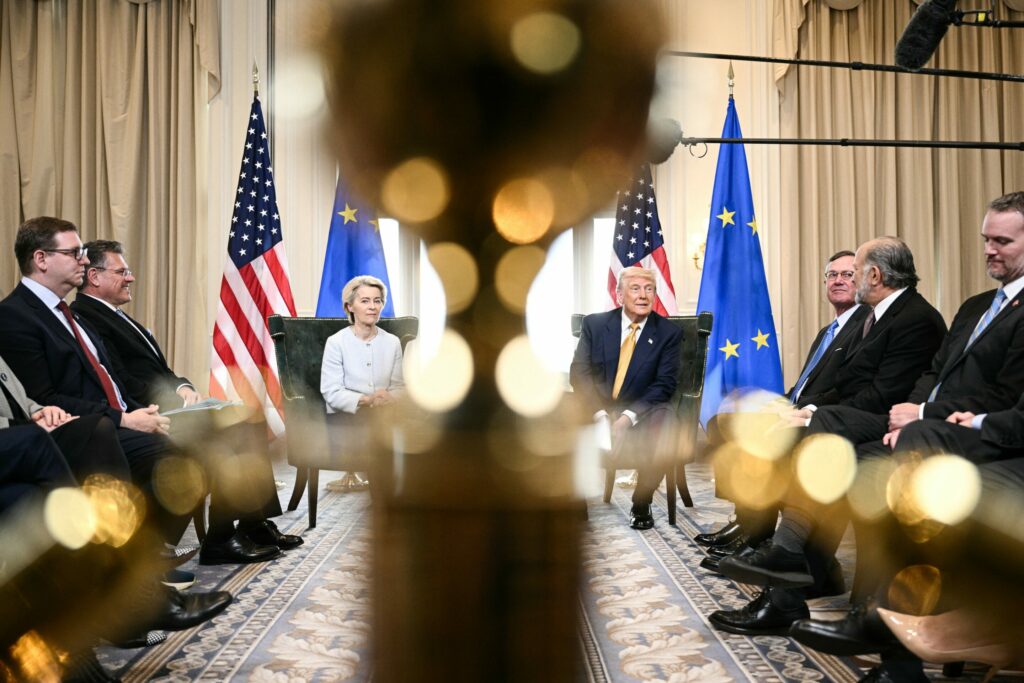
Commission President Ursula von der Leyen worked under immense pressure. This was demonstrated through direct high-stakes diplomacy with Trump in Scotland on July 27, 2025. That summit finalised the deal just in time to prevent U.S. tariffs from escalating on 1 August. EU leadership portrayed the agreement correctly as a ceiling of 15 % tariffs. It included major U.S. purchases secured by the EU, amounting to approximately $750 billion in energy and $600 billion in investment and equipment. The focus, it would appear, was on long-term market stability rather than outright gains for Europe alone.
Preventing Contagion: Economic Logic and Monetary Prudence
Economists warned that steeper tariffs could induce inflation in the U.S., leading to a contraction in Europe. It may even trigger stagflation if both blocs retaliated further. By opting for compromise now rather than brinkmanship, EU decisions supported broader economic stability across the euro area. It also gave the European Central Bank room to manage mixed inflationary outcomes, exchange‑rate shifts, and supply chain shocks.
Shaping EU Cohesion for the Next Policy Cycle
The negotiation’s long-term effect is significant. It reshapes EU cohesion ahead of the next policy cycle. Member states navigated this crisis together. They gained a renewed appreciation of the need for collective action in the face of external pressure. This episode underscored that when challenged by a global power, fragmented national responses can prove disastrous.
Brussels has forged a delicate yet unified position. This position sets a precedent for more integrated economic governance mechanisms. It will guide the next cycle of EU reforms.
Furthermore, the crisis strengthened the case for a more assertive EU trade commissioner with expanded powers. It also proved a case for the development of shared resilience strategies. This involves joint procurement policies. It also includes a coordinated industrial strategy. These measures guarantee the bloc is less vulnerable to external trade coercion in the future. In many ways, the tariff saga accelerated the EU’s political maturation.
In the final analysis, what has been revealed is an EU that has intentionally chosen pragmatism over polemics. Interpretations framing the EU as the “loser” in the tariff deal overlook the sophisticated balancing act behind the scenes. The reality is one of:
- Hard-nosed diplomacy: retaining escalation tools while engaging in negotiation.
- Sectoral preservation: securing carve-outs for high-value industries.
- Economic foresight: preventing inflation shocks and trade uncertainty.
- Institutional cohesion: marshalling fragile internal unity when it mattered most.
Viewed in this light, the EU decision was neither capitulation nor weakness. It was the exercise of restraint and realism in service of greater strategic stability. It also lays the groundwork for deeper EU integration and a stronger common front in the next policy cycle.
