
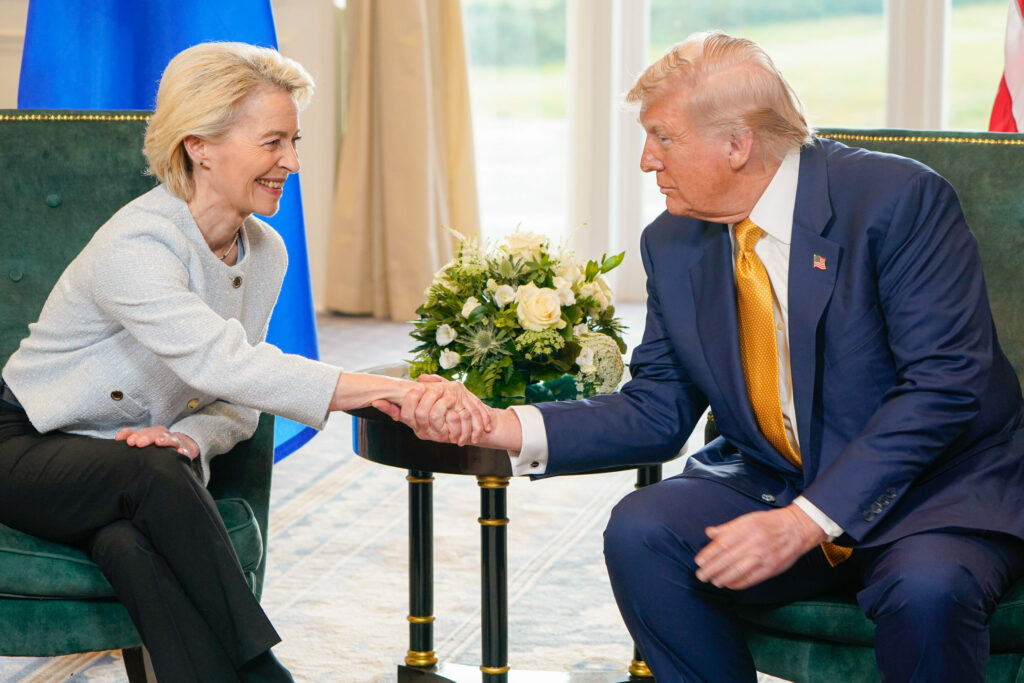
The European Union’s new trade agreement with the United States has provoked controversy and disappointment in equal measure. Here’s how Brussels negotiates its commercial partnerships.
One of the main powers delegated by national governments to the European Commission is a mandate to negotiate on their behalf with non-EU countries on trade matters.
The idea is that a single voice representing the single market is needed so that individual vested interests do not hijack the negotiation process.
When countries join the European Union, they forgo the right to broker their own bilateral deals with other nations. This is a fact that is often misunderstood wilfully or otherwise by a lot of political commentators and leaders.
It was a major talking point before and during the Brexit negotiations. Those in favour of leaving the EU talked up the benefits of being able to broker tailor-made deals with other countries, rather than being lumped in with the other 27 countries.
Critics of this point of view simply pointed out that negotiating as a single country, rather than as a bloc, reduces bargaining power significantly and will inevitably result in poorer and less attractive terms.
During the Brexit talks as well, it was up to the European Commission to negotiate on behalf of the other members on the future EU-UK relationship. Attempts by the UK to talk bilaterally with some more sympathetic governments were always shut down.
The Commission has repeated this dynamic in its recent talks with the US, where the EU executive managed to barter down the global 25% tariff to 15%. However, no reciprocal tariffs on US imports will be levied.
This, coupled with a 50% tariff on steel and aluminium that will remain in place, has provoked disappointment across Europe, where many political leaders have criticised the Commission for giving in to Washington’s demands.
Some, like Spanish Prime Minister Pedro Sanchez, have said they will only reluctantly support the trade agreement, which will require unanimous approval from all the member states to pass into law.
Here is where commerce deals get really tricky, as this unanimous requirement has scuppered efforts in the past to sign trade deals with big trading partners like the US.
Last year, a 25-year-long effort by EU negotiators to finalise a trade deal with the South American Mercosur bloc finally looked to be paying off. But opposition to the final deal from some EU countries, in particular France, means that the Commission has not yet submitted it for ratification.
Attempts in the last decade to sign a comprehensive trade deal with the US also came to nought because of opposition across Europe to the so-called TTIP agreement. The trade deal with Canada, known as CETA, only recently got the final nod of approval after further talks were held.
In that previous example, it was actually Wallonia that was thrust into the global spotlight, as the Belgian political system grants a say to each of its constituent parliaments on commercial deals.
Wallonia decided to vote against CETA, holding up the process for years. It is not impossible that a similar holdup will strike the trade deal that Donald Trump and Ursula von der Leyen announced to the world earlier this week.
