
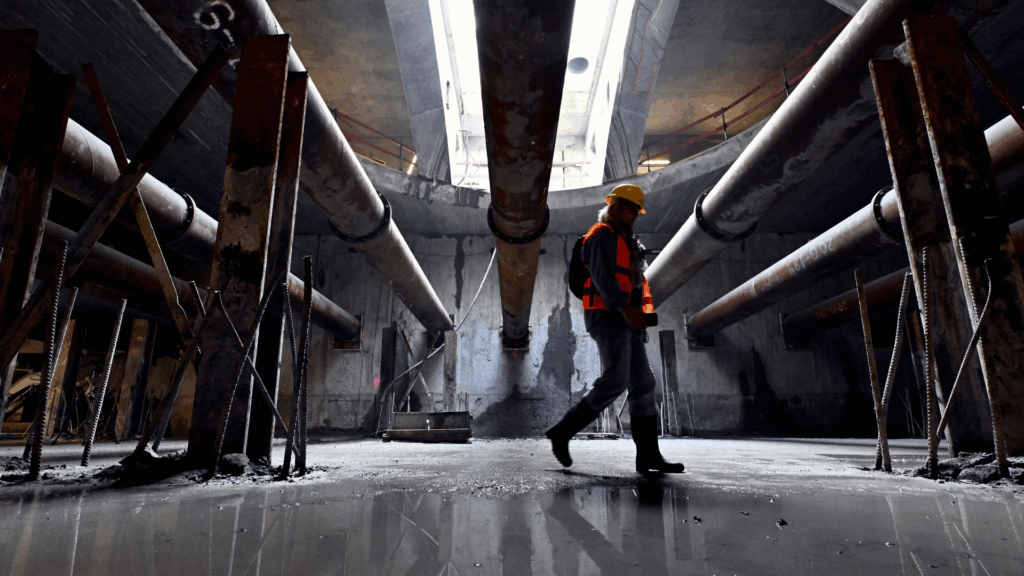
Metro Line 3 is at risk of being axed, according to reports leaked to RTBF, details of which have been confirmed to The Brussels Times.
The potential cancellation follows cost increases on the mobility project in Brussels, and the lack of a Brussels-Region government to sign off on increased funding.
Promoters of the new line, which was given the go-ahead in early 2021, say it is needed to address overcrowding on existing routes between the centre of Brussels and the north and south of the city.
Additional expected benefits include faster journey times for those in Schaerbeek and Evere, by connecting residents and future housing to the speedier metro network. The end-to-end journey of the line is due to be 20 minutes.
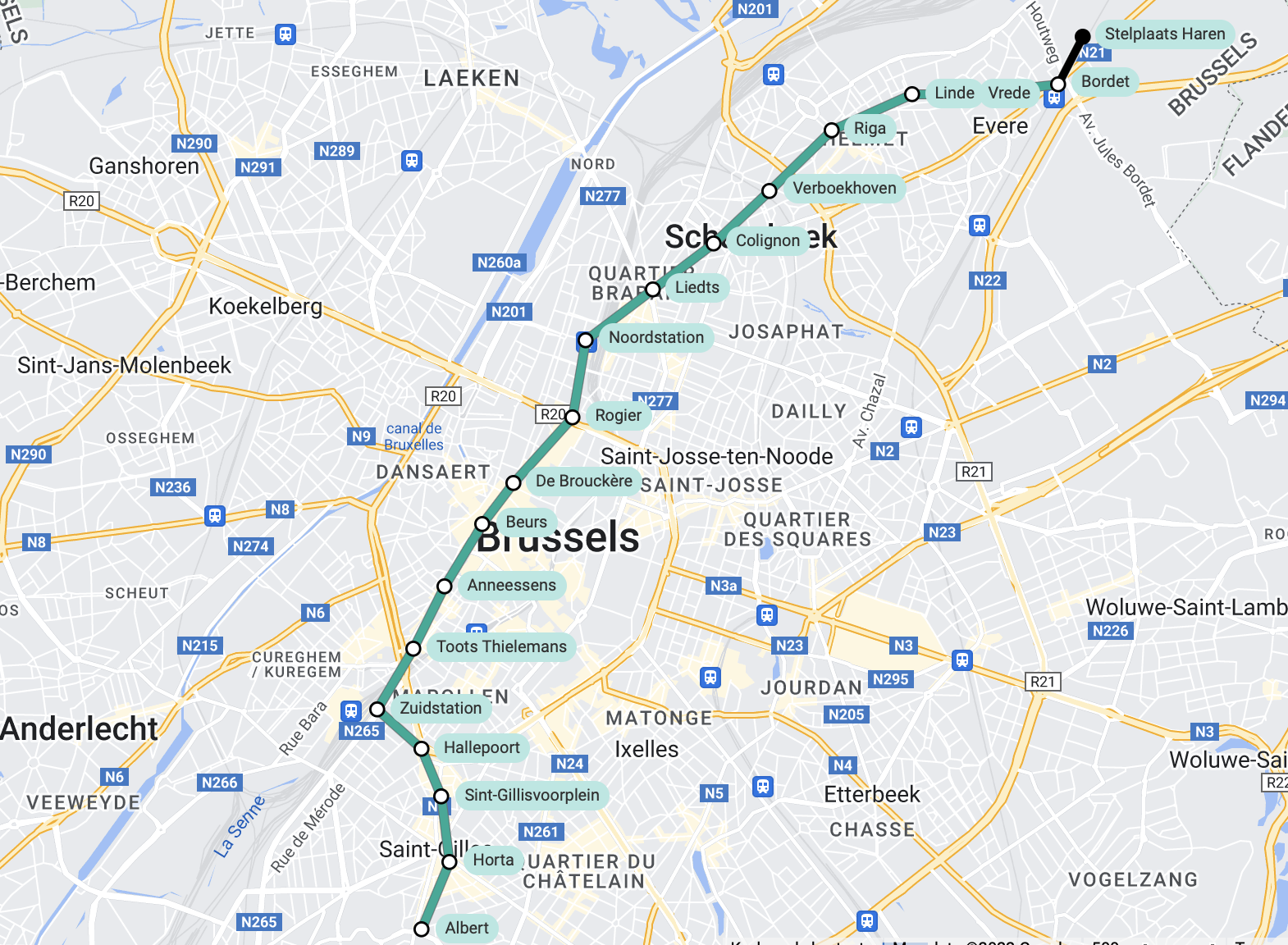
The metro line will better connect the south of Brussels with the rest of the region.
The project has recently attracted controversy with plans to demolish the interior of the historic Palais du Midi, kicking out the businesses and community clubs that use the facilities there.
However, following delays and cost increases caused by factors such as unforeseen construction challenges, the future of the project is uncertain. Political indecision has added further delays, including a pause on works at Brussels North.
In a statement to The Brussels Times, a STIB/MIVB spokesperson confirmed the existence of the report and the existence of six different scenarios.
"STIB-MIVB did not make any recommendation for a particular scenario, but simply listed the possibilities and the consequences of each option, in order for the regional government to make a well-informed decision. It is now up to the government to decide about the future of the project."
Options on the table for the future of Metro Line 3
The project is in limbo due to the need for additional funding. However, there is no Brussels-Region government with the mandate to make decisions on the future of the project.
The options on the table, confirmed to The Brussels Times, were commissioned by the current Brussels-Region government and conducted by STIB/MIVB. The options include:
- Full completion as planned, with Brussels-Region coughing up the extra cash
- The same as option 1, but funded through a public-private partnership
- Scrapping Phase 2, which is the section to Bordet from Brussels North and includes the most new infrastructure
- Pausing for 10 years
- Phasing in operations over three stages
- Complete shutdown of the project
The Brussels Times understands that other intermediate options exist that combine options, such as pausing Phase 1 between Albert and Brussels North while scrapping Phase 2.
Figures seen by RTBF suggest that every option includes additional costs. The most expensive overall is option 2, at €7 billion, this is because the cost would be financed through loans repaid over a long period.
Option 6 would come with the lowest additional cost, an additional €224 million. However, with this option, the €546 million already invested would be lost.
Cancellation would also come with additional costs not included in the report. Sources confirm it would also require a rethink on urban development in the Brussels-Region, as the project has served as the backbone for other schemes.
An estimated €383 million would be needed for additional works on the wider mobility network to compensate.
Option 5 - the most likely option?
Option 5 would split the project into three operational stages, providing project breaks for politicians to make decisions. According to RTBF, this would cost an extra €388 million over the next three years. Although the costs beyond that are unknown, as it depends on when certain stages are given the go-ahead.
In the first stage, completed by 2039 (a year earlier than the reworked option 1), construction would be completed on Phase 1. Trams would be used on the tracks and tunnels through the new Toots Thielemans station to Brussels North station from Albert, alongside existing tram services via Lemmonier.
The second stage would then introduce metro trains on the same track from 2046, ending all tram services. The third stage, ready in 2046 (six years later than option 1), would then see all the new tracks and stations completed and the metro services run to Bordet.
This approach would be in keeping with the staged approach to transport development on the same corridor from Brussels-Midi to North stations. Over the years, this approach has seen the River Senne covered over to create new boulevards, and the tunneled river diverted to create the current pre-metro tram system.
This pre-metro system, which currently has services by trams 4 and 10, would then be upgraded to a full metro as part of the Metro Line 3 project.
Ministers next meet at the end of August, but a decision is unlikely in the absence of a new Brussels-Region government. The project can, in theory, continue to be delayed indefinitely, but The Brussels Times has learned that works currently underway are getting close to the end.
When the current works end, uncertainty will start to creep into the project around whether it makes sense to continue. For example, a decision will be needed on fitting out Toots Thielmans station, and every delay will come with additional cost.
