
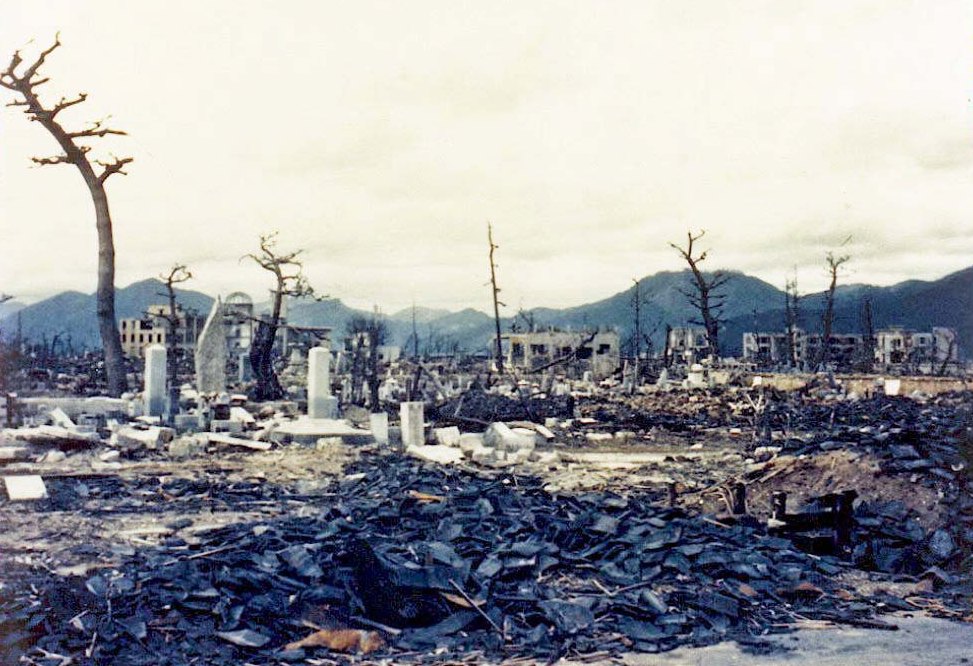
Today, 6 August, marks 80 years since an atomic bomb was dropped on the Japanese city of Hiroshima. Three days later, on 9 August 1945, a second bomb was dropped on Nagasaki. The blast and resulting radioactive fallout of the attacks killed between 150,000 and 246,000 people.
Belgium, through its colonisation of the Congo, had a crucial but little-known role in this dark episode in human history.
'Nothing like it has ever been found'
When nuclear fission was discovered in 1938, uranium quickly became an extremely valuable commodity as scientists realised its potential to generate enormous amounts of energy.
Military strategists working on the top-secret Manhattan Project in the US quickly began buying up huge quantities of the mineral, which had previously been regarded as worthless rock.
There were uranium mines in the US and Canada, but the deposits were of low quality and in short supply. To get the quantities needed to create nuclear bombs, the US military had to look further afield - to the Belgian Congo.
A huge quantity of high-quality uranium had been discovered in Congo in 1915 by Belgian company Union Minière du Haut Katanga.
Congo's Shinkolobwe mine, which was controlled by Union Minière, contained one of the largest reserves of uranium in the world. Ores from the mine typically yielded 65% uranium, compared to 0.03% in the ore found in typical North American mines.
According to Tom Zoellner, the author of Uranium – War, Energy, and the Rock that Shaped the World, “in no other mine could you see a purer concentration of uranium. Nothing like it has ever been found.”
As Union Minière began to comprehend the rapidly increasing value of uranium, Congolese miners worked in horrific conditions day and night to extract the ore.
In a canny move, Edgar Sengier, the head of Union Minière shipped 1,000 tonnes of Congolese uranium to New York in 1939 and stored it in a warehouse to avoid it falling into Axis hands.
With the help of the British, who owned a 30% stake in Union Minière, he negotiated a deal with the US government to provide uranium for the Manhattan Project. The stockpile was transferred to US government ownership and was used in the first detonation of a nuclear weapon in July 1945 in the New Mexico desert – known as the Trinity Nuclear Test.
In May 1944, Union Minière provided the Manhattan Project with a further 1,750 tonnes of enriched uranium, which was used in the ‘Little Boy’ and ‘Fat Man’ nuclear bombs.
A tale shrouded in secrecy
Luc Barbé, author of Belgium and the Bomb, is keen to set the record straight on Belgium's involvement in the development of nuclear weapons – both during and after the second world war.
In a 2013 interview with Vrede, Barbé said: “The main source of uranium for the development of the whole nuclear weapon industry during the first 10 years after the Second World War was the Belgian-Congo. It is only afterwards that the uranium mines of Australia, South-Africa and Canada came in the picture.”
For many years, it was widely assumed that Canada had provided the bulk of the uranium used to create the atomic bombs.
In fact, the role of Belgian-Congo was deliberately underplayed to protect the secrecy of the nuclear project. The town of Shinkolobwe was erased from maps and never to be mentioned. A disinformation campaign continued long after the end of the war, putting out the message that Canada had provided the uranium, not Congo.
Susan Williams, a historian at the UK Institute of Commonwealth Studies, told the BBC that the Congolese contribution to the Allied victory should be more widely recognised.
“Not only did the Congo suffer so much during World War Two – forced labour was used for uranium mining, as it was for rubber and cobalt – but also the financial rewards for the uranium from the mine went to the shareholders of Union Minière, not to the Congolese,” she said.
The Shinkolobwe mine was closed in 1960 when Congo gained independence from Belgium. Its entrance was filled with concrete, but since then Congolese miners have started digging informally at the site in clandestine pits. In 2004, eight miners were killed at the site when a passage collapsed.
