

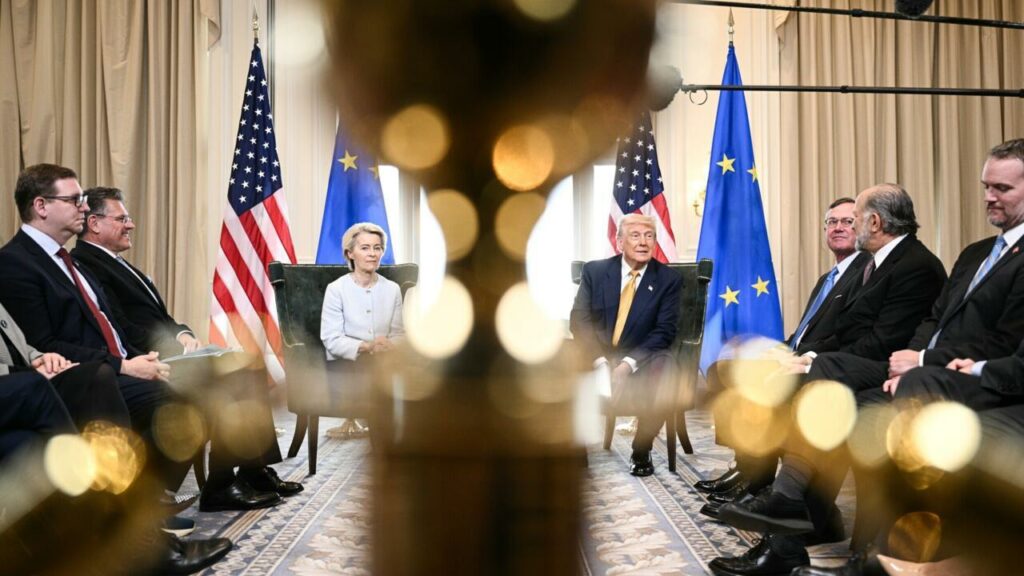
On 27 July 2025, the United States and the European Union finalised a significant trade agreement, following negotiations between U.S. President Donald Trump and European Commission President Ursula von der Leyen in Scotland.
The agreement establishes a 15% baseline tariff on most EU goods entering the U.S. This constitutes a reduction from the previously threatened 30% rate, averting a potential trade war between the two economic powerhouses.
The U.S. maintains a 50% tariff on EU steel and aluminium, though discussions continue about possibly replacing this with a quota system. Certain goods, including aircraft and their components, specific chemicals, generic drugs, semiconductor equipment, agricultural products, and critical raw materials, are exempt from tariffs, allowing zero-tariff trade in these sectors.
The EU has committed to substantial economic obligations. Over the next three years, it is bound to purchase $750 billion worth of U.S. energy, including liquefied natural gas (LNG), oil, and nuclear fuel.
Additionally, it has pledged $600 billion in investments in the U.S. during Trump’s term, covering sectors such as pharmaceuticals and automotive industries. It will also increase purchases of American military equipment.
The EU secures zero tariffs on select U.S. exports to its market, though non-tariff barriers, such as certification requirements for American goods, remain largely intact.
What is changing
Prior to this agreement, EU-U.S. trade operated under the World Trade Organization’s (WTO) most-favoured-nation (MFN) tariffs, with average rates around 1% for both sides. The EU faced 25% U.S. tariffs on steel and aluminium.
The new deal marks a significant shift: the 15% baseline tariff replaces the lower MFN rates for most goods, increasing costs for EU exporters, while the 50% steel and aluminium tariffs persist.
The introduction of zero-tariff categories for specific goods is a new development, providing relief for targeted sectors like aerospace and semiconductors.
The EU’s energy and investment commitments represent a dramatic escalation from previous arrangements. While the EU was already a major buyer of U.S. natural gas and oil, the $750 billion energy purchase commitment over three years is unprecedented, dwarfing prior trade volumes.
The agreement also reflects a departure from earlier EU efforts to secure a “zero-for-zero” tariff deal, as proposed in 2018 and 2025.
Advantages and -more serious- disadvantages for the EU
By securing a 15% tariff rate instead of the threatened 30% or 50%, the EU mitigates the risk of a devastating trade war that could have disrupted its export-driven economies. The framework agreement provides predictability for EU businesses, reducing uncertainty that could deter investments.
Zero-tariff exemptions for key sectors like aerospace and pharmaceuticals benefit companies like Airbus and Novo Nordisk. The commitment to buy U.S. energy supports the EU’s goal of diversifying away from Russian energy. The deal reinforces economic cooperation, potentially stabilizing EU-U.S.
On the other hand, the 15% tariff raises costs for EU exporters, particularly in automotive and manufacturing sectors. It will potentially reduce European competitiveness in the U.S. market. The EU’s massive energy and investment commitments favour the U.S., with unclear reciprocal benefits.
The $90 billion in U.S. tariff revenue contrasts with limited EU gains in market access. Persistent 50% tariffs on steel and aluminium and unresolved issues around wine and spirits tariffs hinder key EU industries.
The European Federalist Perspective
From a European federalist perspective, the US-EU trade deal is seen as a suboptimal outcome. It underscores the limitations of the EU’s current structure as a confederation of nation-states.
The agreement, described by some as a capitulation to U.S. pressure, reflects the EU’s fragmented negotiating power, as individual member states’ interests — such as Ireland’s reliance on U.S. exports or France’s focus on spirits — complicate unified action.
As the Union of European Federalists commented on their Facebook page: “The EU is not a federation. It is a complex and often fragile arrangement between 27 sovereign governments, each with its own electorate, domestic priorities, and short-term interests. This political fragmentation limits the EU’s ability to act strategically on the global stage. The US, a single federal state, negotiates with coherence and leverage. The EU, a union of states, compromises and reacts.”
A federal Europe, with a centralised government and unified trade policy, could have negotiated a more favourable deal.
First, a federal Europe would have greater bargaining leverage, representing a single economic bloc with a GDP rivaling the U.S., enabling it to resist coercive tactics like Trump’s tariff threats.
Second, a federal structure would streamline decision-making, avoiding the delays and compromises required to align 27 member states, as seen in the need for EU ambassadors’ approval post-negotiation.
Third, a federal Europe could prioritise strategic industries and energy diversification without being pressured into massive, unilateral commitments, potentially securing a “zero-for-zero” tariff agreement akin to the EU-Canada CETA deal.
Finally, a federal Europe could leverage its collective market power to counter U.S. demands for deregulation or non-tariff barrier reductions, preserving EU standards on health, safety, and environmental protections.
The current deal’s concessions reflects the EU’s vulnerability to U.S. divide-and-conquer strategies, as seen in Trump’s quicker deals with the UK and Japan.
By negotiating as a single entity with a clear mandate, a federal Europe could have balanced economic concessions with strategic gains, ensuring a deal that better serves European citizens and industries.
