
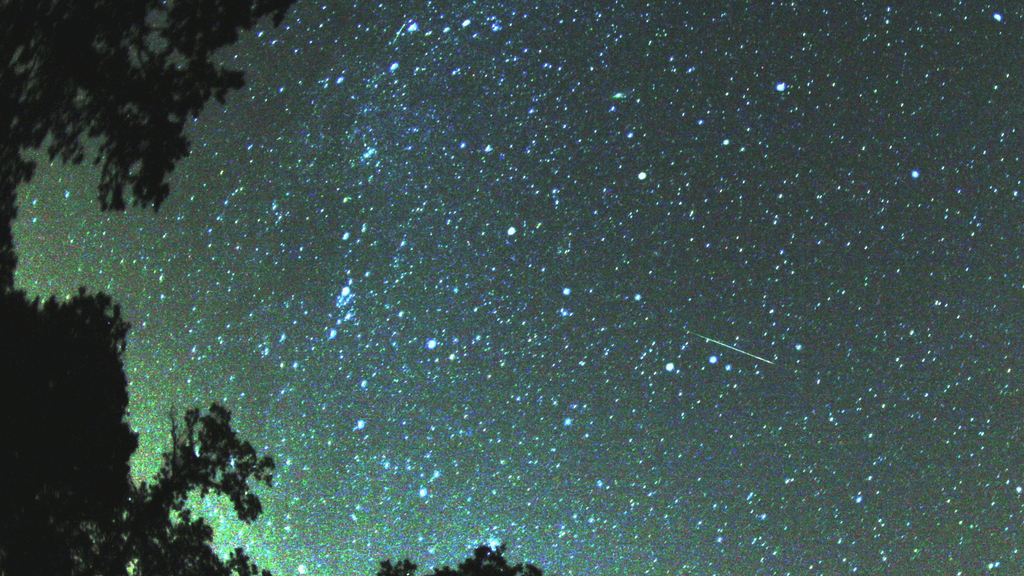
The annual Perseid meteor shower reached its peak this morning. The spectacle, visible in the Northern Hemisphere, will continue over the next few weeks.
While you may have missed it, the brighter moon this year ruined the spectacle for those who did catch a glimpse. Typically, during the peak, 60 to 100 meteors can be seen in an hour. However, according to the Meteovista weather service, this year it will fall to "around 21 per hour during its peak".
The meteors reach speeds of up to 214,365 kmh as they smash into Earth's atmosphere every August when we pass through a cloud of dust particles left behind by comet Swift-Tuttle.
According to the Royal Belgian Institute for Space Aeronomy, "the meteors are called the Perseids because the point from which they appear to hail (called the radiant) lies in the constellation Perseus. The best moment to observe these meteors in Belgium is in the morning, when the radiant is located high in the sky."
This year, the showers will be joined by the coming together of Venus and Jupiter as a conjunction. These two are the brightest planets in the night sky.
Alongside Venus and Jupiter, over the next few days, skygazers will be able to view Mercury and Saturn as part of a planetary parade leading up to 19 August.
Where to stargaze in Brussels
In Brussels, it will be difficult to view the Perseid meteor shower. Those hoping to spot them should look in an east to north-east direction between midnight and pre-dawn and try to be in a very dark area. The planetary parade will be more visible as both Venus and Jupiter can be viewed just before sunrise.
The volunteer group Street Astronomy told the Brussels Times that "for the best view of the meteor shower in Brussels, we recommend spots with minimal light pollution". These include Parc du Cinquantenaire (near the arches), Bois de la Cambre (southern edge), Parc Josaphat looking away from the city lights, or Parc Laeken, "as it is north of most of the city lights".
The group say that "the best moment to observe these meteors in Belgium is in the morning, when the radiant is located high in the sky."
BXLunatics, a community of street astronomers in Brussels under the Street Astronomy umbrella, regularly organise telescope viewing events for members of the public. You can register to be informed of future dates.
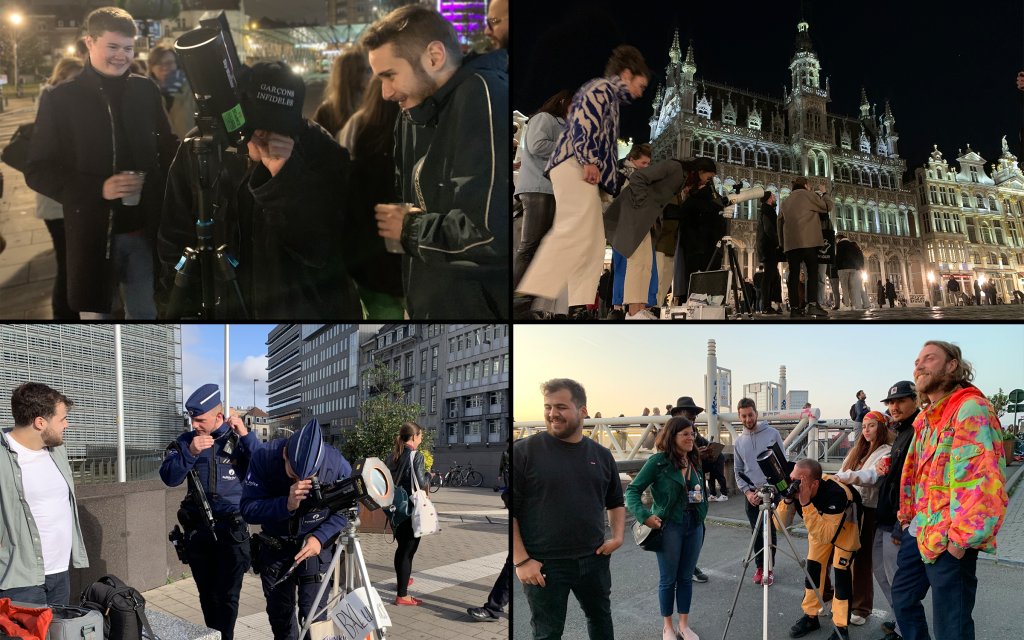
Credit: BXLunatics / Street Astronomy
The website timeanddate.com also gives advice on visibility based on your location for everything happening in the night sky. Alternatively, if you are outside Brussels, you can use this map to find a 'dark site' that gives good visibility.
