
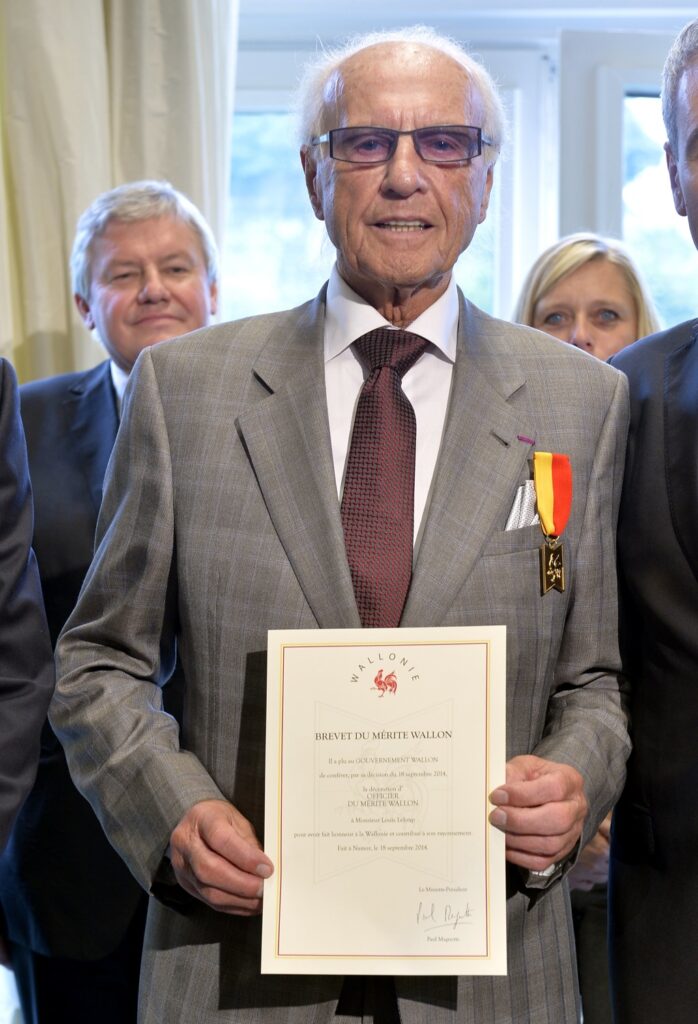
World-renowned Belgian master glassmaker Louis Leloup has died at the age of 96, his family announced on Wednesday.
"After a life filled with dreams and innovative creations, a beautiful and long life of 96 springs, our illustrious master glassmaker Louis Leloup passed away peacefully last night," his loved ones said in a statement. "The brilliance of his wonderful creations will shine brightly for eternity."
Born in Seraing, Liège Province, in 1929, Louis Leloup first enrolled at the Conservatoire de Liège, dreaming of becoming an opera singer. However, he was also attracted to glasswork and joined the Cristalleries du Val-Saint-Lambert in 1947 as an apprentice. He quickly rose through the ranks thanks to his skill and creativity.
Father of the multi-pipe method
Ten years later, at the head of a team of ten glassmakers, he designed a series of vases and bowls with three-sided gradients, which were presented at the 1958 World's Fair in Brussels. At the same event, he unveiled two pieces that were entirely handmade and considered by some to be impossible to produce: a two-metre crystal floor lamp and a round table 70 cm in diameter resting on a 60-cm base.
It was during this period that he introduced multi-pipe blowing, an innovative method that made it possible to create massive crystal sculptures, sometimes weighing several dozen kgs – an advance that is considered his major contribution to contemporary glass art.
In 1965, on the occasion of Queen Fabiola's visit to the Liège area, Leloup created the ‘Madone de la Reine,’ a crystal sculpture representing the Virgin Mary. Then, due to artistic differences with the management, he left Val-Saint-Lambert in 1971 to set up his own studio.
Museum dedicated to Leloup in Kyoto, Japan
The following year, Louis Leloup presented his work at the Bellerive Museum in Zurich, Switzerland. The success of this exhibition earned him numerous invitations. He had the opportunity to exhibit his works at the L'Écuyer gallery in Brussels.
His reputation quickly spread internationally. In 1989, he exhibited at the International Art Fair in Tokyo, where Japanese designer Shiro Ohtani bought all his works and became his exclusive distributor. Ohtani even dedicated a 400 m² museum to the Belgian artist in Kyoto, which was inaugurated in 1997 in the presence of Prince Philippe.
In 2003, Leloup also had the honour of personally presenting his ‘Madone de Lumière,’ a work nearly one metre high, to Pope John Paul II.
In addition to his artistic creations, the master glassmaker designed several trophies, including one that was awarded to the winner of the Prologue of the Tour de France held in Liège in 2012 and another that was designed as an award for the Liège Comedy Film Festival in 2016.
An illustrious career to be crowned by a museum in Brussels next year
In terms of distinctions, he was awarded the Grand Prix Septennal de la Province de Liège in 2003. The following year, he was awarded the title of Officer of the Order of the Crown by the governor of the Province of Liège.
He was made a Knight of the Order of Leopold in 2014 and received the Commander's Tie of the Order of Leopold II in 2022.
He is also an honorary citizen of Seraing, Liège and Neupré.
A final tribute to the artist will be paid on Thursday and Friday at the Bemelmans Funeral Home in Seraing.
The funeral will be held on Saturday morning at the Biens-Communaux Cemetery, also in Seraing.
A museum dedicated to his work is set to open in Brussels in 2026, according to his family.
