
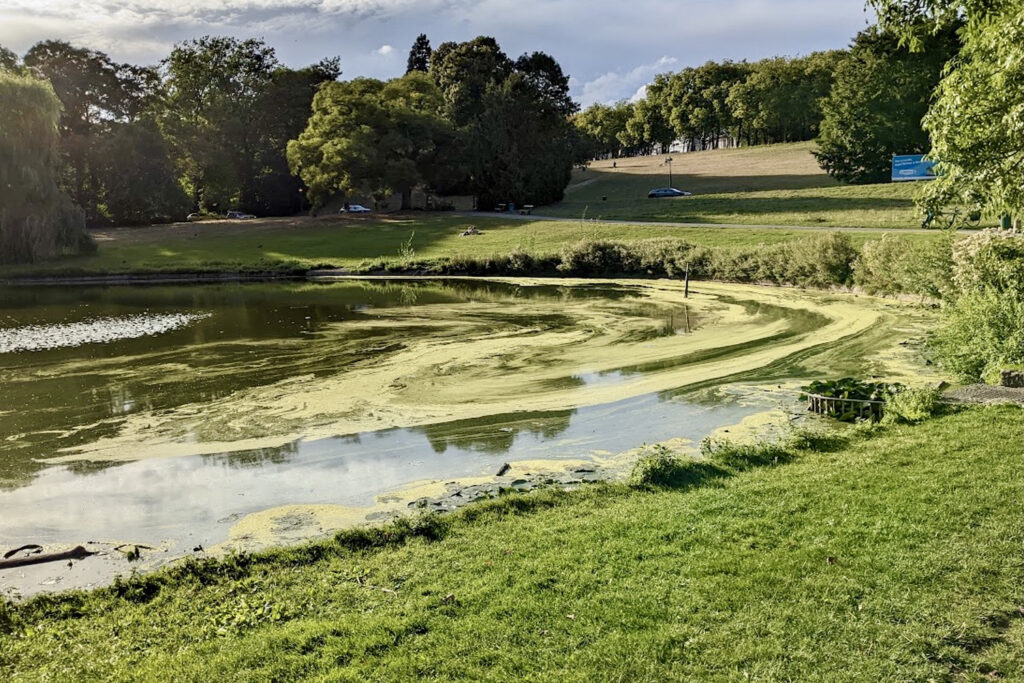
Brussels Environment has confirmed the presence of toxic blue-green algae, also known as cyanobacteria, in four ponds across the capital, with warnings now in place for the public to avoid contact with the water.
The affected sites are the Leybeek pond, the Grand Mellaerts and Petit Mellaerts ponds in Woluwe-Saint-Pierre, and Rouge-Cloître 3 in Auderghem. Two additional ponds (in Parc de Tercoigne and Parc Roi Baudouin) are under close observation following suspicious signs, although no significant bloom has yet been recorded.
According to Bruno Heuze, head of the "Maillage Bleu" department at Brussels Environment, surveillance began at the start of summer through visual checks carried out by park wardens, gardeners, and local associations. "It was last week that we confirmed cyanobacteria in four ponds. This week, two more have been confirmed, prompting the installation of information signs," he confirmed to The Brussels Times.
Detection involves a two-step process: initial visual identification, followed by measurement using a multi-parameter probe. The device records levels of chlorophyll a (found in all algae) and phycocyanin, a pigment unique to cyanobacteria. This allows clear confirmation without laboratory analysis, unless concentrations exceed critical thresholds. Once a pond is classified as "cyanosé"(meaning cyanobacteria are present), visits are increased and readings are taken regularly.
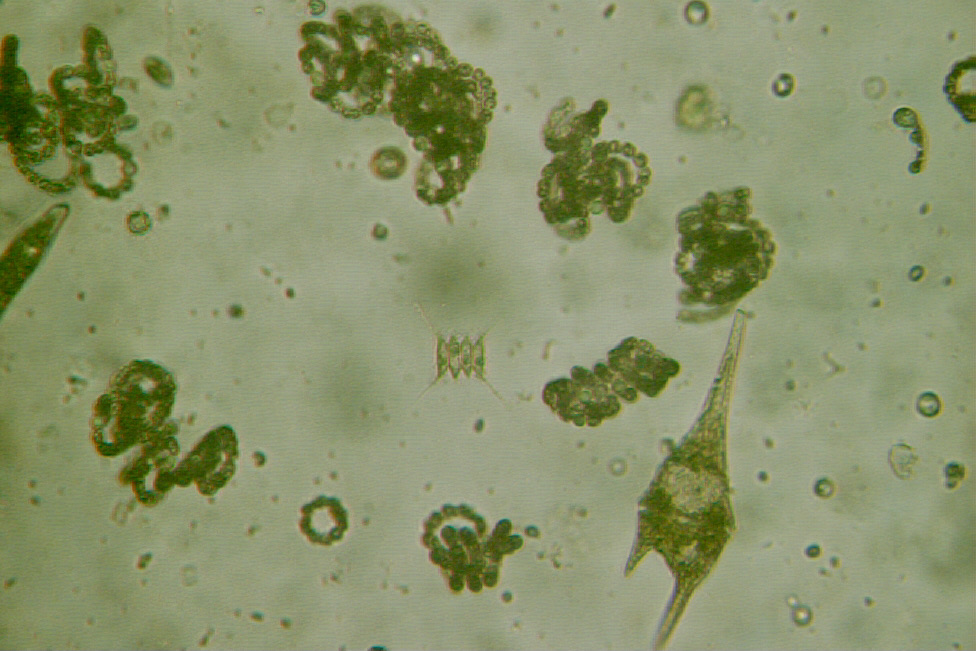
Cyanobacteria and other phytoplankton species seen under the microscope (320× magnification). Credit: smartwater.brussels
Heuze noted that such outbreaks are becoming "more frequent and more intense" in Brussels, primarily due to warmer, longer summers. "The proliferation is mainly linked to two factors: high water temperatures and excessive nutrients such as phosphorus and nitrogen, which act as fertilisers for cyanobacteria," he explained. These nutrients typically come from urban run-off, waste discharges and the decomposition of organic matter in the ponds. Reduced rainfall also slows water renewal, indirectly favouring blooms.
Although generally not fatal, algae can cause headaches, nausea, diarrhoea, skin rashes, and respiratory irritation in humans, and may pose neurological risks for children and animals at high concentrations. They can also accumulate in fish and potentially affect birds that feed on contaminated prey.
Brussels Environment recommends avoiding all contact with contaminated water, keeping dogs on leads near ponds, and not eating fish caught from affected sites. The agency collaborates closely with local authorities to ensure affected areas are clearly marked and that information is widely disseminated.
If toxin levels become dangerously high, access may be restricted with fencing, and in extreme cases, a pond may even be drained. Long-term strategies aim to reduce nutrient inputs, restore pond banks, and explore bio-remediation techniques to bolster ecological resilience, although budget limitations remain a challenge. Climate change, Heuze warned, is worsening the situation: "Rising average temperatures and more frequent heatwaves create ideal conditions for cyanobacteria. This makes it all the more urgent to address other causes within our control."
