
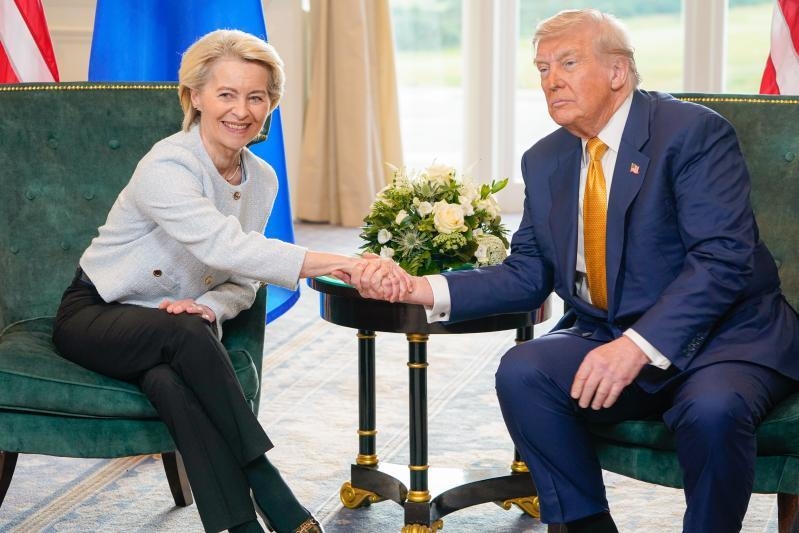
The EU and the US announced on Thursday that they have agreed on a Framework on an Agreement on Reciprocal, Fair, and Balanced Trade ('Framework Agreement').
The new agreement follows the political agreement on tariffs and trade which was negotiated between European Commission President Ursula von der Leyen and US President Donald Trump on 27 July in Scotland. It took longer time than expected to finalise after the two sides had issued separate statements which different interpretations of what had been agreed between them.
The political agreement was described as the best possible outcome after the EU faced the choice between a bad deal and a less bad deal.
In his presentation of the 19 paragraphs of the Framework Agreement, EU’s chief negotiator, Trade Commissioner Maroš Šefčovič, said that the common goal was to put the EU – US trade relations on solid ground and to unleash the potential of their combined economic power.
“The Joint Statement is the result of intensive but constructive engagement, and it carries real weight at a time when the global trade landscape is undergoing profound change,” he stressed. ”This is a serious, strategic deal – and we are fully behind it. A wide range of sectors, including strategic industries such as cars, pharmaceuticals, semiconductors, and lumber, stand to benefit from the deal.”
The alternative – a trade war with sky-high tariffs and political escalation – would harm jobs, growth, and businesses on both sides of the Atlantic, he added. 5 million European jobs would have been at risk without the agreement. “Instead, the EU and US must chart a cooperative path forward, aligned in our shared ambition to re-industrialise and strengthen economic resilience.”
That said, the Joint Statement reflects an acknowledgement by the EU of the concerns of the US and to resolve what the US called trade imbalances. The two sides intend the Framework Agreement to be a first step in a process that can be further expanded over time to cover additional areas and continue to improve market access.
For the EU, the Joint Statement sets out the commitment on both sides to work towards restoring stability and predictability in EU-US trade and investment, for the benefit of businesses and citizens.
The Joint Statement confirms the EU concessions in the political deal. The EU intends to procure US liquified natural gas, oil, and nuclear energy products with an expected offtake valued at $750 billion through 2028 and at least $40 billion worth of US AI chips for its computing centres. European companies are also expected to invest an additional 600 billion across strategic sectors in the US through 2028.
Notwithstanding the concessions that the EU had to agree to in the negotiations, Šefčovič described the Framework Agreement as the most favorable trade deal which the US had extended to any of its partners. In particular, he highlighted the new US tariff regime towards the EU, with a clear maximum, all-inclusive, tariff rate of 15% for the vast majority of EU exports.
Sectors which are already subject to Most Favoured Nation (MFN) tariffs of 15% or above will not be subject to additional tariffs. With regard to cars and car parts, the 15% US tariff ceiling will apply retroactively from 1 August provided that the EU will initiate the legislative procedures for implementing the tariff cuts agreed in the deal by the end of the month.
Some important issues remain to be further discussed and resolved. The two sides will for example negotiate rules of origin that ensure that the benefits of the agreement accrue predominately to them. They did not succeed in agreeing on tariffs on wine and spirits but are ready to lower tariffs in other sectors, according to the trade commissioner.
The EU plans also to substantially increase procurement of military and defence equipment from the US, with the support and facilitation of the US government. This commitment reflects a shared strategic priority to deepen transatlantic defence industrial cooperation and strengthen NATO interoperability. It remains to be seen if the investments in defence will also benefit Ukraine.
For more information about the Joint Statement, click here.
