

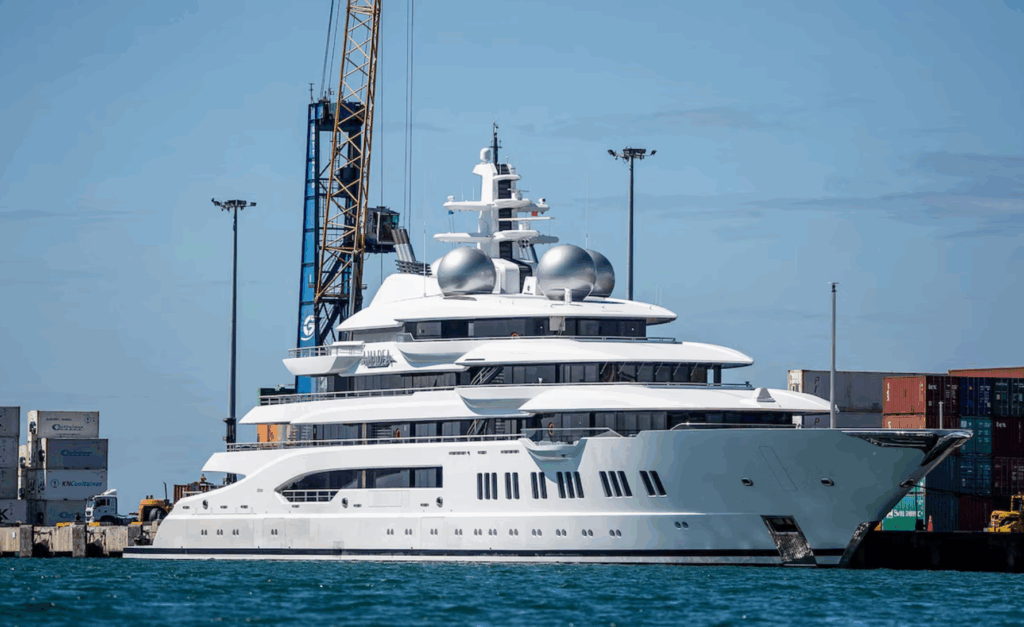
On 10 September 2025 in San Diego, United States, a judge’s gavel will do — or fail to do — more than sell one of the most famous yachts seized as part of US sanctions against Russia for its war of aggression against Ukraine.
The auction of the 106-meter Amadea — a showpiece valued above €300 million — will be a vivid case study in what happens when sanctions policy fails to consider the most important chapter: the exit.
On paper, Amadea looks straightforward. US prosecutors tied the vessel to a sanctioned Russian beneficiary and secured a court-ordered sale. In practice, however, any buyer inherits risks that have little to do with teak decks and everything to do with law.
For nearly three years, the yacht has been the subject of a lengthy legal battle as another non-sanctioned Russian businessman claimed ownership of it before the US government finally persuaded Fiji to seize the asset and hand it over to the US.
With the appellant vowing to contest the decision, seizure of assets like Amadea poses unique challenges. A title that is “clean” in one jurisdiction may not be recognised in another. Ports in Turkey, parts of the Gulf, the Indian Ocean and beyond could entertain rival claims from prior owners or their proxies. Insurance and financing become harder, route planning turns into legal triage, and resale prospects uncertain.
In 2023, ex-Google CEO Eric Schmidt withdrew his winning bid for Alfa Nero, precisely due to the legal headache that unfolded in a similar situation after the superyacht was seized by Antigua and sold in an auction.
Seizing is easy. Selling is hard
This micro-story maps onto a macro-problem. Since Russia’s full-scale invasion of Ukraine, the US and the EU have frozen and, in some cases, moved to forfeit a thicket of assets: yachts, jets, real estate, equity stakes. Seizing is the easy part. What comes next — how assets are maintained, adjudicated, sold or returned — determines whether sanctions operate as leverage or merely as theatre.
If auctions produce titles that don’t travel, the market for distressed sanctioned property freezes. Governments foot spiralling carrying costs (in Amadea’s case, $1 million per month in maintenance and docking fees); courts fill with forum-shopped litigation; insurers reprice risk across entire sectors. None of that strengthens sanctions. It erodes them.
Europe has a particular stake in getting this right. The EU’s comparative advantage is the credibility of its legal order: predictable courts, neutral registries, deep insurance markets, sophisticated ports. If the afterlife of headline seizures is years of cross-border uncertainty, Europe absorbs the spillovers first: higher premiums, chilled investment, clogged dockets, and a reputational hit to the single market’s promise of legal certainty.
An effective sanctions regime
What’s missing is not political will but architecture. A credible sanctions regime needs clear off-ramps and operating rules from day one. Amadea is the caution flag.
We need to start with portability. If a judicial sale in one jurisdiction cannot command recognition in key port states and registries, you are not selling an asset; you are selling a lawsuit. The Commission and Council, with London and Washington, should pursue recognition compacts for high-value disposals, mirrored by major P&I clubs and flag registries, so that buyers are not trapped in a single legal harbour.
Next, escrow over expropriation may be more effective in certain situations. Frozen sovereign funds and disputed private proceeds should sit under multilateral custody and be released only against verifiable benchmarks — durable ceasefires, withdrawals, prisoner exchanges, participation in reconstruction and accountability mechanisms. Escrow preserves leverage without signaling that reserves are political spoils — a message that accelerates financial fragmentation and weakens future sanctions.
Then fix the plumbing of dispute resolution. Europe should establish (or designate) a specialised, time-bound chamber to adjudicate ownership and compensation claims quickly and transparently, with outcomes published in a machine-readable registry that banks, brokers and underwriters can consult in days, not months. Predictability is the cheapest form of deterrence.
Risk must also be made priceable. A narrow, capped indemnity funded from auction proceeds should backstop the specific risk of third-country re-seizure after a recognised judicial sale, paired with mandatory title insurance that explicitly covers named jurisdictions. Convert unknowable political risk into legal risk that markets can price, and liquidity returns without rewarding bad actors.
Finally, build sunset into the system. Regular reviews and automatic status changes — release, court-ordered sale or compensation — should be linked to case progression and geopolitical milestones. Sanctions should ratchet; they should not calcify.
Crucially, such measures would not “go soft” on Moscow - or any future target. They make sanctions more implementable and efficient — sharp enough to coerce, lawful enough to command recognition, and reversible enough to serve diplomacy. They also protect European market integrity and taxpayers, who otherwise end up funding maintenance on stranded assets while auctions underperform because prudent buyers price in chaos.
As for Amadea, the question for would-be owners is simple: are you buying a yacht or a travel-restricted liability with a crew? Until the transatlantic partners harmonise recognition, escrow and claims resolution, the safest assumption is that some ports will stay red, some insurers will be skittish, and some courts may welcome “zombie” claims.
The broader lesson is bigger than one vessel. If sanctions are to remain a first-line tool of Western statecraft, we must design their endings with the same care as their beginnings. Build the exits now — and both Europe’s leverage and its legal order will be stronger for it.
