
The Red Cross rules state that attacks against journalists and the news media are unlawful because, under international humanitarian law, civilians and civilian objects are protected. With few exceptions, not even the propaganda media can be considered military objectives. In other words, while journalists and the equipment they use have no special status, they benefit from the general protection enjoyed by civilian persons and objects, unless they make an effective contribution to military action.
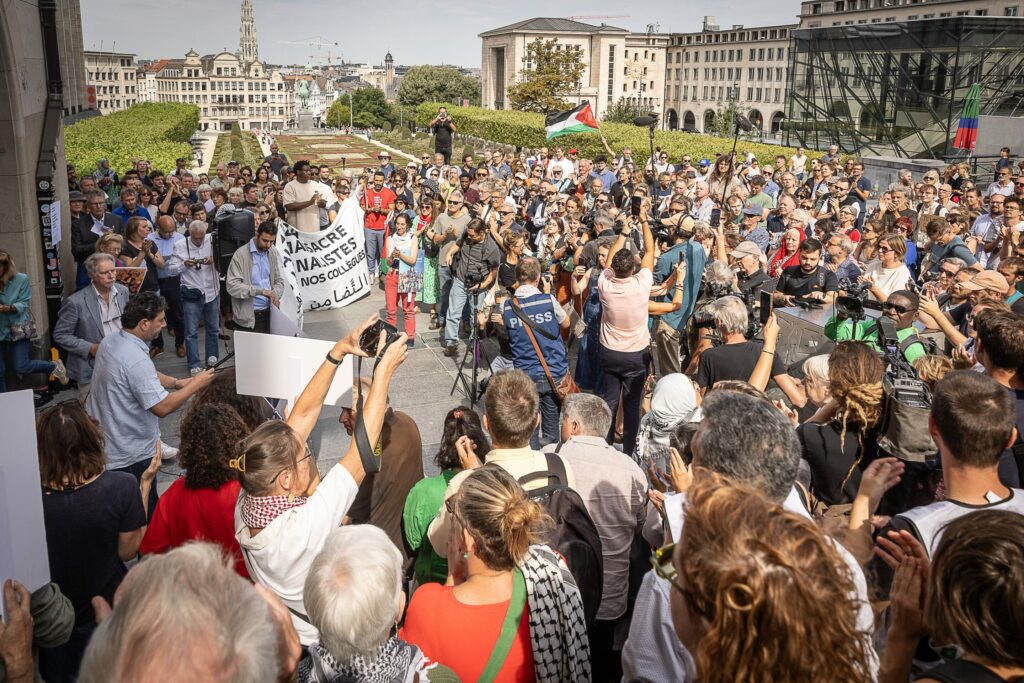
Over 400 journalists and members of the press gathered at the Mont des Arts in the centre of Brussels on Tuesday morning in response to what they called Israel's targeted killing of journalists in Gaza.
The initiative was launched by the Flemish Association of Journalists (VVJ) and its French-speaking counterpart (AJP), as well as the European Federation of Journalists (EFJ), the International Federation of Journalists (IFJ), the SDJ-RTBF, the Palestinian Journalists' Union, and API. They aimed to show solidarity with Palestinian journalists and condemn the killings committed by the Israeli government.
"We are here today not out of choice but out of necessity," one of the organisers said in a speech. "The Israeli government has killed 219 Palestinian journalists in Gaza since 8 October. This is not a coincidence, but a calculated strategy."
He stressed that the attack was not only on Palestinian journalists, but also on the freedom of the press. "We are witnessing a war against the press. But we are here to say no to impunity, no to silence, no to complicity. They can kill a journalist, but they cannot kill the truth."
Breaking the siege
The call to gather was prompted by the death of Palestinian journalist Anas al-Sharif, along with four other journalists, who was working in the Gaza Strip for Al Jazeera when he was killed on 10 August by an Israeli airstrike on Al-Shifa Hospital in Gaza City. Israel claims he was the head of a Hamas terrorist cell. So far there is no independent evidence to corroborate this claim.
Since then, several more journalists have been killed by Israeli attacks. On Monday 25 August, news broke that five more journalists were killed in an attack on Nasser Hospital in Khan Younis. Israel called it "a tragic accident."
At Mont des Arts on Tuesday, Yousef Khader Habache of the European branch of the Palestinian Journalists' Syndicate said that they chose the heart of Brussels for the gathering, as it is where the EU institutions are located.
"We are here to tell the EU that they are complicit. Journalists are killed while doing their work. We want it to stop," he stressed. Habache also announced plans to send a boat with international journalists "to break the siege on Gaza. More concrete details will become clear in the coming weeks."
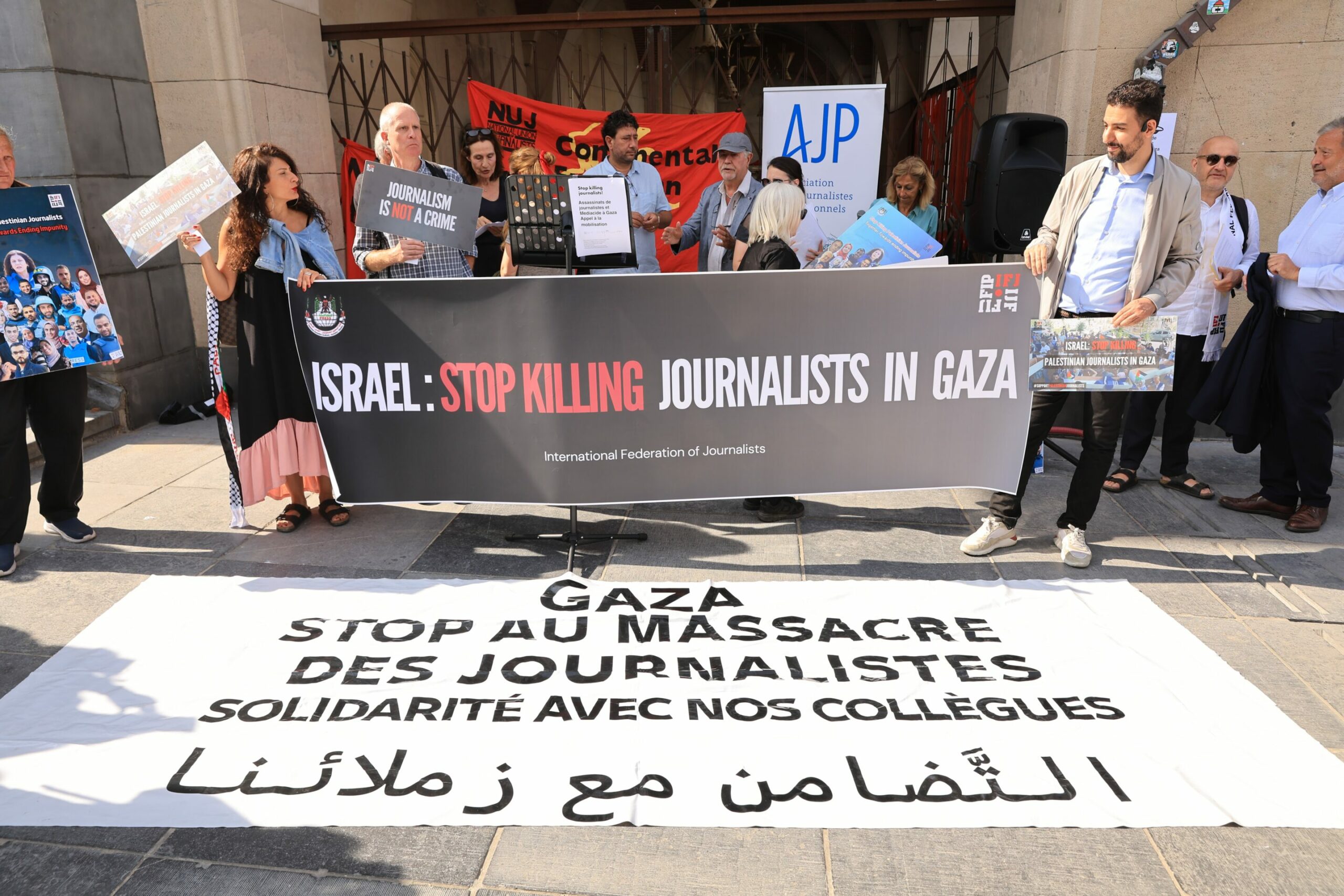
"Stop killing journalists" action organised by AJP, VVJ, FEJ, IFJ, SDJ-RTBF, the Palestinian Journalists' Union and API to show their solidarity with Palestinian journalists and condemn the assassinations committed by the Israeli government, in Brussels, on Tuesday 26 August 2025. Credit: Belga/James Arthur Gekiere
After the speeches by representatives of the various organisations, an audio recording by Anas al-Sharif was played. Afterwards, the names of 219 killed journalists were read aloud, followed by a minute's silence.
The organisations demand an end to the violence in Gaza and hold the European institutions and the international community partly responsible.
One of the journalists who attended the protest, Aylin Koksal, told The Brussels Times that she felt the need to stand in solidarity with the journalists who lost their lives, and the families they left behind.
"In Gaza, their work is often the only window the world has into the reality on the ground. To attack them is not only an assault on individual lives, but on truth itself," she said. "Joining this protest was a way of saying that press freedom matters, that bearing witness matters, and that the killing of journalists can never be accepted as the cost of war."
Israel's war in Gaza was triggered by the Hamas-led attack on southern Israel on 7 October 2023, which saw around 1,200 people killed and 251 taken hostage. Currently, 50 hostages are still held in Gaza, of whom Israeli officials believe around 20 are alive. Most of those freed so far emerged as a result of diplomatic negotiations. Talks toward a ceasefire that could have seen more hostages released collapsed in July.
Meanwhile, more than 62,000 Palestinians have been killed during Israel's military campaign, according to Gaza's Hamas-run health ministry.
