
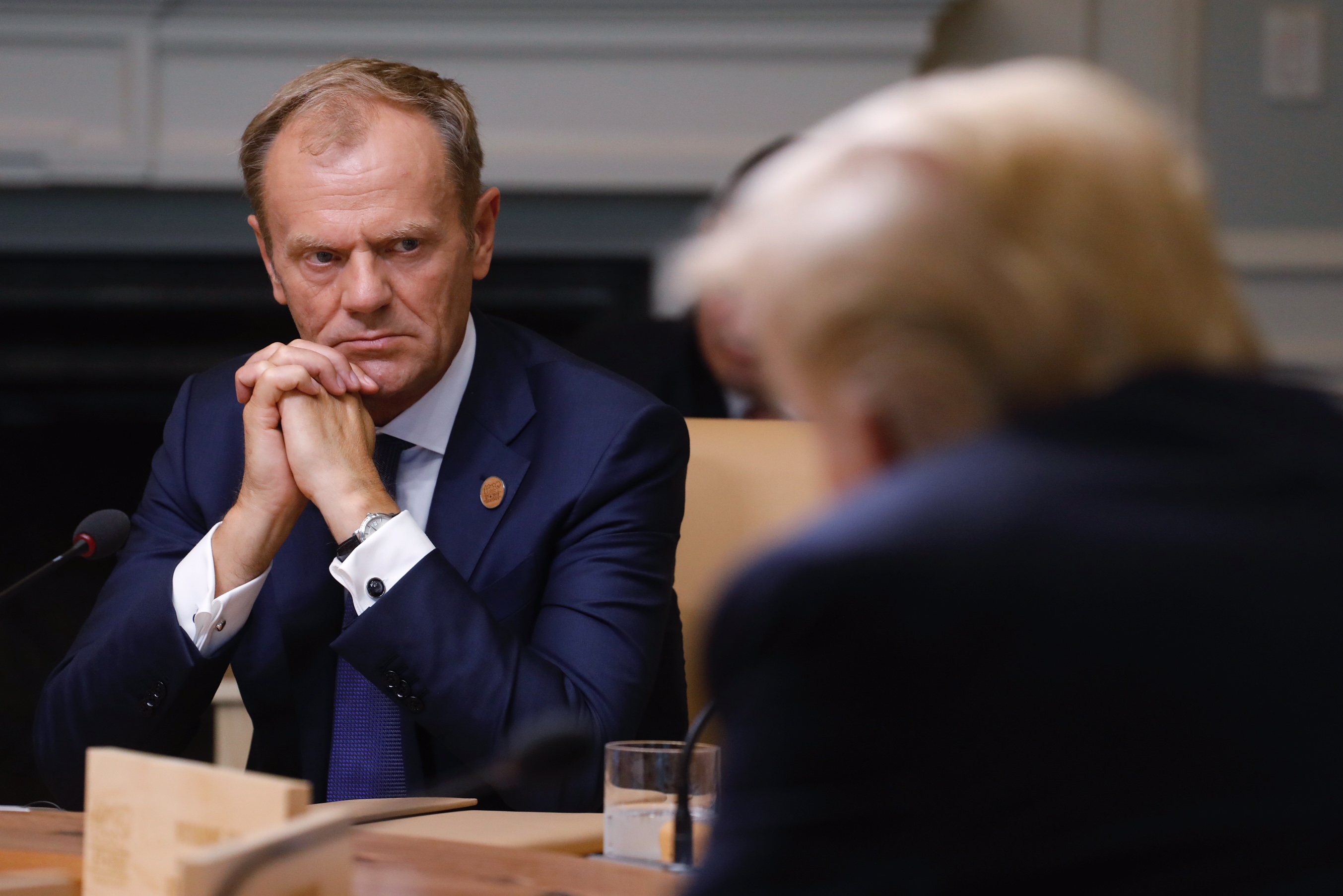
Donalds Trump and Tusk are attempting to lead their countries down two very different energy transition pathways and both are coming up against obstacles that are frustrating their respective agendas.
Some might say it is odd that we live in a timeline where two world leaders are both called Donald.
This columnist has never met a Donald in real life, so the fact that one has been president of the United States (twice) and one the prime minister of Poland (also twice) could be called notable. At least in the Donalds community.
Trump Donald has spent most of his summer attempting to dismantle all of the rules, perks and policies put in place by his predecessor, Joe Biden, that aim to give clean energy a fighting chance against the entrenched forces of fossil fuels.
America's president has been outsmarted by his Russian counterpart during attempts to broker a peace deal, so it seems to have galvanised the Don Quixote of the USA to up his battle against windmills.
That crusade has included tearing up tax incentives, issuing stop-work orders against projects that are already fully permitted and reiterating his pledge that wind and solar will not be allowed on federal lands.
On the face of things, it is great news for Big Oil and terrible news for companies that are investing in the energy system of the future. But it is actually not that simple.
Solar power, for example, has completely ignored Trump’s anti-renewables tirade and according to the latest figures, photovoltaics alone provided nearly 10% of the country’s power supply during the first part of this year.
It is the fastest growing source of electricity by a clear margin and utility-scale solar power plants increased their output by more than 30% compared with last year. This is an industry that is very much on the up, one of the "winners" that Trump is constantly wittering on about.
Wind power has come in for particular bashing by Trump, who has railed against the technology for years, falsely claiming that turbines kill whales and cause cancer. But even that sector appears to be riding out the storm.
Turbines provided more than 11% of power during the same period and provided double the energy output of the country’s hydropower resources. Taken together wind and solar provided more electricity than nuclear or coal.
There is no doubt that Trump’s anti-green edicts will slow this progress down, as a lot of developers are racing to get projects on the board before the tax perks dry up.
But his second and final term in office is ticking away. The US is amid a renewables ebb but the flow will come, at which point the inevitable will be confirmed and unprofitable fossil fuels will be ditched thanks to the cold hard reality of economics.
Trump might have beaten Kamala Harris to the presidency, but he won't beat the market.
Tusk’s frustration
Trump namesake Donald Tusk, meanwhile, is suffering from a different headache as his government attempts to drag coal-reliant Poland onto a more climate-friendly trajectory, a stark comparison to the USA, where the opposite is true.
A lot of his policies are paying off: coal use is down, clean energy is on the up, electric car adoption is increasing, home heating is switching from fossil fuel to heat pump technology. Compared to prior years, Poland is in a good place.
But in order to make even more progress and start attacking high energy bills, which will kill voter enthusiasm for these green policies if left unchecked, more cheap renewables are needed.
Among the very cheapest sources of clean energy is onshore wind. Big capacity, low maintenance costs and acceptable investment outlays make them an extremely attractive option for energy system planners.
In Poland though, permitting is the big problem, as the country has some of the strictest spatial planning laws in Europe. Turbines must be located a long way from residential buildings and can only be a certain maximum height. That severely limits where they can be built.
Tusk’s government has passed a bill that rewrites those laws to make onshore a more viable prospect and unlock loads of extra potential gigawatts but there is a snag: Poland’s president has the power to veto any bills his does not like.
The government attempted to cajole a signature out of the last president, Andrzej Duda, just before he left office, by attaching the wind farm bill to policies designed to make energy bills cheaper.
Tusk’s gambit was that Duda would look bad by not supporting the cheaper bills policy, tarnishing his record in office and making future political prospects less likely to materialise. But it backfired and the signature was not secured before the current head of state, Karol Nawrocki, took power earlier this month.
Nawrocki is anti-renewables and has refused to approve the bill, insisting he will write his own legislation on energy bill support, leaving the wind farm rules firmly in limbo.
For the moment then, the two Donalds will have to make do with what they have got: slow progress towards their stated goals. The difference is that in the case of the USA, Trump is swimming against the tide, while Tusk just has to bide his time for a solution to present itself.
Want more updates and analysis of what is happening in the world of energy and climate? Interested in finding out more information about public tenders and consultations? Sign up to our Energy Rundown newsletter here!
