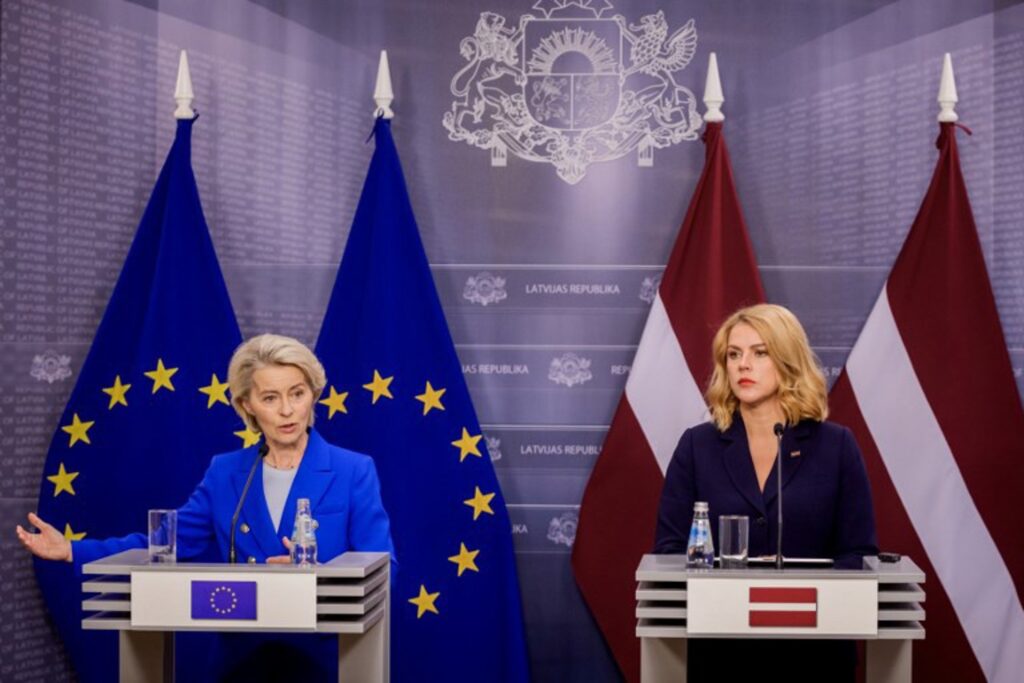
Nineteen EU Member States have applied for low-interest defence loans under the new SAFE mechanism, European Commission President Ursula von der Leyen announced at a press conference on Friday with Latvian Prime Minister Evika Siliņa.
Von der Leyen made the announcement in Latvia, where she began a three-day tour of seven EU countries bordering Russia and Belarus. On Friday afternoon, she was set to travel to Finland, with stops in Estonia, Poland, Lithuania, Bulgaria, and Romania planned for the coming days.
The SAFE mechanism, designed to foster joint investments, will provide Member States with low-interest loans for collaborative defence purchases.
Applications top the €150 billion ceiling set for SAFE
At the press conference, Von der Leyen underscored the urgent need to strengthen European defence capabilities, highlighting the importance of continued support for Ukraine. She referred to the Commission’s proposal to invest an additional €800 billion in defence over the next four years.
In late July, the Commission reported that 18 Member States, including Belgium, had submitted loan applications. That number has now risen to 19, with applications collectively amounting to the full €150 billion available.
Although the application window remains open until the end of November, Von der Leyen confirmed that the remaining eight Member States, including the Netherlands, have opted out. The Netherlands cited its ability to secure loans at lower costs independently.
First tranche should be available before yearend
A Commission spokesperson confirmed on Friday that Denmark is the latest addition to the list of applicants. Other participating countries include Belgium, Bulgaria, Cyprus, Croatia, Czechia, Estonia, Finland, Greece, France, Italy, Latvia, Lithuania, Hungary, Poland, Portugal, Romania, Slovakia, and Spain.
On 9 September, the 19 countries will learn how much they are eligible to borrow. They must then submit detailed national plans by 30 November, outlining their intended purchases and the countries and companies they plan to partner with.
The Commission will review these plans, and a first tranche—likely 15% of the total amount—should be disbursed before the end of the year to kickstart projects.
Commission plans additional defence investment support
Von der Leyen noted that many Member States plan to use these funds to support Ukraine’s defence industry, describing the initiative as “a true European success.”
Additionally, the Commission aims to facilitate a further €650 billion in defence investments by allowing Member States to exclude such spending from their budget deficits.
Sixteen countries, including Belgium, have already expressed interest in taking advantage of this provision.
