
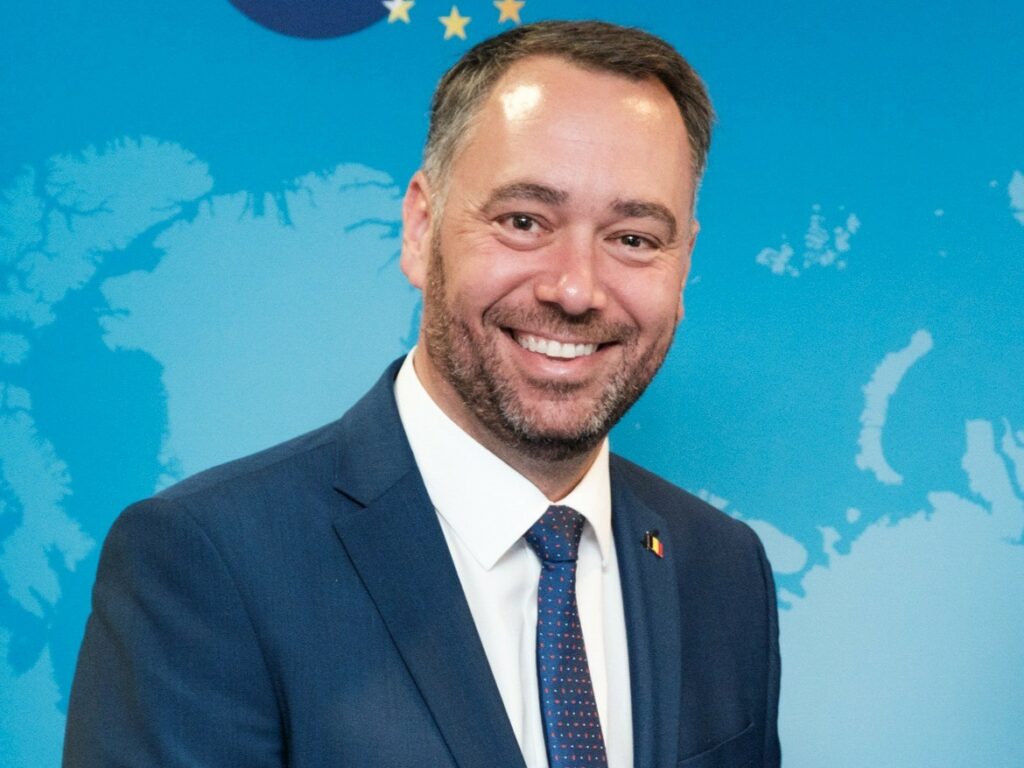
Ahead of an imminent Israeli military operation to take over Gaza City to eliminate what is left of Hamas, Belgium joined this week France and other countries that have announced that they will recognize the State of Palestine before the UN General Assembly (UNGA) in New York in September.
On the sidelines of the General Assembly, France and Saudi Arabia will chair a high-level international conference with heads of state and government on the implementation of the two-state solution.
The Belgian Arizona government was divided on the recognition issue, with Les Engagés, CD&V and Vooruit pushing for recognition while N-VA and MR blocking sanctions against Israel and recognition of a Palestinian state. Prime Minister Bart De Wever (N-VA) was of the opinion that recognition is premature. A compromise decision to avoid a coalition crisis was adopted on Monday without the presence of De Wever.
Foreign Minister Maxime Prévot, who has been advocating for the recognition of Palestine, tweeted that it will send a “strong political and diplomatic signal” to preserve the chances of a two-state solution.
It appears from the decision, that the recognition of Palestine is conditional on the return of all Israeli hostages and the dissolution of Hamas, which would need first to be disarmed. Does this mean that Belgium will not recognize Palestine if Hamas does not comply with these two conditions?
“Belgium has always defended a two-state solution,” Laurens Soenen, spokesperson of the Belgian Foreign Minister, told The Brussels Times.
“The recognition of Palestine is not a reward for any actor, and certainly not for Hamas. It is a political and diplomatic signal to preserve the possibility of a peaceful and durable coexistence between two states, as reaffirmed in the resolution adopted by the Belgian Chamber of Representatives.”
He clarified that Belgium will only formalise this recognition by royal decree once all hostages have been released and terrorist organisations such as Hamas have been excluded from the governance of Palestine.
As this is unlikely to happen, the formal recognition will hardly take place in the UN. The recognition is a matter of Palestinian national self-determination and not linked to Hamas which opposes the two-state solution.
“The recognition of Palestine is rooted in the right to self-determination of the Palestinian people, as enshrined in international law. Belgium’s position is clear: the respect for this right cannot be interpreted as a concession to Hamas,” the spokesperson said.
“On the contrary, Belgium explicitly calls for the demilitarisation of Hamas and supports the renewal of Palestinian leadership through democratic elections. The linkage to Hamas arises from the need to ensure that the future Palestinian state is governed by legitimate, peaceful, and representative institutions, not by armed groups that reject coexistence.”
The decision says further that Belgium will support the "complete" suspension of the trade, research and technological cooperation components of the EU-Israel Association Agreement, including Israel’s participation in EU programmes such as Horizon Europe and the Open Skies Agreement.
The European Commission decided in July to propose a partial Israeli suspension of Israel’s participation in Horizon Europe, EU’s flagship programme for research and development. The Commission also declared that all options in the review paper on the possible suspension of the EU-Israel Association Agreement remained on the table.
In fact, the decision was symbolic and an early warning that EU’s patience with the Israeli government is running out. The decision, which until now has not been supported by a required qualified majority of EU Member States, applies to a minor part of Horizon and will not have an effect on existing contracts and collaborative research projects.
What does “complete” suspension of the EU-Israel Association Agreement mean? How do you design the sanctions so that they will not target Israeli civil society and academic research?
“Belgium supports a complete suspension of the commercial, research, innovation, and technological cooperation components of the EU-Israel Association Agreement, including Israel’s participation in Horizon Europe, the Open Skies Agreement, and the agreement on conformity assessment and acceptance of industrial products (ACAA)”, Laurens Soenen replied.
The goal is to target state-level policies, not civil society, he explained. The measures are designed to exert pressure on the Israeli government in response to violations of international law, notably the expansion of settlements and the humanitarian crisis in Gaza. Belgium insists that funding benefiting Israeli NGOs active in human rights defence must be preserved.
Does this imply that a trade ban will be limited to imports from settlements in the occupied territories or will it affect all trade as the Boycott, Divestment, Sanctions (BDS) movement is campaigning for?
“Belgium actively supports a European-level decision to ban the import of products and services originating from Israeli settlements in the occupied territories, in line with the advisory opinion of the International Court of Justice of 19 July 2024. In the meantime, Belgium will begin implementing this ban at the national level, pending EU-wide action.”
“This targeted approach ensures compliance with international law without endorsing a blanket trade ban, as advocated by the BDS movement.”
Belgian security services will further strengthen their vigilance against antisemitic threats from terrorist organisations. How concerned is the government about the increase in antisemitism in Belgium after 7 October? Will the fight against antisemitism be reinforced?
“Belgium is deeply concerned about the rise in antisemitism following the Hamas attacks of 7 October 2023. The federal government has reinforced its vigilance and coordination through the inter-federal mechanism against antisemitism. Belgium remains firmly committed to combating all forms of racism and antisemitism, and to protecting all communities living in Belgium.”
Like French President Macron’s announcement last July to recognize Palestine, Belgium's decision addresses some of Israel’s concerns such as the disarmament of Hamas and the demilitarization of Gaza but Prime Minister Netanyahu’s response was the same. In a tweet on X, he accused De Wever of being a “weak leader” seeking to appease Islamic terrorism.
The Belgian government’s decision comes at a crucial junction in the conflict with mass demonstrations in Israel against the government and the army mobilizing for expanding the war into Gaza City where up to 1 million Palestinians are living. Israel’s plan to take over the control of Gaza City will risk the lives of the hostages there, lead to more civilian casualties and worsen an already intolerable humanitarian situation in the Gaza Strip.
