
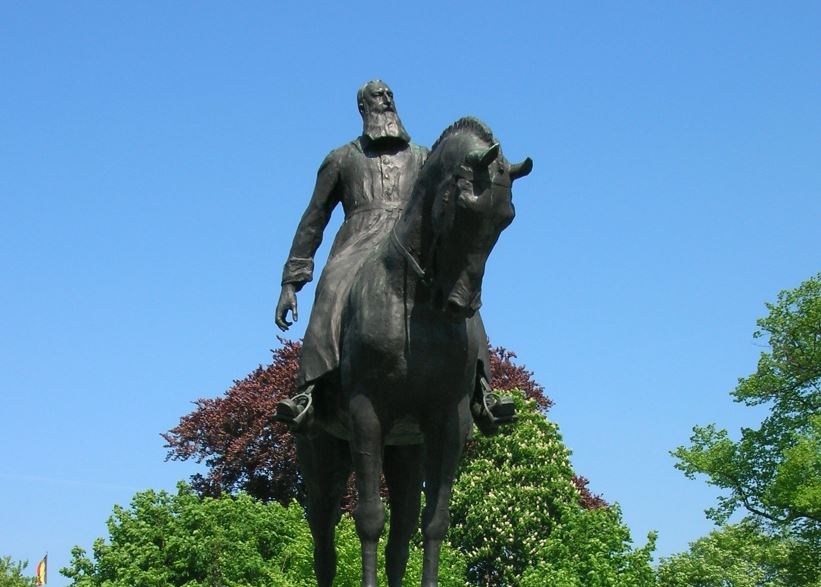
A year after the Brussels Parliament asked the government to start decolonising the capital’s public spaces, no concrete steps have been taken towards that end, according to MPs Soetkin Hoessen (Green) and Kalvin Soiresse Njall (Ecolo), who led that first initiative.
“Despite the broad support for the initiative last year and all the attention surrounding the theme, it seems that no concrete steps have yet been taken to decolonise our public space,” the two said in a press release.
“It is time for Secretary of State Smet to step up a gear so that we can quickly see results.”
The MPs say that references to Belgium’s colonial past are common in Brussels’ public spaces, with statues and street names paying homage to Leopold II and generals responsible for historical atrocities against former colonies.
“These references are almost always in line with the ‘civilising mission’ of the colonists,” the press release explained, and are generally found without any accompanying historical information.
“Several studies have shown that there is a direct link between racism today and the failure to decolonise the public space,” Hoessen said.
“In Brussels, everyone is welcome and everyone should feel at home. The public space should radiate this. A one-sided representation of our colonial history, which was very bloody, is unacceptable.”
The Brussels parliament adopted a resolution last year to urge the government to make public space more inclusive, and to at the very least contextualise the existing monuments and references.
A steering committee with members from interest groups and academics was to help out, with solutions like moving the statues to museums, changing the names of streets, or providing correct historical framing for public monuments.
The parliament also asked that more attention be given to people who have done pioneering work in the field of human rights, anti-racism and the fight against colonisation.
Last year’s Black Lives Matter movement in Belgium strongly fuelled this debate on the decolonisation of public space.
“Although the big attention around the BLM movement has subsided a bit, the justified questions to make our streets and squares inclusive are still alive,” Hoessen and Soiresse Njall said.
“In practice, however, one year later, we still do not see much result of the enthusiasm of State Secretary Smet to work on this. We therefore urge him to step up his efforts and make rapid progress in making public spaces inclusive.”
The group is meeting on Monday to have a roundtable discussion on racism in the streets, and are hoping to accelerate the efforts towards decolonising the public spaces in Brussels within the context of the discussion.
