

Long regarded as the Wild West of urban planning, where anything goes, the zany approach to development in the Belgian capital spawned a term known by planners and architects around the world to denote the haphazard, indiscriminate, careless and chaotic approach to planning: Brusselization.
It should therefore be no surprise that Brussels/Brussel/Bruxelles has taken on the current architectural and planning zeitgeist of building energy performance with a similar schizophrenic aplomb.
Adding to the irony is the fact that the ‘capital of Europe’, which hosts the EU institutions, is the place where EU-wide legislation on the energy performance of buildings is forged - and most recently updated again in 2024.
Belgium is a curious country from an administrative perspective, with multiple, often-overlapping layers of governance. It should therefore also be no surprise to discover that rules regarding the energy performance of buildings vary widely between the regions.
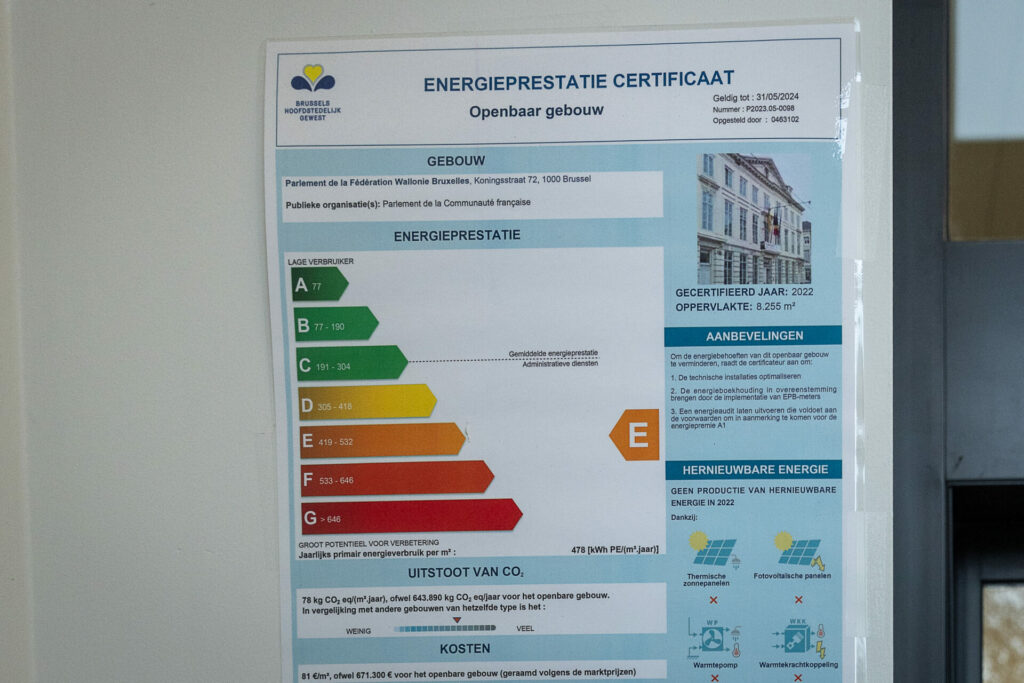
The EU legislation establishes a rating system for the energy performance of buildings, from A to G. This grades buildings according to their theoretical energy performance or consumption, measured in kilowatt-hours per square metre per year. In theory, a practical tool, albeit deeply flawed, random and often punitive in practice.
However, Belgium’s three regions have three different approaches to this. Each region attributes different theoretical energy performance levels (or estimated consumption) to the relevant grading scale. Complicating the matter further, each region takes into account different elements in calculating the theoretical energy consumption, with arbitrary methodologies that take into account factors like insulation, ventilation and heating systems.
The result: the same house on one street in south Brussels could have a different energy rating if it was moved 50 metres down the road to Flemish Brabant and again a different energy rating if it was move a few kilometres further down the road to Flemish Wallonia.
This could just be a humorous Belgian quirk if the matter were not so serious. The region of Brussels has adopted strict provisions that seek to impose on home owners and prospective home buyers the requirement to invest huge sums to improve the insulation and heating systems in their homes. Worse, it has been considering a draft law to actually impose fines on owners of houses that do not meet its arbitrary objectives for these theoretical energy performance levels.
Worse still, even though Brussels is imposing these onerous and incredibly costly renovation obligations on homeowners, it is also failing to take into account the wildly different nature of the buildings in its diverse housing stock.
Many of which are simply unsuitable for accommodating wall insulation, whether for technical or urban aesthetic reasons, or for accommodating heating solutions like heat pumps - the current panacea being pushed by naive and technically illiterate policy makers.
Even worse, in many cases, the relevant authorities will not authorise or grant permits for homeowners to deploy the precise technologies that Brussels is trying to impose on people.
External insulation of walls and buildings is subject to permitting, and there are many scenarios in which the relevant authorities will refuse to grant such permits. One some levels, this is a relief, since wrapping all off Brussels’ beautiful and unique houses in polyurethane and render, would be an architectural and aesthetic travesty even beyond the ravages of Brusselization.
Furthermore, nobody ever calculates the environmental impact of producing all the insulation, which is based on petrochemicals, or the carbon impact of tearing down existing walls and buildings, and replacing them with new plastic and cement-based materials.
Heat pumps - which despite the pleas of their acolytes, are simply unsuited to many houses and heating systems, and still often involve the use of powerful greenhouse gases - are also increasingly subject to permitting and/or to court orders obliging their removal due to their related problem of noise nuisance.
The region of Brussels is divided into six zones, determining the tolerated level of noise over three different daily time periods, depending on the presence of parks/nature, housing, schools, businesses and so on. In most of these zonal areas, the external units of most standard heat pumps are more noisy than the tolerated decibel level during the daytime, and are far above it during the night.
Finally, all of this ignores the fact that there are simply not enough materials (insulation, windows, heat pumps, piping) or installers to deliver on the Brussels Region’s objectives. Even if there were, the cost of doing so is simply unrealistic. The costs of installing heat pumps and adapting heating systems can run up to €50 000 for a small, single-family home, with €15 000 being the bare minimum. Similar budgets need to be anticipated for external wall insulation projects or external roof insulation projects.
The objectives are simply totally unfeasible, and the situation is a total mess.
The region of Brussels is currently operating without a government, but undoing this mess should be a priority of the next administration.
I will confess some mea culpa. As someone who worked on the EU building energy performance legislation in good faith, convinced of its benefits, I now feel like Dr Frankenstein, observing the horrors unleashed by the monster created by other well-meaning individuals involved in the legislative process.
It is not too late to adopt a reasonable and balanced approach to improving the energy performance of buildings, thereby reducing our energy consumption. This is a goal that should remain a top priority.
