

Flemish public transport operator De Lijn has launched a pilot project with self-driving minibuses in the city of Leuven. The vehicles are currently driving through the city empty, but they will start carrying passengers from mid-November.
De Lijn had planned to use self-driving shuttles for passenger transport for many years, but had to shelve them a few years ago because the technology was not yet ready. Now, the start of the first pilot project has been announced.
"It is a Belgian first: for the first time, autonomous vehicles are driving in heavy city traffic at normal speeds (up to 40 km/h)," De Lijn stated in a press release.
The minibuses will travel a fixed route from Leuven station via Maria-Theresiastraat and Naamsestraat to Naamsesteenweg, ending at Reeboklaan in Heverlee. Passengers can use a digital ticket via the app, a text message ticket, or their subscription. The fare for a ride remains the same as with the current buses.
Steward on board
The shuttles made their first run in Leuven on Wednesday, under police escort. "The trip went very well and smoothly," said Leuven councillor for Mobility Dirk Vansina (CD&V).
"The bus covered the route between Leuven and Heverlee several times without any problems," he said. "It gained its initial experience and scanned the surrounding area to learn and become 'smarter'. We will continue this in the coming period, not daily, but a few times a week."
The buses will not carry passengers until mid-November to allow for sufficient testing of driving behaviour in traffic. A steward will always be on board who can intervene if necessary. The police escort will be gradually reduced.
Passengers will be able to ride the minibuses from mid-November. There is room for eight people. The route will continue between Leuven station and Heverlee, and the steward will remain present for safety. The pilot project will run until the end of January 2026.
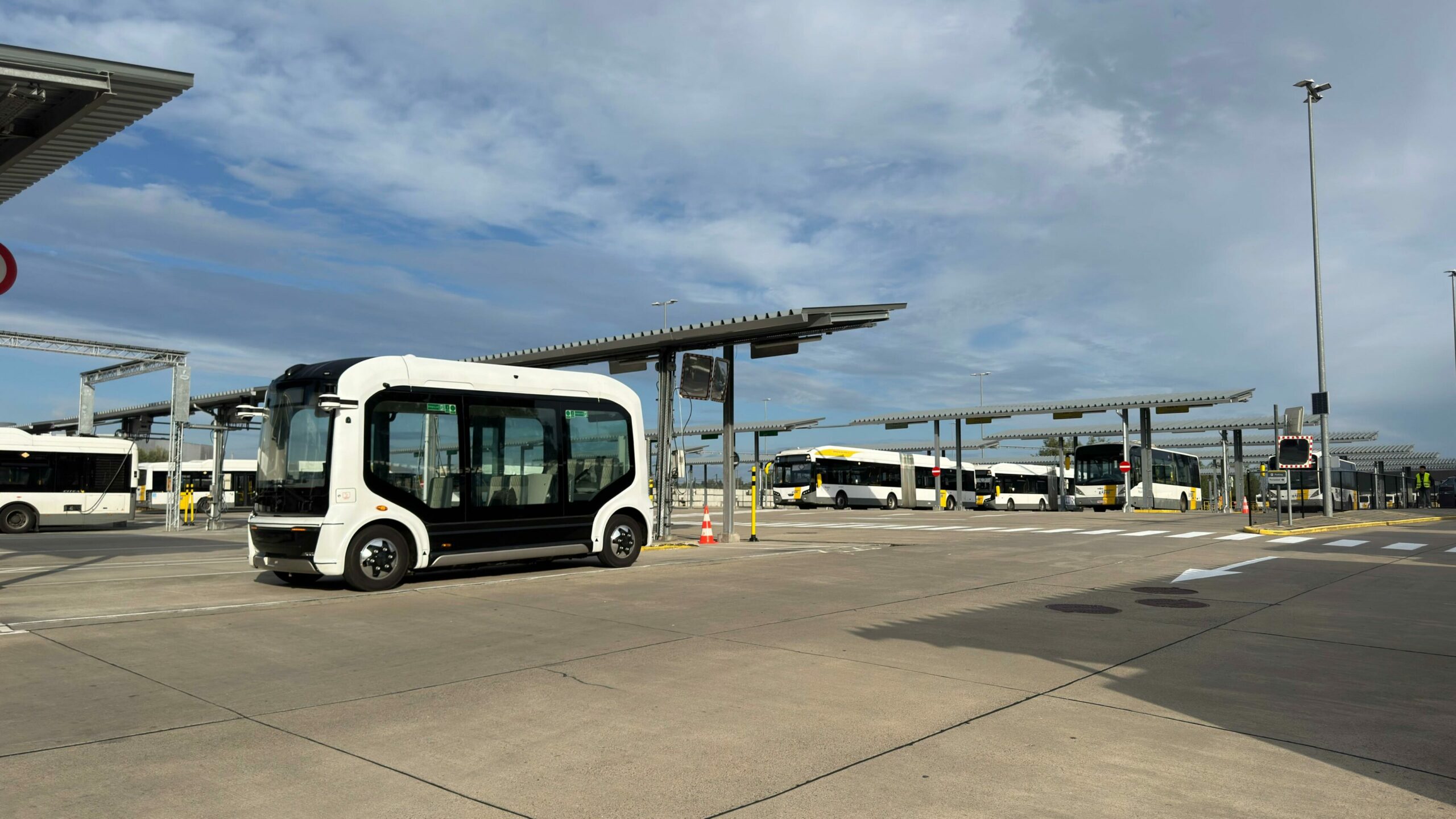
Credit: De Lijn
"With this first project, we are harnessing the potential of autonomous vehicles to increase road safety, reduce congestion, and alleviate parking pressure," said Flemish Minister for Mobility Annick De Ridder (N-VA). "Outside city centres, they can also provide 'last-mile' connections and reliable transport to rural areas and for people with reduced mobility."
Trade unions ACOD and ACV are "critical" of the self-driving vans, but are not currently concerned about potential job losses.
"It is all still in its infancy," said ACOD representative Dimitri Van Can. "We don't expect any impact in the short or medium term."
"Moreover, the legislation isn't ready yet," added ACV secretary Bart Reyns.
The vehicles are supplied by technology company WeRide, in which Renault Group is a shareholder.
