
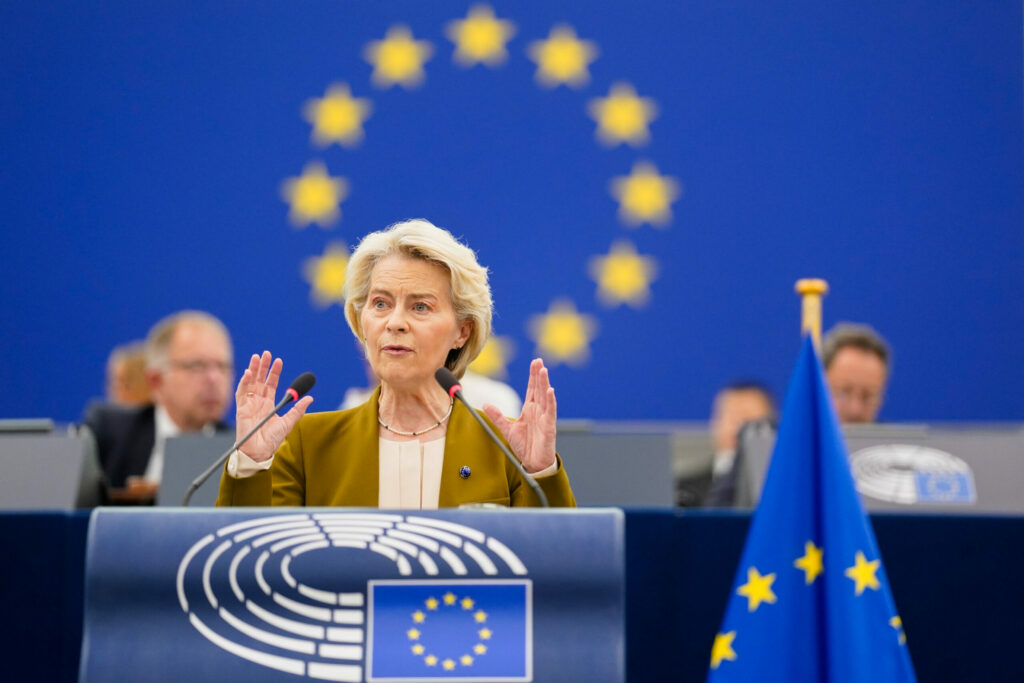
European Commission Ursula von der Leyen’s State of the Union speech last week, drafted to mobilize political support across political party lines in the European Parliament, omitted some policy areas and lacked details about new ideas and proposals.
As already reported, while parts of her speech were greeted with ovations, not all MEPs were persuaded by her rhetoric. Belgian MEPs argued that many policies had simply been rebranded and that the EU was lacking results during the first year of her second mandate.
On the most controversial issue, the Israeli - Palestinian conflict, von der Leyen admitted that the EU is stuck without a majority concerning a previous proposal on partial suspension of funding under Horizon Europe. In her speech, she proposed additional sanctions against Israel leaving the details open and without any timing. Her spokespersons explained that the Commission is working on the scope and details of the sanctions.
Roma integration missing
A missing policy area in the speech was EU’s fight against racism, antisemitism, islamophobia, antigypsyism, and discrimination of minorities. The EU and national strategies for the integration of EU’s largest ethnic minority was not mentioned. The word ‘equality’ was only used in connection with the enforcement of the rule of law.
“Europe's independence is about protecting our freedoms,” said the Commission president. “The freedom to decide. To speak out. To move around a whole continent. The freedom to vote. To love. To pray. To live in a Union of equality. Our democracy and the rule of law are the guarantors of those freedoms. This is why we have done so much to strengthen our tools and step-up enforcement.”
“President von der Leyen acknowledged Europe’s social crisis and the need for fair competitiveness – but without Roma economic and political empowerment, both Europe’s economy and democracy will remain incomplete,” commented The Roma Foundation for Europe (RFE).
Welcoming the Quality Jobs Act, the European Anti-Poverty Strategy, and the new packages on affordability and the cost of living as important commitments, the RFE warned that success will depend on whether they reach those most excluded from work and security. A recent report shows that the economic cost of leaving Roma behind is huge.
Animal welfare left out
What more was missing? As in previous State of the Union speeches, President von der Leyen did not mention the revision of EU’s outdated animal welfare legislation. While almost EU’s major policy areas were addressed, animal welfare was again conspicuously absent in her speech. When speaking about agriculture, the focus was on the cost of living linked to food and farm income.
“In Europe, we have access to high-quality food that our outstanding farmers and fishers produce at affordable prices,” she said. “They are also the custodians of our lands and oceans, our biodiversity. The key to our food security. But they are facing headwinds – from high input costs to red tape or unfair competition. We are acting on all those fronts.”
“We hope that the long overdue modernization of the relevant standards on the treatment of animals is promoted by all political actors,” commented Gabriela Kubíková at the European Institute for Animal Law & Policy.
Among actions that should be taken are ending caged farming, reducing stocking densities on farms, improving welfare for aquatic animals, reducing live animal transport and phasing-out cruel stunning and slaughter methods.
The absence of any mentioning of plans to improve the lives of Europe’s animals contradict the wishes of the majority of European citizens according opinion polls. In a Eurobarometer in 2023, 84% of Europeans believed that the welfare of farmed animals should be better protected in their country. 60% were also willing to pay more for animal-welfare-friendly products.
As Europe strives to meet its Green Deal objectives and ensure food security in the face of climate change, the need for innovative, sustainable protein sources becomes ever more urgent. The Brussels Times will organize an online interactive debate on 14 October about “Cellular Agriculture and the Role of Farmers.”
This high-level event will explore how cultivated meat can be integrated into rural economies, with farmers as active participants in the production process.
New E-car unexplained
The speech included new ideas, notably a new small affordable cars initiative. Von der Leyen highlighted the importance of cars as a pillar of EU’s economy and industry with millions of jobs depending on them. Millions of Europeans want also to buy affordable European cars, she said, implying that the demand is not supplied by the European automotive industry.
“I believe Europe should have its own E-car. E for environmental – clean, efficient and lightweight. E for economical – affordable for people. E for European – built here in Europe, with European supply chains. Because we cannot let China and others conquer this market.”
When asked about details about the affordable E-car, the spokespersons of the Commission replied on Thursday that the details will be worked out in the coming weeks and months in dialogue with the automotive industry. The production of such a car would require “enabling conditions”. Public interventions like these are normally the result of market failures but this was apparently not the case.
The Commission referred to the Strategic Dialogue on the Future of the European Automotive Industry on the following day, together with key stakeholders across the whole automotive value chain. The meeting reaffirmed the need to act fast to implement the Automotive Action Plan but no details about the Commission proposal for an affordable E-car were disclosed.
The next two years are decisive to gain technological leadership in Connected and Autonomous Vehicles, according to the Commission. “The car of the future will be a supercomputer on wheels, powered by electrification and AI,” said Henna Virkkunen, Executive Vice-President for Tech Sovereignty, Security and Democracy.
For the whole 2025 State of the Union speech, click here.
