
United States President Donald Trump said this weekend that he is "ready" to impose new sanctions on Russia if NATO countries stop buying Russian oil. In Belgium, meanwhile, the share of energy imported from Russia is now higher than it was before the invasion of Ukraine.
In a post on his Truth Social platform, Trump claimed that the halt on Russian energy purchases (in combination with heavy temporary tariffs on China) would be of "great help" in ending the conflict.
Soon after the Russian invasion of Ukraine in February 2022, the European Union issued a ban on Russian oil imports (with exceptions for Hungary and Slovakia, which are both NATO members). As a result of these sanctions, Belgium lost Russia's share (approximately 30%) of its crude oil supply, and had to diversify its sources to compensate.
However, Belgium has not stepped away from importing Russian gas – quite the contrary. Despite promises to reduce dependence on Russian gas and consequently reduce the Russian war chest, the opposite trend has occurred: a record amount of liquefied gas from Russia arrived on the Belgian market last year, according to the official figures in the annual Belgian Energy Data Overview released by the Federal Economy Service before the summer.
Higher than before 2022
Of all the gas consumed by households and businesses in Belgium last year, 8.7% came by ship from Russia. This means that dependence on Russia now is slightly higher than before the Russian invasion of Ukraine in 2021.
While the supply of Russian gas by pipeline (through Ukraine, Eastern Europe, and Germany) to Europe has almost completely ceased, tankers carrying liquefied natural gas (LNG) from the Russian Arctic have decisively taken over.
As a result, the terminal by the gas grid operator Fluxys in Zeebrugge increasingly emerged as a hub for alternative supply – with LNG tankers not just from Russia, but also from Qatar and the United States.
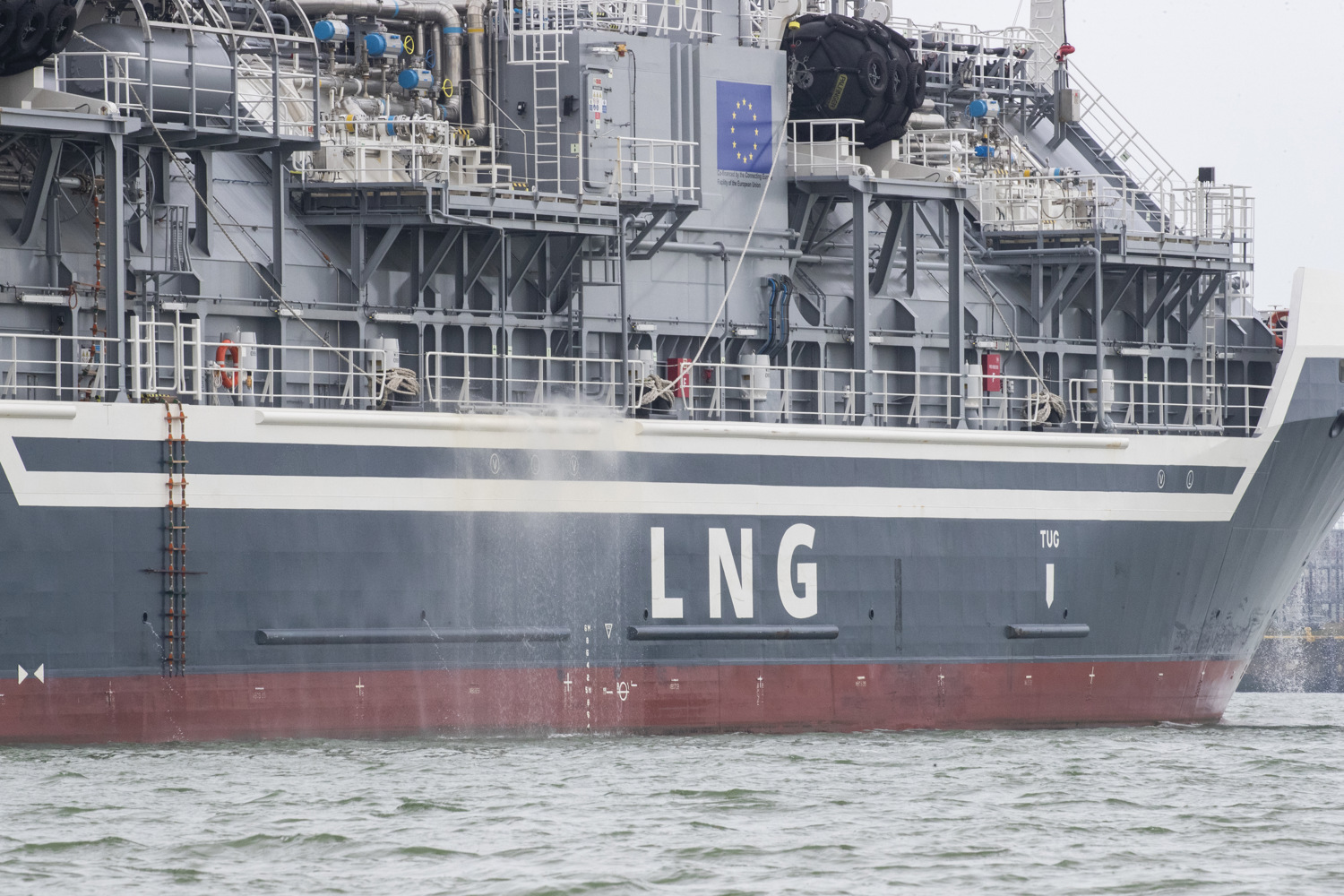
Ship transporting LNG at the liquid gas terminal of Fluxys, in Zeebrugge Harbour, Credit: Belga/Nicolas Maeterlinck
At the import terminal of the gas grid operator Fluxys in Zeebrugge, tankers transported 13.3 Terawatt hours (TWh) from Russia for Belgian customers in 2024 – a 12% increase compared to the previous record year of 2023.
This led to Belgium further developing into a crucial transit country for supplying Germany and the Netherlands with sufficient gas. And once this transit to other countries is also taken into account, the dependence on Russia weighs even more heavily. Of all the gas Belgium imported – including for transit to other countries – last year, 18.3% arrived by ship from Russia.
This means that President Vladimir Putin's regime was Belgium's second-largest supplier in 2024, after its loyal European gas supplier, Norway.
EU ban by 2027?
Since the end of March, a ban has been in place on transshipping liquefied natural gas from Russia in Europe to vessels destined for transit to destinations outside the European Union. The consequences, particularly for Zeebrugge (which was one of the most important transit ports to the Far East) are unclear, De Tijd reported.
Meanwhile, the European Commission is working on the next step, and in May launched its plan – called the RePowerEU plan – to completely phase out Russian gas by the end of 2027.
"Belgium fully supports the RePowerEU plan, which was initiated under the Belgian Presidency. We welcome its implementation," the cabinet of Federal Energy Minister Mathieu Bihet (MR) told The Brussels Times. They stressed that Bihet also reiterated these points during the recent EU Council meetings, and in Belgium's Federal Parliament.
