
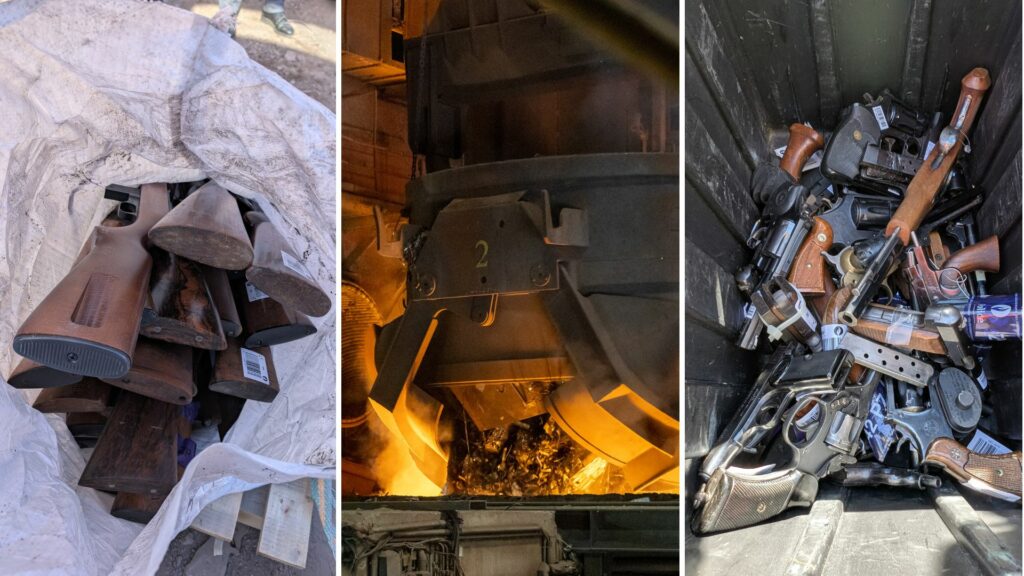
Nearly 400 firearms in the Brussels-Capital Region were destroyed last weekend in a bid to reduce the number of illegal weapons circulating in the capital.
The 377 weapons were legally owned but voluntarily surrendered to the police by private individuals to "prevent them from ending up on the black market," according to the regional security agency safe.brussels.
"The shootings that have been hitting our neighbourhoods for several months reflect a terrible reality: the number of firearms in Brussels is increasing," said Sophie Lavaux, senior official for the larger Brussels area and governor for crisis management in the region.
"The destruction of legally surrendered weapons sends a strong message: we will not allow these weapons to enter the illegal trade and create new victims," she added.
The weapons were melted and turned into metal during the heightened surveillance operation.

Credit: safe.brussels
In May 2025, a new protocol was signed between the chiefs of the six Brussels police zones, the director-coordinator of the Brussels Federal Police, the company APERAM, and Lavaux. This protocol allowed the destruction of firearms to take place last Friday.
According to safe.brussels, the protocol "strengthens the efforts of all security and prevention actors" through the regional strategy against drug trafficking. These efforts should, in theory, stop the associated violence and restore peace to the neighbourhoods.
Complete destruction
The authorities called on Aperam Châtelet, which has industrial facilities for the safe and precise management of these types of operations. The destruction took place under their supervision and according to strict conditions that ensure the complete neutralisation of the weapons – ensuring the safety of the population.
"We had already carried out a similar operation at our site last April for the governor of the province of Walloon Brabant," said Serge Dallenogare, director of the Châtelet site. "We are pleased to once again make our weapons destruction services available to the authorities.
"Once ammunition was removed, it was melted in our electric furnace and converted into liquid steel. That way, the process is part of a beneficial circular economy. All of this was done under police supervision."
How many people own guns in Brussels?
In Brussels, more than 6,600 people legally own a gun, primarily as members of a shooting club, according to figures from the Central Weapons Register, which is managed by the federal police.
For Belgium as a whole, the number of (legal) gun owners is approximately 150,000. These are private individuals who own one or more weapons. Legal entities such as police districts or security firms are not included in these figures.
Belgium's Firearms Act was tightened in 2006. Since then, a permit has been required for every weapon. Additionally, an amnesty programme was introduced for firearms owners who did not want to apply for a permit, after which at least 200,000 weapons were voluntarily surrendered.
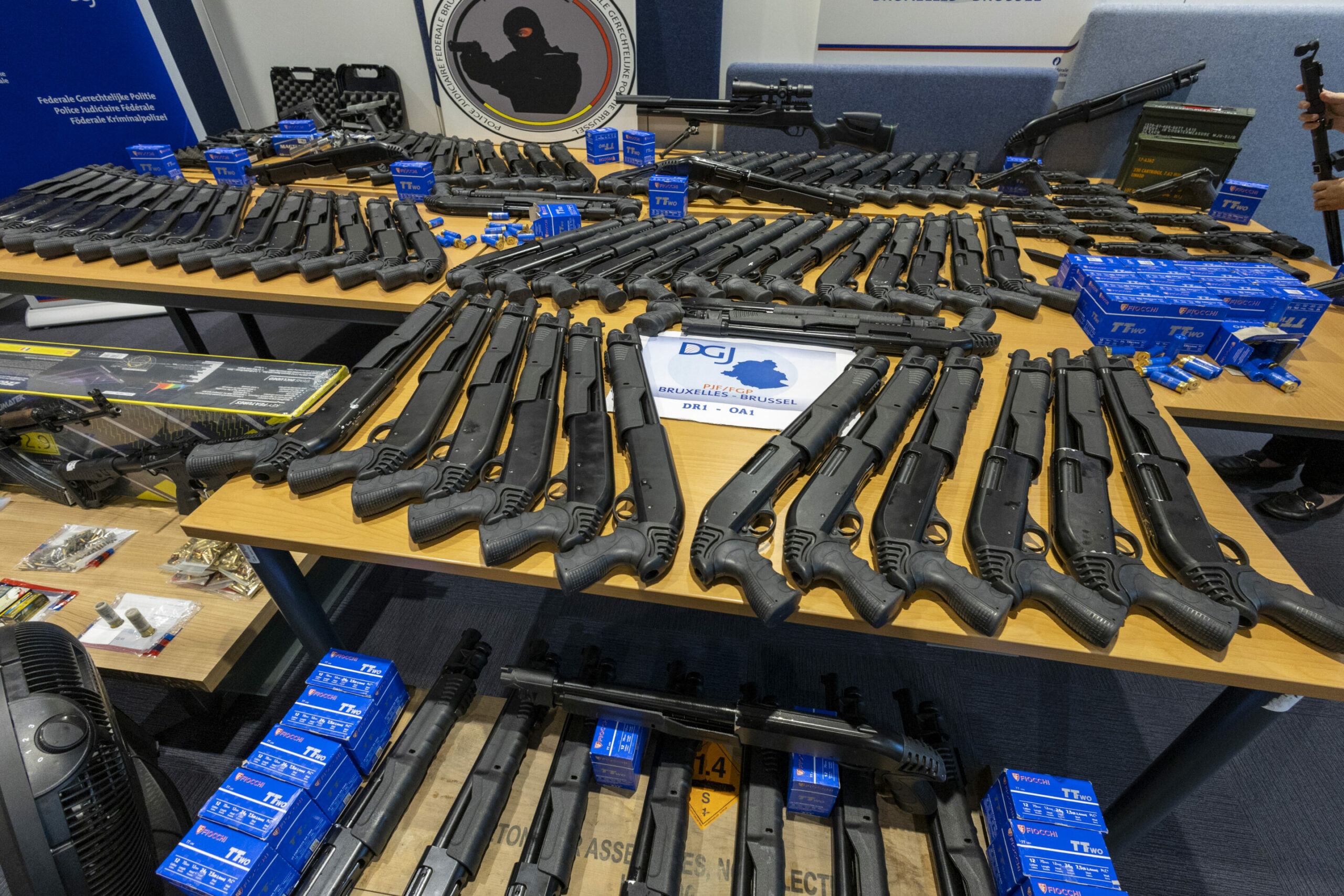
This picture is taken during a press conference on a seizure of over 110 firearms by the Brussels Federal Judicial Police, in Brussels, on Friday 13 September 2024. Credit: Belga/Nicolas Maeterlinck
The Brussels Firearms Department noticed a brief increase in firearms ownership particularly following the March 2016 Brussels terrorist attacks. While 477 permits were issued in 2015, this number rose to 772 in 2019. Following the Covid-19 pandemic, however, the number of permits issued to Brussels residents fell again, to 426 in 2024.
Once a permit is issued, it can be kept for life. However, inspections are carried out every five years. Firearms owners must then demonstrate, among other things, that they are still a member of a shooting club and regularly go shooting. Permits are occasionally revoked due to potential safety issues and some people choose to hand in their weapons if they stop shooting for sport.
However, it is not the licensed weapons but the illegal weapons that are the real problem in Brussels, experts say. Illegal gun possession is still a blind spot for the police and the judiciary, as seizures are usually made in separate judicial files from various agencies, both federal and local.
