

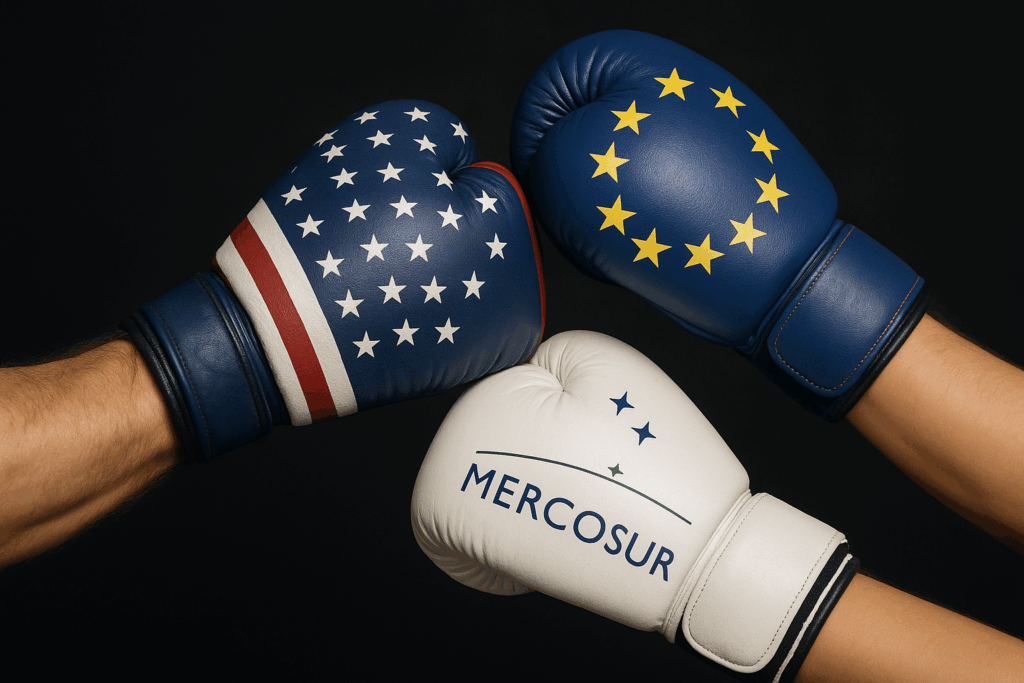
Earlier this month, the European Commission put forward the signing and adoption of the EU–Mercosur Agreement, paving the way for the creation of the world’s largest free trade area. But why now — and how could this reshape the game of international trade?
Trade wars between countries are rarely confined to immediate tariff shocks. In reality, international economic relations are shaped by geopolitical tensions, asymmetric legal reciprocities, and bargaining strategies that can be explained through Game Theory.
The recent tariff war unleashed by Donald Trump – on 2 April, in what he called “Liberation Day” – imposed a global minimum tariff of 10%, affecting all foreign partners. At that time, Trump presented a table of reciprocal tariffs, applying a 20% tariff on the European Union (EU) and, in parallel, a minimum tariff of 10% on Brazil. However, this changed months later.
In July, the EU was compelled to accept an unbalanced agreement with the United States. Washington set a maximum and comprehensive tariff of 15% on European exports (a reduction of 5%), while at the same time guaranteeing zero tariffs on a wide range of American products sold in the EU. Moreover, the EU was pressured to commit to investments in the United States (US$600 billion) and to purchase energy goods and defence materials from American companies over the following three years (US$750 billion).
In the same month, Trump threatened Brazil and subsequently signed a decree imposing a 50% tariff on Brazilian products (adding 40% to what had been announced in April). Despite a long list of exemptions published by the White House, the 50% tariff applied to 35.9% of Brazilian exports to the United States, hitting symbolic products such as coffee, mangoes and guavas (fruit), beef, sugar, chocolate, and automotive parts.
In this scenario, what strategic international interactions might the EU and Brazil (via Mercosur) adopt to mitigate Trump’s tariff shock? The fact is that a window of opportunity has opened.
The situation shows that the United States decided to employ the “ultimatum game”, in which one player – the US – adopts the dominant strategy of applying unilateral tariffs, forcing the others – in this case, the EU and Brazil – either to accept or to reject its trading conditions. Notably, in this context, the US chose a protectionist strategy (a “betrayal” of existing agreements), disregarding the “prisoner’s dilemma”, even though cooperation would have produced greater benefits for all.
The EU, faced with this move, recognised that rejecting American conditions and retaliating with reciprocal tariffs would put at risk more than €800 billion (2024) in exports of goods and services to the US. Although the US is statistically the largest destination for EU exports, from a geopolitical perspective such dependence has shown that the European economy is in a vulnerable position. This explains why the EU accepted an unbalanced agreement with the US, confirming the economic principle that any positive outcome is better than none.
On the same board, Brazil faced a geopolitical threat from the US when Trump declared support for the Bolsonaro family’s interests while criticising the Brazilian judiciary and President Lula’s government. Thus, in addition to the 50% tariff, the US introduced sanctions – such as visa suspensions and the Magnitsky Act – against officials in Brazil’s executive and judiciary. Unlike the EU, Brazil is economically less exposed to disputes with the United States, since only 12% of total Brazilian exports (US$40 billion) are destined for the American market. Hence, economic retaliation may be an option – already authorised by Lula – to respond to US political and legal sanctions.
The US–EU–Mercosur triangulation and the “bargaining game”
Game Theory suggests that when one player (the US) systematically adopts an aggressive strategy, the others (EU and Brazil) may converge towards cooperation with each other in order to counterbalance the power of the challenger. Robert Axelrod, in The Evolution of Cooperation (1984), shows that cooperation among those harmed, in repeated interaction scenarios, tends to emerge as a rational strategy, where the gains from cooperation are greater than the costs of isolation.
It is precisely at this point that the EU (responsible for the common trade policy of its 27 member states) and Mercosur (responsible for the trade policy of its signatories, with Brazil accounting for over 70% of the bloc’s economy) need to accelerate the ratification and implementation of the EU–Mercosur Agreement signed in December 2024. Such a strategic move can be seen as a “bargaining game”.
While the US seeks to maximise gains through unilateral tariffs, the EU and Brazil (via Mercosur) perceive that, faced with a common rival, the EU–Mercosur Agreement ceases to be merely a trade treaty and becomes a strategic response to a more hostile international environment.
In other words, this means redirecting part of European exports and part of South American exports towards a new transatlantic market – with 750 million consumers – that offers greater political predictability.
On the international chessboard, the logic is simple: while the EU reduces its vulnerability vis-à-vis the US, Mercosur expands its international projection, reducing the political vulnerability of its largest regional player, Brazil.
Studies estimate that the EU–Mercosur Agreement could increase bilateral trade by up to 70% and intra-Latin American trade by up to 38%. In this way, it could consolidate an economic bloc whose combined GDP would be comparable to that of the US.
The challenge, however, is that in international relations, games are dynamic, with simultaneous strategic moves, which means that the United States will not remain passive in the face of a “bargaining game” between the EU and Brazil (via Mercosur).
