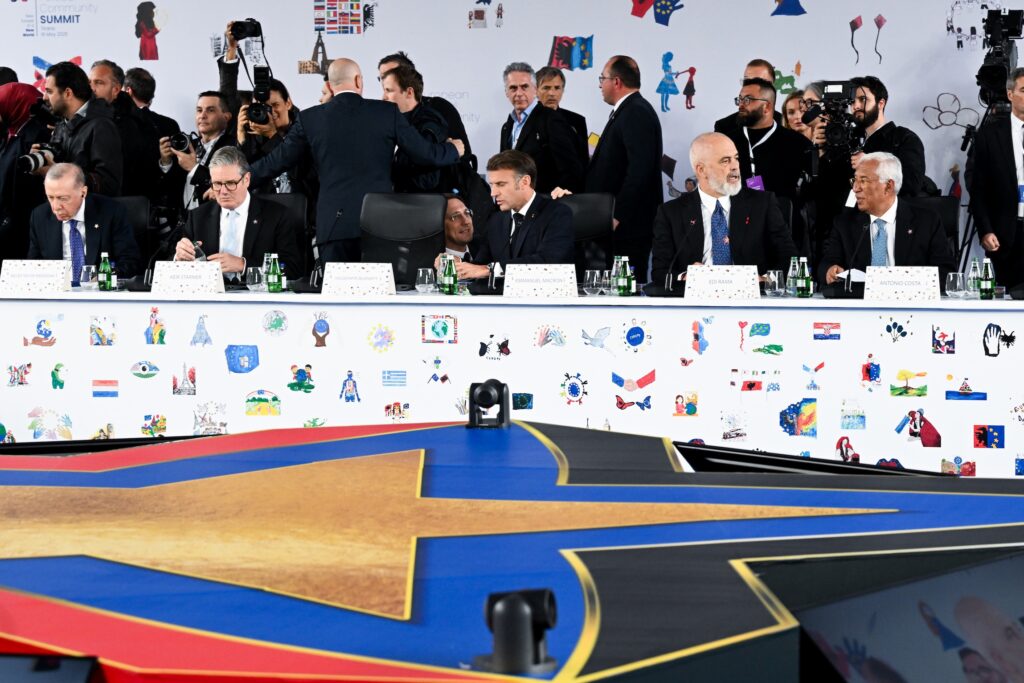
The latest edition of the European Political Community is taking place in Copenhagen today, involving leaders from EU countries and their closest neighbours. But what is the point of this meeting?
Heads of state and government of the European Union’s 27 member countries meet every couple of months in Brussels to discuss priorities, policies and politics. But for a number of years, there was a lack of representation from outside the club.
Leaders from those countries seeking to join the EU or at least have close relations with the bloc had to make do with bilateral meetings every now and then to have their voices heard.
But in 2022, shortly after Russia invaded Ukraine, serious plans began to emerge to create a more inclusive format that would allow all those countries looking to align their priorities with those of Brussels to meet together on a regular basis.
That was the genesis of the idea behind the European Political Community, which was initially the brain child of French President Emmanuel Macron. Two summits are held every year, one in an EU country and one in a non-EU country.
Currently, 47 European countries meet in the EPC format, with just Vatican City, Russia and Belarus as non-participants.
The upcoming non-EU hosts will be Armenia, Switzerland and Azerbaijan in 2026, 2027 and 2028, respectively. Previously, Albania, Moldova and the United Kingdom have performed the hosting duties.
Reception to the EPC has been mixed. Its advocates say that it has already seen success in mediating the conflict between Armenia and Azerbaijan, repairing relations between the UK and the EU, and maintaining pan-European support for Ukraine’s war effort.
However, its critics have pointed to a lack of defined purpose and for stepping on the toes of other intergovernmental fora like the Council of Europe. There are also concerns that it is being used by Brussels to de facto replace the EU enlargement process.
Hopes were raised when the EPC first started meeting that it would accelerate the membership applications of the most progressive EU candidates but there is little evidence to suggest that it has had any impact whatsoever.
Today, in Denmark, it will be Ukraine and migration topping the agenda. Whether any tangible outcomes will come of the meeting is rather unlikely but there is something to be said for the soft power dividend such summits can provide.
After all, it is only by talking to each other that problems can be solved, so in that regard the EPC may well be having a positive effect on Europe as a whole.
Whether it survives as a format once its most enthusiastic participant, Emmanuel Macron, leaves office is another question. For some leaders, it is just another talking shop that they could take or leave.
