
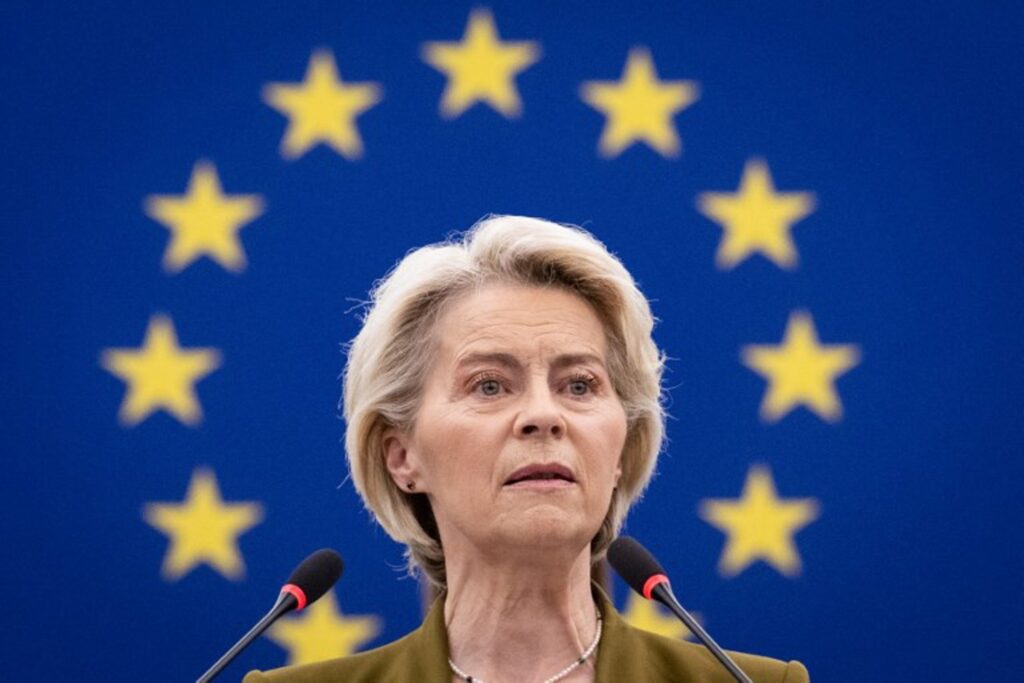
European Commission President Ursula von der Leyen has called for unity in the face of extreme uncertainty, as she prepares to face two new motions of no confidence in the European Parliament this week.
Von der Leyen is set to defend her position on Monday against motions tabled by the far-left group The Left and the far-right Patriots for Europe, after surviving a previous motion in July. During her earlier defence, she denounced her opponents as “conspiracy theorists” and “friends of Putin,” but this time, her appeal focused on solidarity.
Speaking before the Parliament and flanked by 22 of her 26 commissioners, Von der Leyen said, “The world is in the most precarious and dangerous state in decades. Europe is threatened from the east and challenged from within. We are living in a time of maximum uncertainty and explosive volatility.”
She urged Europe to prioritise unity and concentrate on critical challenges. “The truth is that our adversaries not only seek to exploit our divisions but also to inflame them,” she said, referencing drone violations of European airspace and Russian President Vladimir Putin’s attempts to blame Europe for the war in Ukraine.
“This is the oldest trick in the book—sow division, spread disinformation, create a scapegoat. All to pit Europeans against each other, to weaken our resilience and determination. That is a trap we cannot afford to fall into,” she warned.
The Commission President acknowledged concerns raised by Parliament members on issues such as Gaza, Ukraine, trade, and relations with the US, themes reflected in the motions against her. “I understand these come from sincere and legitimate concerns. There are other pressing issues too—economic security, dependencies, the cost of living, climate change,” Von der Leyen said, pledging continued dialogue with Parliament to find collective solutions. “I believe this is a shared responsibility at a dangerous moment in our history,” she concluded.
Last month, Von der Leyen had similarly extended a hand to the Parliament during her State of the Union address, following a turbulent period that saw the pro-European coalition under pressure. Tensions arose after the European People’s Party (EPP) aligned with far-right groups on certain votes, although sources say the situation has since stabilised. However, the political groups remain eager for tangible progress.
Socialist leader Iratxe García Pérez warned that her faction’s support “depends on the Commission keeping its commitments,” and called for collaboration with pro-European parties rather than anti-European forces. Similarly, Valérie Hayer of Renew criticised the lack of progress since the last motion of no confidence and appealed to both the centre-right EPP and the centre-left S&D to avoid empowering extremist factions by endorsing their amendments.
Meanwhile, Terry Reintke of the Green group pointed to a range of issues with the Commission, from inaction on Gaza to sidelining climate policies. Still, she argued it was not the time for an institutional crisis. “We need a clear strategy,” Reintke stressed, adding that Europe was weakened by the EPP’s indecision over its political alliances.
