

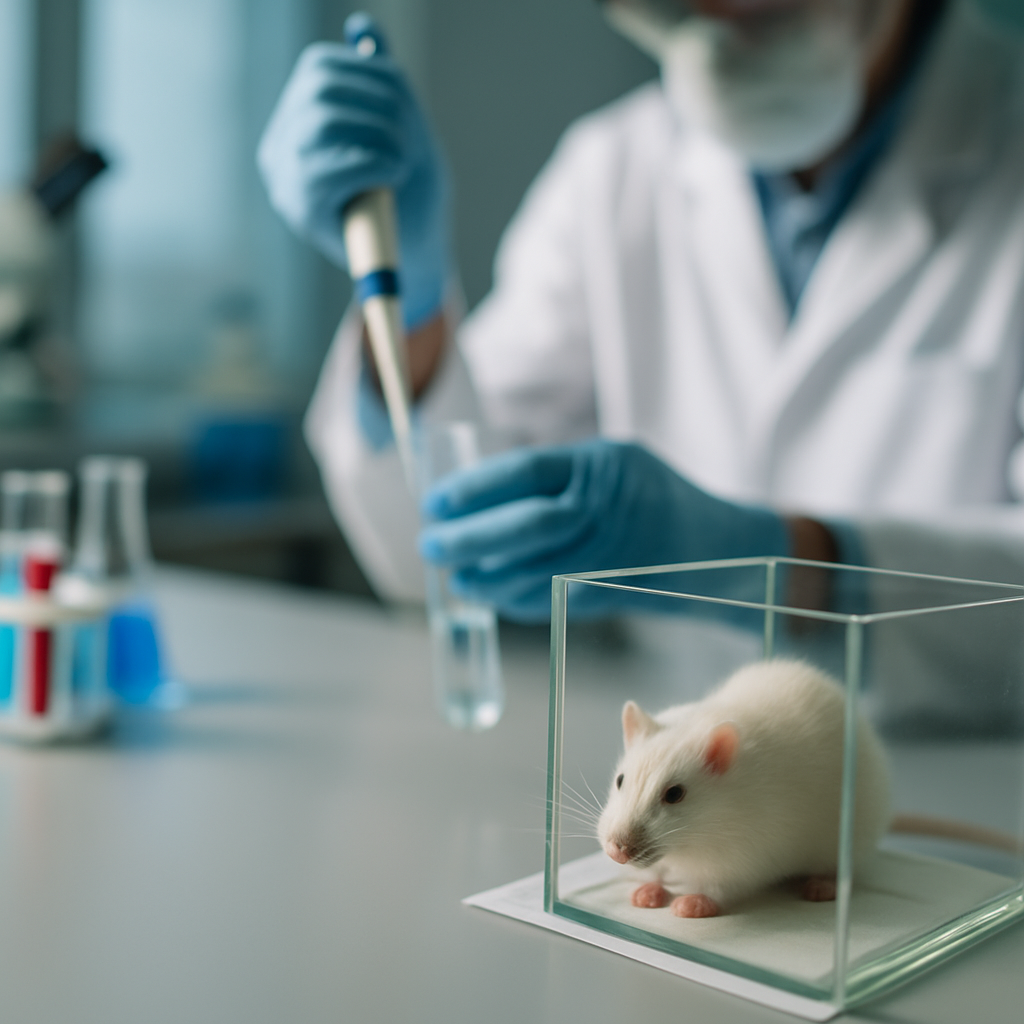
As Europe positions itself as a global leader in ethical science and innovation, the EU faces a defining moment: will it uphold its commitment to phase out animal testing, or allow outdated practices to persist under its flagship chemical safety regulation?
The Registration, Evaluation, Authorisation and Restriction of Chemicals (REACH) is the EU’s central regulation for assessing the safety of substances used in industrial processes and consumer products. Despite its goal of protecting health and the environment, REACH still permits painful animal testing, even when modern alternatives exist.
Across EU laboratories, rabbits, rats, fish, and other sentient beings are subjected to force-feeding, induced allergic reactions, and lethal dosing to fulfil the regulatory requirements. These animals endure prolonged suffering in procedures that often fail to reflect human biology and can delay the adoption of faster, more predictive non-animal methods.
Now, REACH is under formal review, with proposed revisions expected by the end of this year. This is a pivotal opportunity to streamline regulation and confront the ethical and scientific urgency of ending animal suffering in chemical safety testing.
Moreover, the European Commission recently announced a chemicals simplification package, as part of a broader action plan to strengthen the European chemicals industry.
The package is designed to cut administrative burdens and compliance costs for businesses, while maintaining high standards for human health and environmental protection. However, simplification must not come at the expense of our humanity.
The suffering animals endure in chemical safety tests is not an unfortunate byproduct—it’s a systemic failure. In its current form, REACH continues to permit outdated procedures that betray both public trust and scientific progress.
By delaying the uptake of non-animal methods, REACH imposes real costs on human health, environmental safety, animal suffering and EU credibility as a global leader in scientific innovation.
In response to the European Citizens’ Initiative, Save cruelty-free cosmetics: commit to a Europe without animal testing, the EU has already pledged to phase out animal testing. The science to support that transition is at our fingertips. What’s missing is the regulatory will to embed it.
Six pathways to reform REACH
1. Close the cosmetics loophole
EU law bans animal testing for cosmetics. However, under REACH, companies are still required to test cosmetic ingredients on animals to assess risks to worker safety.
This legal loophole keeps animals confined to laboratories and undermines consumer trust. Most consumers would rather see a product pulled from shelves than discover its ingredients were tested on animals—especially those marketed as cruelty-free.
REACH needs to catch up with the cosmetics ban. That means relying on non-animal safety data driven by consumer demand, and prioritising the use of advanced, humane methods for assessing environmental safety. Animals shouldn’t continue to suffer because of a legislative loophole.
2. Make non-animal approaches the default
Legislative reforms are costly and rare, so REACH must be built to last. Modern science offers powerful tools such as predictive toxicology and advanced computational models, which often outperform animal tests. However, under REACH, these methods are sidelined.
It’s time to flip the script. Non-animal approaches must be the starting point, not the backup plan. The revised regulation must embed non-animal approaches as the first tier in safety assessments, and regulators must enforce the rule to test on animals “only as a last resort” with teeth.
3. Future-proof REACH
This is about more than ethics. Smarter regulation can reduce costs, drive innovation, and help the EU meet its commitment to end animal testing. REACH should move away from prescribing outdated tests and instead focus on setting clear protection goals. Scientists and experts should be trusted to choose the most effective methods to meet those goals, using the latest non-animal technologies.
To support this shift, the European Chemicals Agency (ECHA) must have the authority to determine how protection goals are achieved. This includes issuing guidance, technical documents, and other tools that reflect scientific progress and provide legal clarity. Regular updates to these materials, along with proper training for regulators, will ensure the EU stays ahead in advancing humane and effective chemical safety.
4. Cut red tape, not corners
Animal tests should never be rubber-stamped. Before any test is approved, companies must provide solid evidence that no suitable non-animal option exists. ECHA should be empowered to reject weak proposals and request innovative, non-animal approaches.
Companies should also be allowed to update their REACH dossiers throughout the regulatory process with a clear communication track with the regulatory authorities. Streamlining dossier updates will prevent unnecessary delays and animal suffering.
5. Boost transparency, slash waste
Fine-tuning REACH is about saving animals, protecting human health, and protecting the environment while ensuring resources aren’t wasted on redundant experiments on animals.
REACH must require full transparency on all animal tests and promote data sharing to eliminate duplication and cut waste. Tracking the use of non-animal approaches will highlight progress and accelerate their uptake, saving animals and public money.
6. Create an expert committee to lead the way
A dedicated, independent committee can guide REACH’s transition to humane science. It would support regulators, advise on scientific updates, and ensure non-animal approaches are used confidently and consistently.
The bottom line
Animal testing under REACH is more than a technical issue. It reflects a deeper moral failure, driven by regulatory inertia and institutional hesitation. Each unnecessary test causes animal suffering, wastes public resources, and blocks progress toward more innovative, humane science.
The EU has a chance to lead the world in simplifying and transforming regulation. By adopting targeted reforms and embracing systemic change, Europe can save lives, protect the environment, reduce costs, and redefine global standards for ethical science.
Europe must not miss this moment.
