
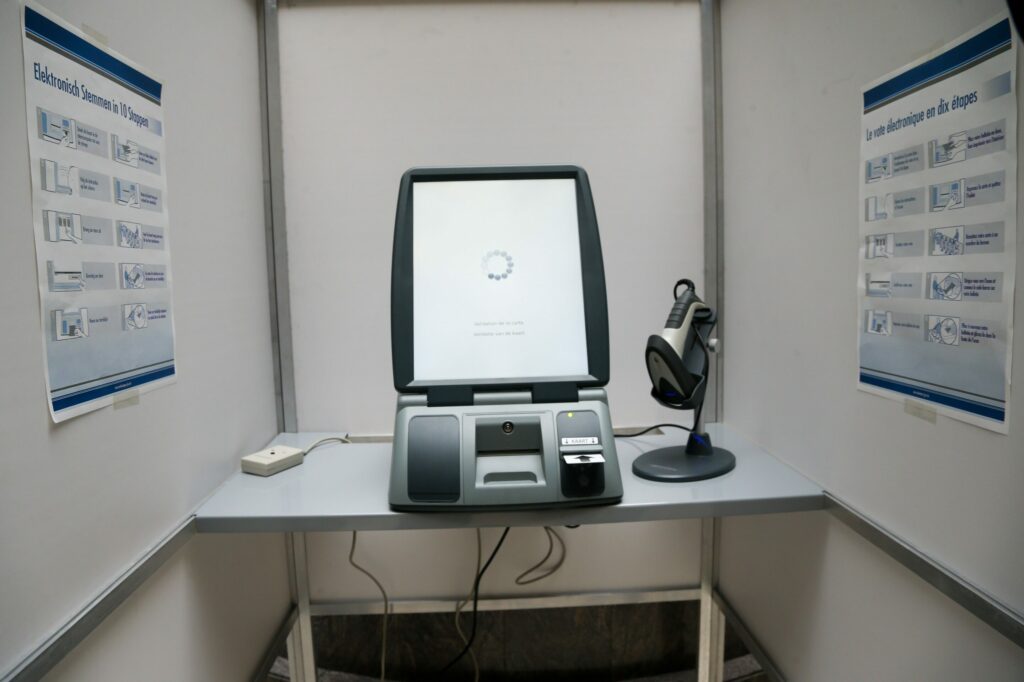
Electronic voting is set to return to Brussels for the next elections, the Brussels government has confirmed, even though the current supplier's contract expires in 2027.
The Brussels government, currently in caretaker mode, confirmed last Thursday its decision to maintain electronic voting for upcoming elections and rejected a return to paper ballots, unlike Flanders and the German-speaking Community, Local Government Minister Bernard Clerfayt (DéFI) announced on Monday.
The government has also tasked Minister-President Rudi Vervoort and Local Government Minister Bernard Clerfayt with formally communicating the Region's position regarding the allocation of funds and staffing, and negotiating urgently with the federal government a memorandum of understanding to set out the division of costs and human resources.
According to Clerfayt, following this decision, Federal Interior Minister Bernard Quintin (MR) approved Brussels' position, paving the way for the implementation of an electronic voting system, either through a new nationwide platform or by extending the current system specifically for the Brussels Region.
Clerfayt has long advocated for ensuring a "reliable voting process" in Brussels ahead of the 2029 (federal, regional and European) and 2030 (municipal) elections.
He said he had been "alerted by population and civil registry directors in the 19 Brussels communes to the risks of returning to paper ballots". He had therefore taken several steps to guarantee the continuity of electronic voting.
Since 1999, the majority of Brussels communes have voted electronically. However, the minister noted that the contract with the current supplier will expire in 2027.
Given the limited time to develop a new system and the fact that Brussels' municipalities are firmly opposed to a return to paper voting, Clerfayt has also proposed extending the existing system if the new one is not ready in time.
For Clerfayt, a return to paper ballots would increase the risk of errors, fraud, and delays in vote counting.
