
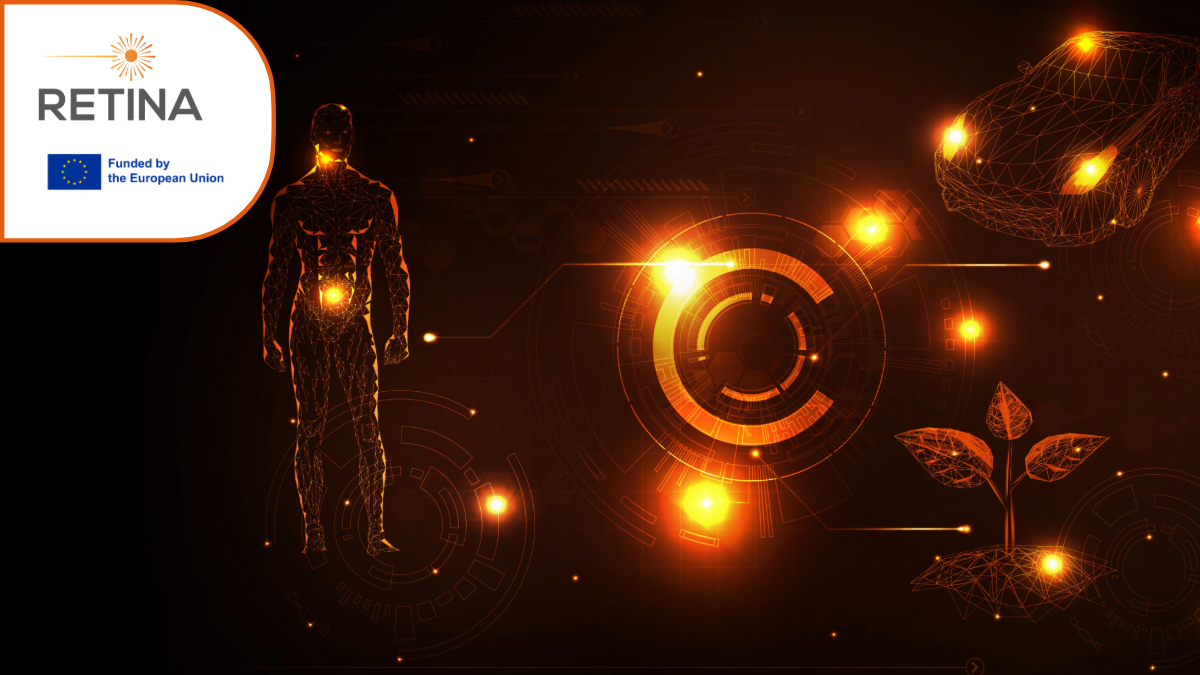
RETINA is creating a new generation of compact, intelligent sensors that mimic human perception and then vastly exceed it. By fusing light-based technology with machine learning, these palm-sized devices perceive the world in new ways, enabling fast, intelligent responses in complex environments.
The project’s core innovation is the seamless integration of two advanced technologies onto a single photonic chip. The first is a snapshot spectral imager, a miniaturized camera that detects material composition by seeing a vast range of wavelengths beyond human vision. The second is a photonic chip-based LiDAR, a laser system that accurately maps shape and distance, even in challenging conditions like fog or darkness.
This unique hardware-level fusion is what allows RETINA to overcome the limitations of conventional sensor systems, which often operate in isolation. Together, they enable a system to understand not just what something is made of, but also where it is, all processed in real time through embedded machine learning. This real-time processing is critical for applications where a delay of even a millisecond could have significant consequences.
This powerful fusion is already demonstrating its value across critical sectors. In healthcare, surgeons test RETINA’s sensors to visualize tumors and monitor blood flow, enhancing surgical precision and safety. For example, the technology can help delineate healthy tissue from cancerous cells during an operation, providing a crucial guide for surgeons.
In the automotive industry, the system empowers Advanced Driver Assistance Systems (ADAS) to "see" more clearly in rain, darkness, and fog, significantly boosting road safety. And in agriculture, RETINA supports precision viticulture by enabling early detection of plant disease, monitoring water stress, and predicting harvest levels, helping farmers adapt to climate pressures. Ultimately, this means less water waste, fewer pesticides, and a more secure food supply.
These are not just lab prototypes. RETINA’s systems are engineered for real-world deployment: they are compact enough to fit into drones or handheld tools (under 10 cm), energy-efficient (consuming less than 5 watts), and process fused data at 10 frames per second for immediate insight. Their rugged design ensures they can withstand the vibrations in a vehicle, the sterile environment of an operating room, and the variable conditions of an open field. They are now being actively validated in hospitals, on city streets, and in vineyards across Europe to accelerate their path to the commercial market.
To see these innovations in action, we invite you to the online event “RETINA in Action: Smart Photonic Sensing for Healthcare, Automotive and Agriculture” on 25 November 2025, from 15:00 to 17:00 CET. The event will feature a detailed introduction to the technologies utilized and Q&A sessions with the lead engineers and researchers. For more information and to register, click here.
About RETINA
Details about RETINA can be found on their website and on social media channels LinkedIn and X.
This project has received funding from the European Union’s Horizon Europe research and innovation programme under grant agreement number 101135529.
Views and opinions expressed are, however, those of the author(s) only and do not necessarily reflect those of the European Union or European Health and Digital Executive Agency (HaDEA). Neither the European Union nor the granting authority can be held responsible for them.
