
As prime minister of the Netherlands, Mark Rutte was notorious for his outspoken, tough-guy remarks. At an EU summit in Brussels, he once told his Hungarian counterpart, Viktor Orbán, “if you don’t like it, there is also an alternative: leave the Union.”
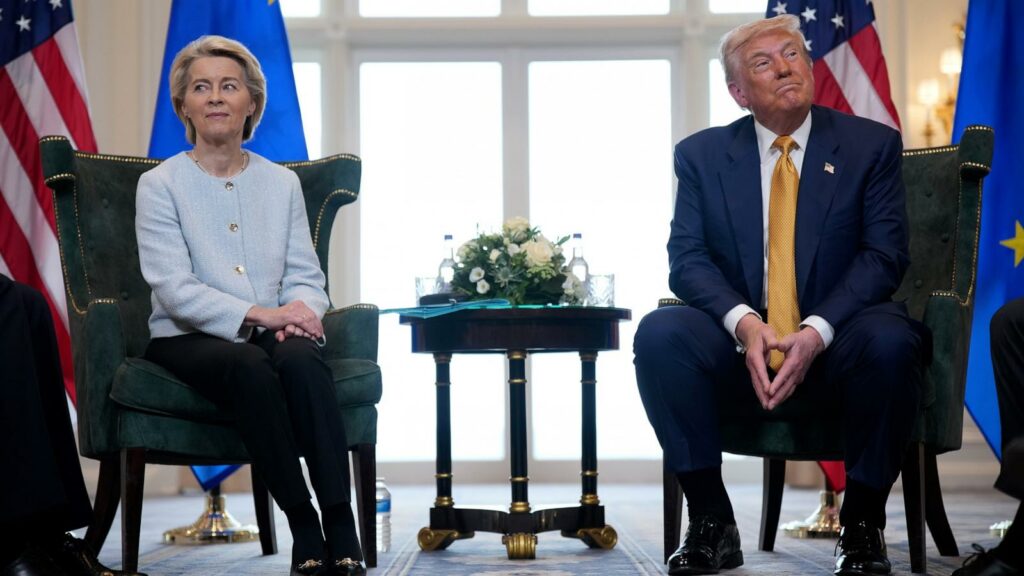
Yet in his current role as secretary-general of NATO, Rutte attracts headlines for a very different reason: his cringeworthy deference to US President Donald Trump, whom he has called “Daddy”.
While that choice of words is questionable, Rutte’s subservience is understandable. Europe is under threat from Vladimir Putin’s Russia and reliant on Trump’s nuclear umbrella for its defence.
Rude awakening
Until recently, the EU thought it was a superpower.
After all, when the 27 member states act together, they can boss around their neighbours: witness how tiny Ireland held the whip hand over the UK in the Brexit negotiations. I
ndeed, such is the size of the EU single market that giant global businesses feel compelled to obey its rules, and other countries to emulate them – in what American academic Anu Bradford calls the “Brussels Effect”. And in the bygone era when the US and China often agreed to be bound by international rules, notably those of the World Trade Organisation, Brussels used to stand up successfully to Washington and Beijing.
But now that global decisions are increasingly dictated by hard-power realities not technocratic rules, the EU suddenly seems like a paper tiger, a Chinese term for an entity that seems formidable but is actually puny.
Ursula von der Leyen, the president of the European Commission, sounded the alarm in her state of the union address in September. “Battlelines for a new world order based on power are being drawn right now,” she declared. “Europe must fight. For its place in a world in which many major powers are either ambivalent or openly hostile to Europe” and “dependencies are ruthlessly weaponised”.
The EU’s frailty was highlighted by its meek acceptance over the summer of Trump’s one-sided trade deal, which involves the EU acquiescing to an additional 15% US tariff on its goods exports while also abolishing its own duties on imports from the US.
Rightly, President von der Leyen has called for a more muscular “new Europe” to emerge. But for now, the EU is bringing a butter knife to a gunfight.
Four flaws
The EU has four big weaknesses that prevent it standing up to superpowers such as the US and China.
It is largely defenceless at a time when Putin has invaded Ukraine and threatens the rest of Europe, and Trump cannot be counted on to protect the continent. Witness how European airports, including Brussels, are increasingly disrupted by drones, almost certainly at Russia’s behest.
It is dangerously dependent on foreign powers more broadly. US tech giants dominate the digital economy. China has a chokehold over critical commodities such as rare-earth minerals that are essential for many industries, from cars to fighter jets. Much of Europe’s energy is sourced abroad (including, shockingly, still from Russia). And the EU relies on open international markets to absorb its trade surpluses.
It is also deeply divided, both among member states and within them. Whereas Trump, Putin and China’s Xi Jinping are strongmen who can do more or less as they please internationally, the EU requires consensus, or close to that, to act.
Its sanctions on Russia can be vetoed by Hungary’s pro-Putin premier. Using frozen Russian assets to fund EU military aid to Ukraine requires the agreement of Belgium, where most of the assets are located.
And political paralysis within countries is just as problematic: just look at France’s inability to agree a budget, and thus to fund a much-needed increase in defence spending in the EU’s only nuclear-armed power.
Worse, the EU is rapidly declining. In 2000 it accounted for 21.6% of the global economy, adjusted for purchasing power, more than the US (20.4%) and dwarfing China (6.6%). But now the EU is down to 14.2%, behind the US (14.8%) and well behind China (19.3%). Economic stagnation erodes the EU’s global clout while making politics more intractable and defence spending harder to fund.
Strategic autonomy?
If Europe is to stand up to foreign bullying, it needs to stick together and stand on its own two feet – what’s known as “strategic autonomy” in EU jargon.
For sure, the EU is not going to become a single state any time soon, let alone – fortunately – one where a strongman holds sway. Treaty reform to streamline decision-making also seems unlikely for now, given the need for ratification, sometimes by referendum, across all of the 27.
So, a more muscular EU will need to develop either among coalitions of the willing, or through difficult compromises that involve strong-arming and paying off recalcitrant governments.
The immediate priority is rearmament. Poland is leading the way, while Germany has lifted its debt brake to unleash defence spending. Finland shows how a smaller country can deter a much bigger neighbour by involving all of society in national defence.
France ought to develop a doctrine for deploying its nuclear weapons in defence of its European partners, who could in turn help pay for them. Much more EU funding is also needed, both for Ukraine and for innovative defence start-ups developing artificial intelligence (AI) and drones.
Europe also needs to enact bold reforms to boost economic growth and geopolitical resilience, such as those recommended in the report by former European Central Bank president Mario Draghi.
In part to reduce its reliance on foreign markets such as the US, the EU needs to complete its single market, notably for services, savings and investment. Instead of exporting capital globally, it needs to deploy more in Europe, not least to fund investment in new technologies.
Accelerating the shift to locally produced clean energy would benefit continental security as well as the climate. Rare earths can be sourced from allies such as Australia.
It’s a tall order. But unless the EU bites the bullet, it will remain a big child in a hostile world of dominant daddies.
