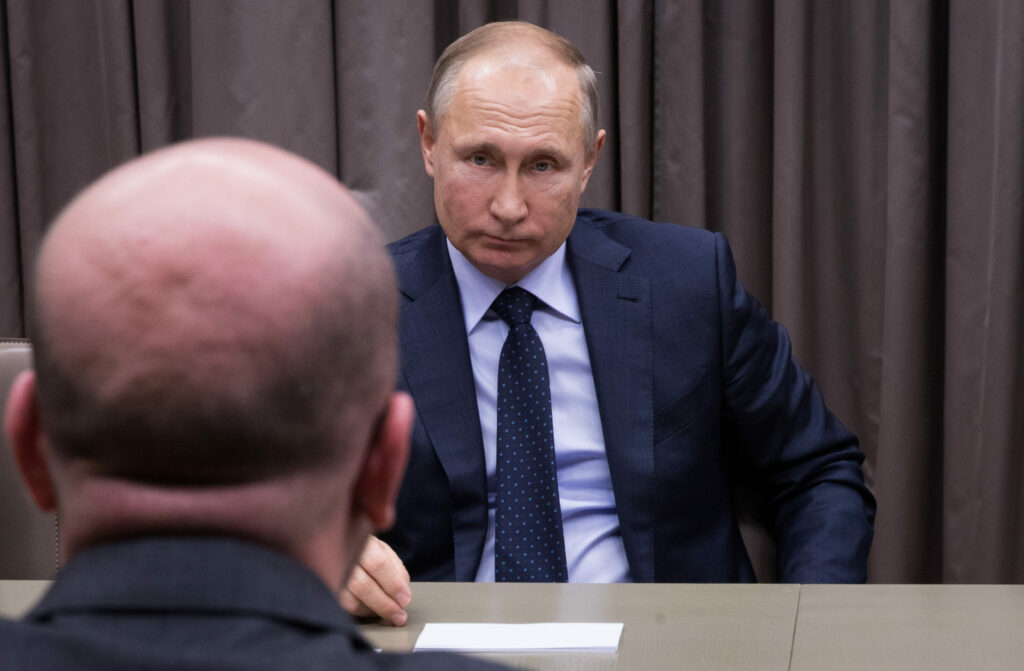
From cyberattacks, like those that recently hit Proximus and UZ Ghent in Belgium, to spreading confusion with drones, it has almost become part of the daily arsenal of Russian threats in Europe. More than ever, the autocrat Putin plays the card of repression, both at home and abroad. In dark times, it is up to Europe to provide light and break this cycle of fear.
In the early days of Putin, there was still hope for a pragmatic new leader for Russia. The state apparatus was modernised, and ordinary Russians benefited from a revived economy. Today, we know better.
At least 1,500 dissidents and opposition members are currently behind bars because of their political beliefs, without mercy. Others died of deprivation in the Siberian tundra, inexplicably fell from a tenth-floor window, or were “helped” along by nerve gas or radioactive substances.
From our Western European perspective, we do not always feel the imminent threat from Russia, nor will T-55 tanks roll down the streets of Brussels tomorrow. There is no immediate prospect of a conventional war in the West, and yet things here are far from peaceful. The invasion of Ukraine radiates outward. More and more.
A Europe that is slowly heating up
Just as a microwave uses radiation to warm our leftovers by creating chaos in the molecules, Putin also sows chaos in the molecules of Europe. And as everyone has experienced, a microwave does not heat evenly. Take a bowl of soup: the edges may be boiling while the centre warms only slowly. Slowly but surely.
This process is similar to the security situation in Europe. At our external borders, the boiling point has clearly already been reached, with an extremely hot conventional war in Ukraine. Inside Europe, things are less aggressive, but there are numerous hybrid threats and attacks.
Sometimes, even bizarre ones, such as when Russia, according to French intelligence services, fanned panic about the bedbug infestation in Paris in order to discourage tourists from attending the Olympic Games. But hybrid warfare usually has far greater impact: the sabotage of utilities in Finland, Sweden, Norway, Poland or Lithuania is not harmless, nor are the poisoning of rivers in Ukraine, arson in German warehouses, or disruptions of French railways. Not to mention the Russian “shadow fleet” drifting off our coasts.
Hybrid warfare in our backyard: Microwave war
The most recent chapter has unfolded in recent weeks, with various drones threatening to paralyse our airports and military bases in Belgium. Not a day seems to pass without some simple off-the-shelf drone attempting to sow panic somewhere.
A Belgian strategy, as will be discussed by the National Security Council, will certainly be useful, but a real response must be coordinated and, above all, European.
Because we are not alone in this. The war in Ukraine is very hot, but further towards Western Europe, temperatures also continue to rise due to hybrid attacks, disinformation, and spillover effects from the front. Putin aims to create chaos and destabilise our societies. Yet for some, this still feels like something far away, making the conflict seem “cold.”
We can no longer speak of a new Cold War, but of a Microwave War: boiling at the outer edges while the inside still feels cool, though it is slowly heating up. Europe must not wait until it gets cooked along with the Russian destabilisation.
Interestingly, the microwave, like the internet, originates from a military innovation. When developing Patriot missiles, a candy bar in the pocket of Raytheon engineer Percy Spencer melted during tests to create a radar system based on microwaves for the defence of London in World War II.
Turning destabilising radiation into light
Both economically and militarily, we must take more steps toward a strong position for Ukraine, and for ourselves. Reining in the Russian shadow fleet, acting proactively against sabotage attempts in the Baltic Sea, building a robust defence against Russian cyberattacks, providing additional weapons to Ukrainian troops… These are all essential elements in responding to Putin.
The upcoming European Drone Defence Initiative is a first step toward a joint defence, but more will be needed. Without a unified and forceful response, Putin will continue to play divide-and-rule across our continent.
Europe must take the lead and forge alliances so that, from a position of strength, we can end this Russian interference and aggression as quickly as possible. Only then can we turn the destabilising radiation from Russia into rays of light and hope. Because, as Cohen said: “There is a crack in everything, that's how the light gets in.”
