
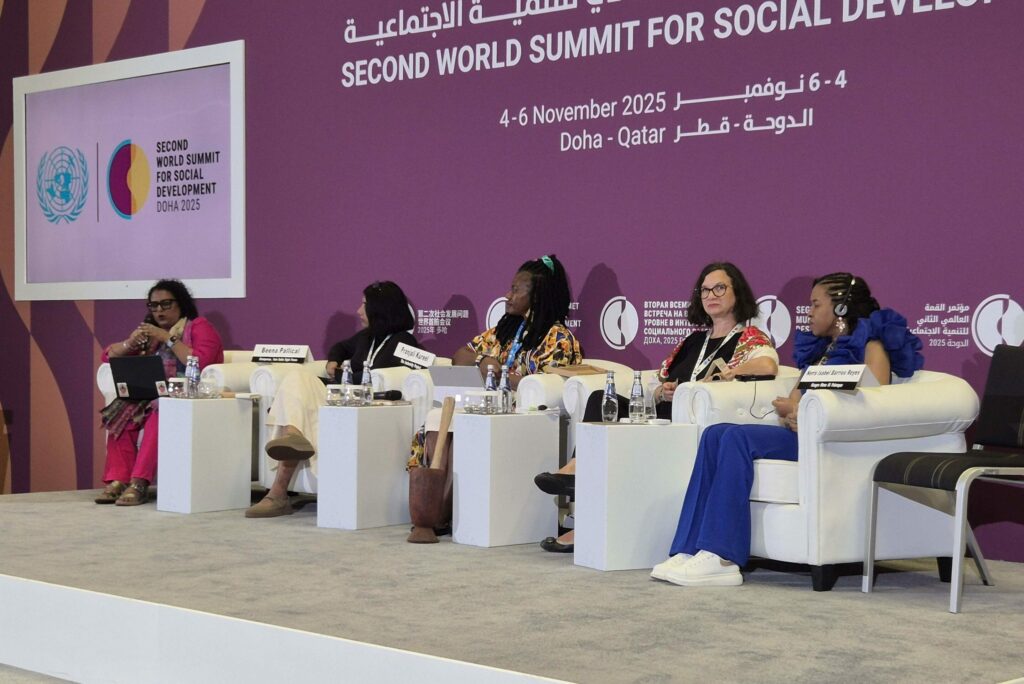
When I walked into the conference halls of the Second World Summit for Social Development in Doha last week, I knew that our presence there would spark questions.
The venue remains a controversial choice—and rightly so. But I also knew something else: if Roma voices are to shape global decisions that affect our communities, we must be in the rooms where those decisions are made.
That week in Doha, the rooms were filled with representatives from governments, UN agencies, and civil society leaders from every region of the world.
For too long, Roma have been spoken about, studied, and debated—but rarely included in global conversations about poverty, equality, and social justice. This time, we were not observers. We were contributors.
Why we showed up
For nearly two decades, ERGO Network has pushed for Roma inclusion not as charity, but as justice; not as a niche topic, but as a European priority. Our work has shown how deeply anti-Roma racism—antigypsyism—shapes the daily lives of Europe’s largest ethnic minority.
But in recent years, we realised something important. Roma communities are not alone in facing inherited, structural, generational exclusion. Across the world, there are more than 270 million people whose social position is determined not by their ability or aspirations, but by their descent.
This is why ERGO Network co-founded the Global Forum of Communities Discriminated on Work and Descent (GFoD) — a coalition linking Roma with Dalits in Asia, Quilombolas in Brazil, Burakumin in Japan, Haratin in North Africa and many other groups across the world. We are connected by a shared history of being pushed to society’s margins simply because of who we are.
What it means to be discriminated
Most Europeans are familiar with the concept of racism, but fewer recognise descent-based discrimination. It is a form of systemic exclusion that ties people to certain occupations, neighbourhoods, social roles, and limits their opportunities for generations.
In Europe, this often plays out in the segregation of Roma children in “special schools”, in the underfunded settlements cut off from services, and in the entrenched barriers to decent work. Elsewhere, it may take the form of caste systems, bonded labour, or near invisibility in public institutions.
Different histories, different cultures—yet the same pattern: when birth determines destiny, injustice becomes structural.
Roma rights are global rights
In European policy debates, the Roma story is often boxed in as a local issue—a question of domestic inclusion strategies or anti-discrimination laws. But these national frameworks, however important, do not account for the global patterns of exclusion we share with others. The struggle of Roma communities is part of a much broader fight against deeply rooted systems of inherited inequality.
Standing in Doha among Dalit activists from South Asia, Haratin advocates from Mauritania, and Afro-descendant community leaders from Latin America, I felt a profound sense of recognition: we are separate, but not alone.
And this global perspective matters for another reason: Roma communities are not only a European reality. They live in Brazil, Colombia, North America and across Latin America - often invisible within national statistics and absent from policy debates. The Global Forum allows us to connect with Roma overseas, exchange experiences, and recognise that our struggle for dignity and equality is shared across continents.
Why Doha mattered
Attending an event in Qatar is not a decision we take lightly. The country’s human rights issues cannot be ignored. But absence helps no one. Global processes do not wait for perfect conditions, and silence has never served our communities.
In Doha, our delegation participated in high-level panels on structural inequality, co-organised a major event with UN Women, and showcased Roma art and culture—from Sead Kazanxhiu’s installations to the moving film “Missed Lives–The Dom People”.
But what mattered most was not the panels or the photo opportunities. It was the conversations. The connections. The sense that Roma civil society belongs in global social justice spaces—not as guests, but as partners.
Visibility is not enough
The Summit took place against a backdrop of multiple crises—conflict, climate instability, rising extremism, and shrinking civic space. These crises hit our communities first and hardest. Yet the people most affected continue to be those with the least access to global decision-making.
A phrase I heard several times in Doha has stayed with me: “You cannot build a social contract on empty pockets.” And it is true. Grassroots organisations—whether Roma, Dalit, or Haratin—cannot meaningfully participate without sustained funding, political will, and institutional support.
If the world wants to “leave no one behind”, then it must invest in the people who have been left behind the longest.
Our call to the international community
Roma civil society, through ERGO Network and GFoD, is asking for concrete action:
- A UN resolution on work- and descent-based discrimination, including a dedicated mechanism focusing on women and girls.
- Formal representation of affected communities—including Roma—in all global social development processes.
- Translation of global pledges into national policies, especially those affecting Roma inclusion and combating poverty.
- Transparent funding to ensure that participation is not symbolic but meaningful.
- Stronger cross-regional cooperation, because our struggle is shared.
Because only when these commitments are put into practice will we finally be able to live as ourselves without fear.
