
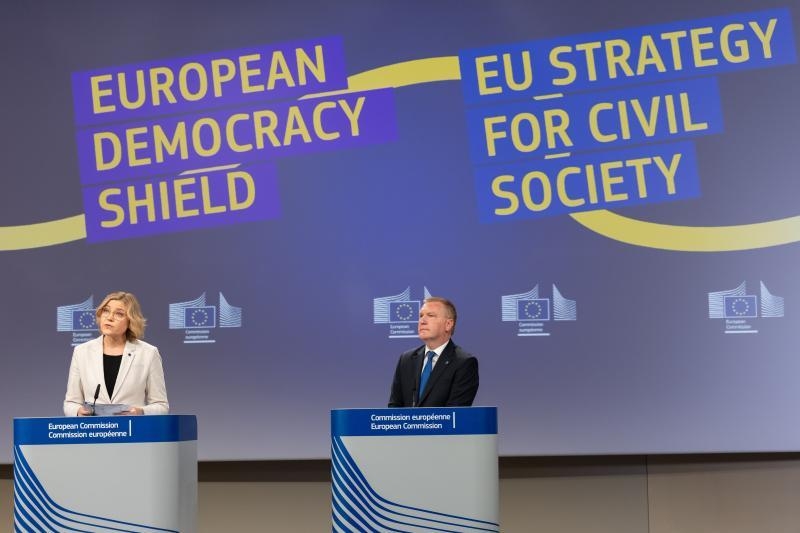
The European Commission presented last week the ‘European Democracy Shield’, a series of measures to empower, protect, and promote strong and resilient democracies, and a EU strategy for civil society.
According to the Communication, the foundations of democracy reside in free people, free and fair elections, free media and strong democratic institutions and processes. More than a system of governance, democracy is a way of life. It guarantees citizens’ rights and freedoms, safeguards equality before the law, and ensures that those in power can be held accountable.
Opinion polls show that EU citizens see democracy, human rights and the rule of law as the EU’s main strength. However, in an age of growing geopolitical confrontation, international and regional conflicts, as well as technological disruption, democracies in both the EU and beyond are under internal and external pressures, both internally and by interference by other countries such as Russia.
Some have been targets of intense destabilisation and interference attempts. No countries under pressure are mentioned but democracy in EU countries as Hungary, candidate countries as Turkey, and third countries as the US and Israel is threatened. Supporting EU candidate countries and potential candidates to consolidate democracy before and after accession is especially important.
Moldova, a candidate country and one of the frontrunners in the recent enlargement package, is highlighted as a good example. Its parliamentary elections last September saw intense Russian hybrid threats including cyber-attacks, fake bomb alerts, and foreign information manipulation and interference (FIMI). However, with EU support, Moldova reinforced its resilience and tackled FIMI.
“The Democracy Package will serve as our roadmap to confront the evolving challenges our democracies face, and to support all those who uphold them,” said Michael McGrath, Commissioner for Democracy, Justice, the Rule of Law and Consumer Protection, when presenting the proposal at press conference (12 November).
“Ultimately, democracy is only as strong as the people who believe in it. We must continue working together to protect and promote it for generations to come.”
“Citizens are the heartbeat of our democracies,” said Executive Vice-President Henna Virkkunen, referring to the role of civil society. “Our proposals are about more than defence — they are about empowerment. We want every citizen, every association, every voice to know that Europe stands with them. A confident, open, and resilient democracy is the best answer to those who seek to divide or weaken us.”
Measures under three pillars
The European Democracy Shield includes actions across three main pillars: safeguarding the integrity of the information space; strengthening institutions, fair and free elections, and free and independent media; and boosting societal resilience and citizens' engagement.
Under the first pillar, the Commission will further work under the Code of Conduct on Disinformation and prepare a Digital Services Act incidents and crisis protocol to facilitate coordination among relevant authorities and ensure swift reactions to large-scale and potentially transnational information operations.
An independent European Network of Fact-Checkers will be set up to boost fact-checking capacity in all EU official languages. The European Digital Media Observatory will develop new independent monitoring and analytical capabilities for situational awareness on elections or in situations of crises.
Under the second pillar, the Commission will reinforce the work under the European Cooperation Network on Elections and organize systematic exchanges on key topics for the integrity of electoral processes. The Commission will also present a guidance on the responsible use of AI in electoral processes and update the Digital Services Act Elections toolkit.
To help address growing violence against political candidates and elected representatives, the Commission will also present a Recommendation and a guide of best practices in the Member States on the safety of political actors.
The Communication underlines that transparency and accountability of funding in politics, including campaign financing, are key to prevent interference and critical to ensure a level playing field among political parties and candidates. The EU has its own legal framework for the funding of political parties at European level but funding rules are not harmonised within the EU acquis.
The Commission says that it will look at issues of common interest such as anonymous donations and cryptocurrency, which can be used to fund activities in ways that are not transparent and difficult to detect.
Media freedom and freedom of expression are key elements for democracy. The Commission will among others reinforce financial support for independent and local journalism under the new Media Resilience Programme. It will also update a recommendation on the safety of journalists.
The third pillar is about boosting societal resilience and citizens' engagement. The Commission will roll out measures to foster media and digital literacy for all ages and develop an EU citizenship competence framework along with guidelines to strengthen citizenship education in schools.
A crucial element is the proposal for a European Centre for Democratic Resilience to better support cooperation and coordination in addressing different aspects under the pillars. The Centre, described by a senior Commission official as a ‘flagship institution’, will bring together existing expertise (possibly also the EU East Stratcom Task Force) under one roof but the details have not yet been worked out.
It will be open to Member States while the candidate countries, that might need it the most, will be invited on a voluntary basis. Asked about the participation of the candidate countries, an official replied that those who want to join the Centre will benefit from it in their gradual integration process. Four candidate countries are already associated with the Rule of Law reports.
Democratic backsliding is a risk both before and after accession of new Member States. “We know that the closer candidate countries get to accession, the more intensive is the threat of foreign interference they’ll face,” said Commissioner McGrath.
Support to civil society
With the EU Strategy for Civil Society, the Commission intends stepping up its engagement with civil society and support to civil society organisations. A new Civil Society Platform will be established by 2026 to further facilitate dialogue on the protection and promotion of EU values. More funding will also be available to civil society organisations.
At EU level, the Commission will use several tools to involve EU citizens in its policymaking, from the European Citizens’ Initiatives to the European Citizens’ Panels. The latter tool was established during the Conference on the Future of Europe and has been used since then. The Commission also encourages Member States to use similar tools on national level.
When preparing the proposal on the ‘European Democracy Shield’, the Commission launched a public consultation, one of its routine measures to consult the public on new proposals. The consultation took place during April – May 2025 and was based on a questionnaire. It was published together with a Call for Evidence.
Consultations aim to gather to gather views, information and analysis from a broad range of stakeholders, including individual citizens, civil society organisations, the private sector and national authorities. The sample is non-random and not necessarily representative. According to the summary report, close to 4,000 responses were received to the questionnaire, the vast majority from individual citizens (93 %).
A majority of those who filled in the questionnaire agreed when asked to rate the importance of different measures to support citizens’ participation and engagement. While the replies were received from all the 27 Member States, some countries dominated. The most represented countries were Germany (50% of the respondents), France (16%), Italy (6%), Spain (6%), and Belgium (5%).
The call for evidence solicited ca 400 responses but were not summarized and it does not emerge from the report what impact they might have had on the proposal.
