

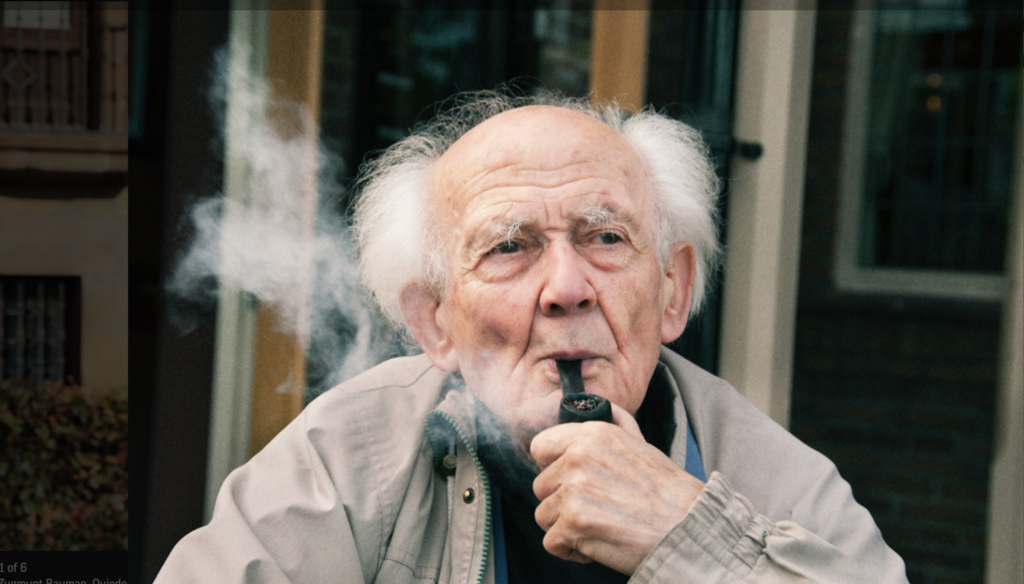
This year marks the 100th birth anniversary of Zygmunt Bauman (1925 – 2017), the Polish-British sociologist who conceptualised the theory of liquid modernity. It refers to a social condition where previously solid structures—such as careers, institutions, and relationships—have become increasingly temporary and fragile.
Bauman put it best himself in his 2000 book Liquid Modernity, where he wrote: "What was some time ago dubbed (erroneously) 'post-modernity'—and what I have chosen to call, more accurately, 'liquid modernity'—is the growing conviction that change is the only permanence, and uncertainty the only certainty."
Unlike the 'solid' era, contemporary public discourses are often merely a flash in the pan, rapidly replaced by the next novelty. This shift from tangible, lasting foundations to fluid, shifting sands suggests that the fixity of social forms is continually undermined.
This transition thus defines our current socio-existential experience, compelling us to interrogate whether any substance remains when social forms are increasingly designed to dissolve. Bauman remains relevant because he provided a precise language to articulate the sense of unease and impermanence felt by millions.
Bauman mapped the corresponding metamorphosis in the human condition, conceptualising the shift from the structured, predictable world of 'solid modernity' to our present 'liquid' state. His work, beginning with the Liquid series (which explores love, fear, life, and culture), offers a unifying framework for understanding seemingly disconnected social phenomena.
The fundamental condition of liquefying modernity is that the only certainty is change; uncertainty constitutes the new norm, instability and insecurity the prevailing order. Identity is thus reframed as a matter of choice, which itself relies upon improvisational ability and access to the requisite resources for its sustainment. Consequently, identity becomes the primary arena for social struggle, in which entrepreneurial subjects strive to propel themselves from local identities towards cosmopolitan identities, establishing new aspirational norms for others to emulate or exceed.
Bauman's work offers profound insights into the shift from identities formed by production to identities, life, and society shaped primarily by consumption, to impress anonymous others. Bauman's analysis is crucial, for it precisely frames the evolution of social existence from the stable, hierarchical "solid" phase, through the loosening, "liquid" phase, and into the increasingly ephemeral "digital," or "super-liquid," age driven by ubiquitous connectivity and data.
The illusion of digital community
The transition from 'solid' stability to 'liquid' flux effectively dismantled collective support systems, transferring the entire burden of identity formation and security onto the individual. The liquid self is an identity decisively shaped by consumption and by the constant gaze of others. Unlike the 'solid self' of industrial society, which was fundamentally embedded in fixed class relations, the liquid self is fluid, dynamic, and critically dependent upon a sense of belonging to specific, yet often transient, identity categories.
The subsequent shift into the digital environment introduces a phase of super-liquidity, where the promise of infinite connection masks a profound sociological problematic: the degradation of meaningful bonds. The central Baumanian diagnosis concerning digital connection is captured in his own words: "The question of identity has changed from being something you are born with to a task: you have to create your own community... but what the social networks can create is a substitute."
The digital realm organises individuals into mere swarms: temporary associations drawn together by fleeting viral objects that instantly disperse when the prevailing trend shifts. Since these connections are frictionless—formed or eliminated with a simple click—the self remains perpetually unsecured, defined solely by the ease of its exit strategy.
The absence of a fixed social identity in this "super-liquid" state engenders a continuous, anxious dependence on external validation. Because liquid modernity has dissolved the traditional sources of identity, the individual's sense of self is no longer internally secured or fixed. Instead, identity becomes a project—a hypothesis that must be constantly tested and approved by others. If society no longer provides the mould, the individual requires daily confirmation from others to affirm existence and relevance.
With the dissolution of fixed identity, the only avenue to perceived authenticity is performance. The digital space serves as the stage for this perpetual charade. The self must continually exhibit that it is active, popular, informed, and achieving. Visibility equates to validity. To cease posting is, in essence, to cease existing within the liquid realm. This renders the digital sphere a place where "vigilance is voluntary and self-inflicted." The individual is compelled to constantly police their public stream of content to ensure it conforms to the fleeting standards of their tailored network.
The seductive face of power
Historically, totalitarian regimes utilised physical surveillance (police, spies) to enforce conformity, representing an external, coercive power. In the digital age, conversely, power operates through seduction and ease. Individuals volunteer to be watched (by logging in and agreeing to the terms of service) and engage in self-policing (self-inflicted vigilance) because the reward (affirmation/visibility) is so addictive, and the penalty (exclusion/silence) is so terrifying to the liquid self.
Individuals meticulously edit their lives to fit the network's shifting rules, fearing being cast out of their self-made "echo chamber." This constitutes a highly efficient form of social control because the individual manages their own conformity voluntarily, rather than through coercion.
The online world is not a separate reality; it functions as a continuation and reflection of the offline one. Online identities and cultures are never wholly separate but intrinsically linked to physical societies. Therefore, the digital realm does not provide a 'blank slate' for radical self-reinvention. Instead, this virtual space is immediately permeated by the existing offline ideals, realities, and discourses.
These are the deep-seated social structures—like learned prejudices, cultural norms, power hierarchies, and consumerist values—that people internalise throughout their lives. Individuals inevitably carry their social baggage into the digital realm: the anxieties, aspirations, and limitations imposed by one's real-world environment are transported online, fundamentally shaping how identity is performed and received in the digital age.
The problematic, therefore, manifests as an existential crisis of meaning: Digital life hyper-accelerates the liquid tendency, replacing the arduous, meaningful work of building resilient communities with the instant, frictionless affirmation of a bespoke echo chamber, thereby ensuring the individual remains chronically exposed to the exhausting uncertainty of the ceaseless digital flow.
Transcending the digital identity
Bauman's critique of the transition from solid to liquid is fundamentally a moral and existential challenge, rather than a political one. He provided a precise diagnosis—chronic instability, personalised anxiety, and the erosion of dialogue—but offered no facile prescription for re-establishing the old, solid walls. The central conclusion of his theory is that the institutional failure to guarantee security has subsequently transferred the entire burden of meaning entirely onto the individual.
To transcend the anxiety of the swarm, a philosophical shift must be embraced. The liquid individual must commit to the ethical act of "becoming"—the continuous, deliberate striving towards self-improvement and moral engagement.
Moreover, a path must be found to counter the digital tendency to fracture society into easily managed swarms by rejecting divisive identity politics. The practice of viewing people primarily through the lens of group categorisation encourages conflict and undermines genuine human connection.
The solution to the digital echo chamber, therefore, is not simply to avoid the digital world, but to choose the more demanding path: cooperation and dialogue with those who are different. By prioritising shared character over fleeting collective affiliation, one begins to build genuine social resilience, demonstrating that substance is not found in temporary validation but in the enduring value of human connection.
Ultimately, the digital age promises a frictionless existence—rapid connections, facile validation, and filtered information—yet genuine substance is forged in friction. This constitutes the final challenge. To combat the existential crisis of constant performance and self-inflicted vigilance, the liquid individual must embrace the difficulty of the non-disposable—that is, committing to those durable moral obligations and communal projects that resist the liquid imperative of swift discard.
In this super-liquid reality, which constantly tries to render all beliefs temporary and light, our freedom rests in the autonomous power to make enduring ethical commitments and perform conscious actions that assert lasting moral value.
