
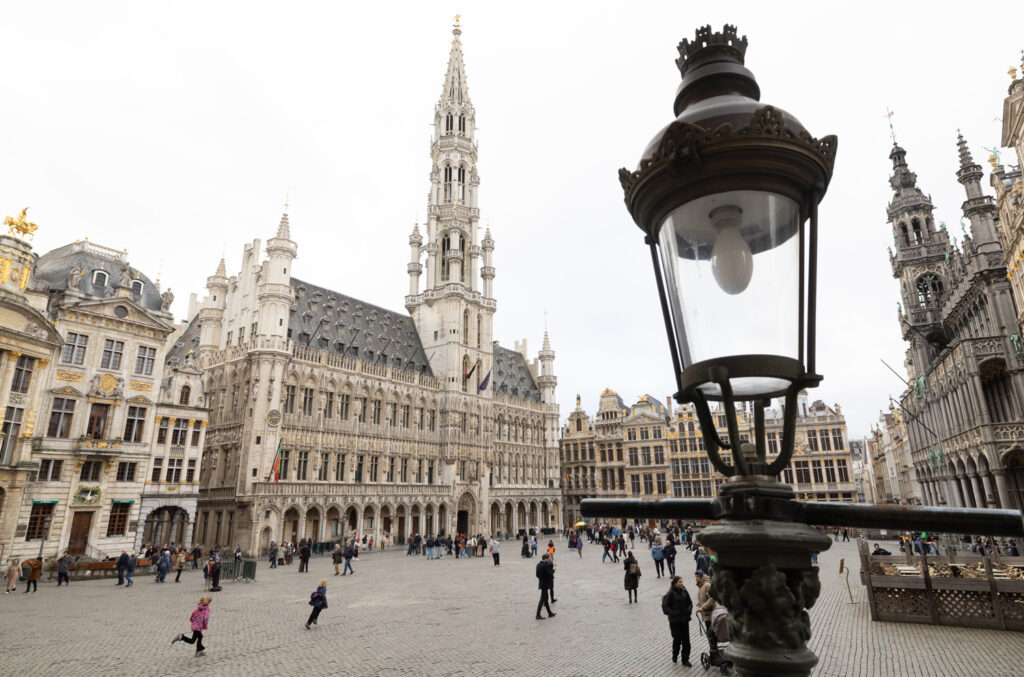
Belgium has made it into the top ten countries for high English proficiency globally, according to Education First's latest index. But despite making progress, one of the country's regions continues to let the side down.
Flemish people have the best command of English in the world as non-native speakers, the most recent English Proficiency Index from Education First shows. The region gained this year's top score of 654 – higher than the Netherlands' 624, which was ranked the best in the world.
Walloons, however, fall considerably lower than their Flemish neighbours, coming in at 32nd. This resulted in Belgium slipping to ninth place in the country rankings with a score of 608 – up from 13th place last year (592).
Following the Netherlands, Croatia is in second place (617), followed by Austria (616). Germany, Norway, Portugal, Denmark, Sweden, Belgium, Slovakia, Romania, Finland, South Africa, Zimbabwe, and Poland rounded off the top 15 countries with "very high proficiency". At the other end of the scale were Cambodia, Côte d'Ivoire and Libya with the lowest levels of non-native English in the world.
Where is the best English spoken in Belgium?
Within Belgium, the provinces of West Flanders, Antwerp and East Flanders score the best, while Luxembourg, Namur and Walloon Brabant score the worst. The Brussels-Capital Region, meanwhile, ranks 26th among capitals cities worldwide.
In terms of Belgian cities, Leuven came first with 674, Ghent was in second place with 672, and Antwerp completed the podium with 646. Brussels (588) only came in fifth place after Hasselt (611).
Interestingly, Belgian young people between 18 and 20 score the lowest of the different age groups. Those in their 20s and 30s perform best.
Credit: Belga / Siska Gremmelprez
Education First, which offers education worldwide through cultural exchanges, was not surprised by Flanders' high score and the fact that Wallonia is lagging behind.
"Walloon culture has historically been more focused on France, just think of English films being dubbed into French. There is also less focus on English in education and working life," a spokesperson told Belga News Agency.
"In Flanders, children grow up with English-language series and films, laying the foundation for a better knowledge of the language later in life. However, we are also seeing an increase in the focus on English in Wallonia, both in education and in the business world."
Is Dutch under threat in Flanders?
With such an emphasis on the advantages of learning English as a foreign language, however, the Flemish Government has expressed concerns that the region is moving too far away from its native language and has scrambled to ensure that Dutch continues to take pride of place. Most recently, the regional government refused to endorse a series of Bachelor's and Master's degrees taught in a foreign language at higher education institutions.
However, Wim Vandenbussche, professor of Dutch language and literature and expert in multilingualism at the VUB, confirmed to La Libre that Dutch is not about to disappear.
"Even though the number of PhD theses written in English at Flemish universities is increasing – which is a good thing – multilingualism is not undermining Dutch. Dutch will remain the official language of instruction at most of our universities," Vandenbussche said, pointing out that Flanders is not Holland, where higher education has become largely anglicised. In Flanders, 91% of Bachelor's degree programmes and at least 65% of Master's degree programmes are taught in Dutch.
Even if it faces challenges from English, particularly in the scientific and academic fields, Vandenbussche underscored that Dutch has its place in Belgium and in the world. According to him, opposing English in the academic sphere makes no sense because it would be going against the tide.
"On the other hand, we must continue to invest in learning the Dutch language and not reduce the subsidies to CVOs (adult education centres in Flanders). The aim of these courses is to help those who wish to improve their language skills (particularly in Dutch) in Brussels and towns in Flanders, where the linguistic challenges are immense due to cultural diversity."
Related News
- Belgium drops out of top ten countries for best non-native English speakers
- Embrace 'bad English' as the European 'lingua franca,' says Timmermans
- Will English ever become an official language in Brussels – and should it?
- Where can you learn French and Dutch as an adult in Brussels?
The EPI ranking is based on data from 2.2 million adults who took an EF test online, including 6,895 Belgians. The average age of participants was 26 years old. This year, in addition to listening and reading comprehension, active knowledge (speaking and writing) of English was also assessed for the first time. The latter is slightly more difficult for Belgians than listening and reading.
There is no maximum score and the categories are as follows: 600 and above (Very high); 599-550 (High); 549-500 (Moderate); 499-450 (Low); below 450 (Very low).
