
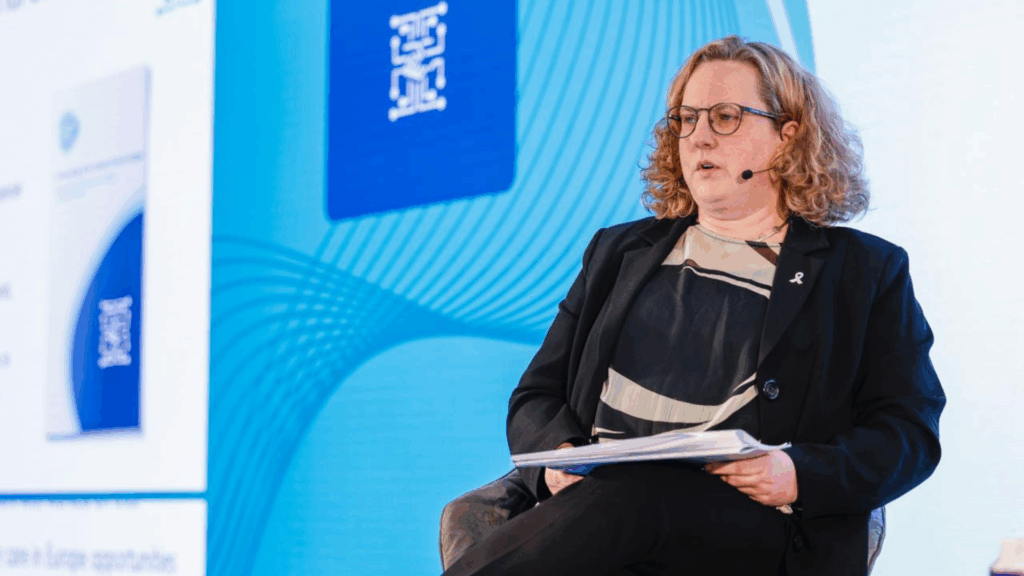
Although the artificial intelligence (AI) boom has the potential to support cancer care in Belgium, in reality, the technology is still far from fulfilling all its promises, according to radiology expert Annemiek Snoeckx.
Belgium is currently implementing the European Union's AI Act into national legislation as the Ministry of Health finalises its AI strategy within healthcare.
But while legislation is in the works, AI is already used regularly in cancer care as a tool for diagnosis, in clinical trials, or even in medical reports.
The topic is nothing new for Snoeckx, who, in addition to being the head of radiology at the Antwerp University Hospital, is also Co-Chair of the European Cancer Organisation's Digital Health Network.
Speaking to The Brussels Times, Snoeckx said she has seen AI evolve rapidly in her field, particularly with AI algorithms that improve the quality of CT scan images.
As a self-proclaimed “optimistic realist”, Snoeckx says a lot of things excite her about the promise of AI.
However, as it stands, she sees several challenges that need to be addressed regarding technology, education, and legal frameworks.
“AI is, in my opinion, overhyped,” she said. “The potential is huge, the promise is there, but there's still a lot of work to be done.”
Fragmented approaches
In Belgium, the types of AI algorithms used in healthcare are largely left up to individual hospitals and medical departments. “I don't believe that is the way forward,” said Snoeckx.
For the radiology expert, the country would benefit from a clear nationwide view on the use of AI and which AI algorithms would be most beneficial to invest in. “It's not because [an algorithm] exists that we should use it or that we need it,” she added.

Illustrative image of a person receiving chemotherapy. Credit: Belga/Dirk Waem
Nonetheless, she acknowledges that an economic framework needs to first be defined before Belgium can effectively invest, integrate, and develop the use of AI.
“It's not that you buy an algorithm, payment is done, and now it works. So you need to consider the technical integration in your systems, the practical implementation in your workflow, the costs, and whether it always serves the needs?”
However, Snoeckx believes the health benefits will ultimately outweigh the bureaucratic and technical hassle.
She further notes the potential for economic benefits if, for example, AI can help doctors recognise which treatments are not working at an earlier stage than usual.
Trust in humans and education
While Snoeckx has heard theories that “AI will replace radiologists” one day, she is not fazed by this prospect, as AI is developing simply as a tool which will always need expert human oversight.
However, she believes more needs to be done to understand what patients actually think about AI and educate them on how AI and medical professionals work together.
“I think we still live in a world where trust in humans is still being valued. I think education will be extremely important,” she said.
Nonetheless, for AI to be integrated properly, there also needs to be an investment in educating doctors on AI. "For a general clinician to use something, there needs to be something in it for them or their patients. It needs to be clear,” she said.

Illustrative image of a nurse walking. Credit: Belga
At the University of Antwerp, where Snoeckx is an associate professor, AI is addressed within the faculty of medicine and health sciences. However, Snoeckx says it is not yet a defined topic within the curriculum like anatomy or physiology.
“It's a growing field, it's difficult, it's complex…but there is more and more attention to artificial intelligence in [medical] education. There's more and more interest,” she said.
As technology develops, Snoeckx underscores that education on AI cannot fall behind not only in Belgium but also the rest of the EU, otherwise there is a risk of increasing inequalities regarding access to treatments and care.
“I think with anything that is going really fast, the likelihood of having people falling behind is just increasing. So Europe absolutely needs to invest in that,” she said.
‘We will not survive without AI’
With the growth of AI in the medical field, Snoeckx says liability is an aspect that needs to be addressed.
“Now with all these algorithms, it's the medical doctor who signs off, and what will happen in the future? I have no idea,” she said, adding that the liability for the use of AI "will probably never” be the responsibility of the software companies, due to the costs of insurance.
While Snoeckx can easily point out the challenges to using AI, she is still a believer in what the developing technology can bring to Belgian hospitals. "It's not because I'm critical that I don't think the potential is huge,” she emphasised.
As Belgium continues to work on its AI strategy, she sees AI as an indispensable tool for the future of the country's healthcare.
While she doesn't see the tool being used to fix major issues like the healthcare workforce crisis, she sees potential in its ability to increase efficiency.
"Cancer patients live longer, and cancer is becoming a chronic disease, which is great, but that also means there is a huge pressure on the healthcare force,” she said. “We will not survive without AI to be a partner on a number of things.”
Related News
- ‘I was told it was flu’: Late sepsis diagnosis puts lives at risk
- Belgian startup uses AI to identify sepsis in premature babies
- Belgian doctor guilty over patient's fatal drug mix-up
- Is the EU at risk of banning hand sanitisers?
- 'I’m not a survivor, I’m alive': Living through and beyond breast cancer in Belgium
