
East-West rivalries are today at their most visible across the EU and its neighbourhood. Recent elections in Romania, Georgia and Moldova show that Russia and its proxies spare no expense to influence voters, manipulate elections, and sway foreign policy orientations.
In most cases, they are unsuccessful. With strong, visible backing from its institutions and leaders, the EU has responded decisively, supporting pro-Western actors and countering Russian disinformation.
The results, though impressive, come with major caveats. While Romania and Moldova elected pro-EU leaders, Georgia’s EU aspirations have stalled. It also remains unclear whether new governments can bridge domestic divides, or if future elections will devolve into vicious EU–Russia competition.
For the EU, navigating these challenges may, at times, require a ‘less is more’ approach. In the cases of Hungary and Serbia, specifically, a proactive approach can backfire.
Overt support for democracy movements and EU politicians may create the illusion that they are ‘Western puppets’ — precisely the image that illiberal leaders seek to create when labelling pro-Western opponents ‘foreign agents’. Laying low, working behind closed doors, and taking a more reactive stance can mitigate these challenges.
State capture
Since the 2010s, Hungary’s Viktor Orbán and Serbia’s Aleksandar Vučić, have progressively consolidated state capture. Once a post-socialist success story, Hungary is now among the poorest EU members. Serbia, with its legacy of armed conflict and bumpy democratic transition, ranks lowest among the Western Balkans’ EU candidate countries in democratic performance.
As reported in the 2025 Enlargement Package, Serbia is one of six candidate countries lagging behind in the accession process.
Both countries share an ideology based on a vision of a ‘declining western civilization’, pro-Russian and anti-EU stances, and an elusive rhetoric of protecting sovereignty ‘at any cost’.
Yet, both regimes are facing their gravest domestic challenge yet: the rise of strong, credible opponents and movements. The roots of discontent, too, are similar: economic stagnation, soaring inflation, and corruption.
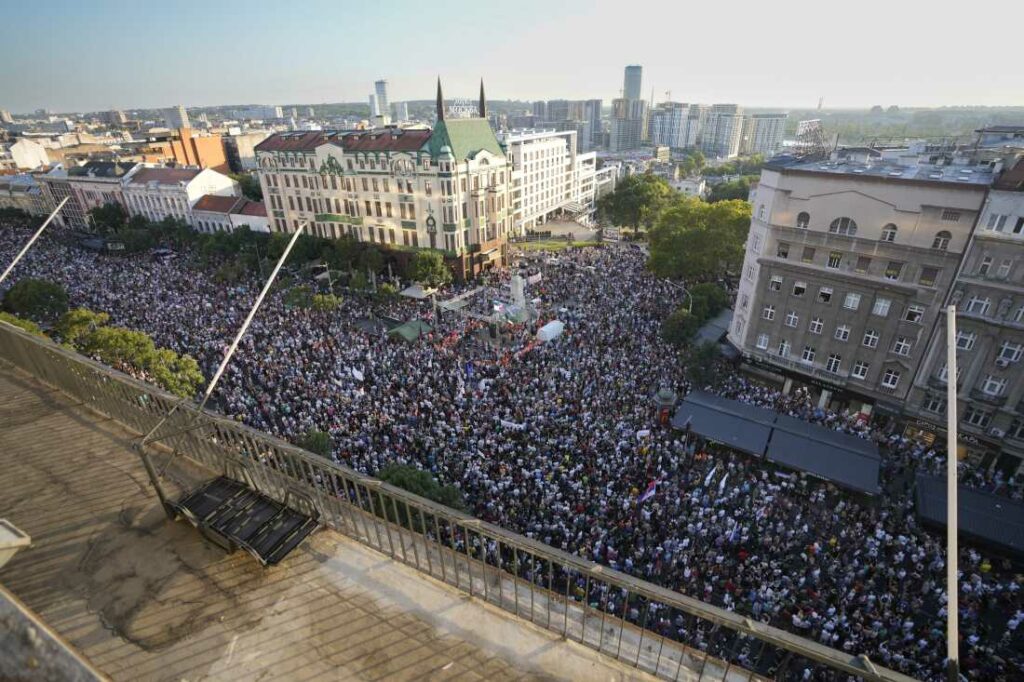
Scandals served as catalysts: in Hungary, a presidential pardon in a paedophilia case spurred the creation of a new party led by former insider Péter Magyar; in Serbia, the Novi Sad canopy collapse triggered mass anti-government protests. For the first time in nearly a decade, both regimes face potentially terminal challenges.
Russia’s disinformation
International players are watching closely. Russia, of course, is doing more than monitoring the situation, as the EU puts it. Moscow is actively funding political parties and experts in both countries while spreading disinformation about Orban and Vučić’s opponents through state media and the Serbian Orthodox Church.
Strikingly, Kremlin-run institutions have published near-identical analyses of politics in Budapest and Belgrade, accusing the EU of seeking to overthrow incumbents and install ‘puppet cabinets’ loyal to ‘liberal European elites’. They decry independent media, Serbian protesters, and Hungary’s Péter Magyar as pawns in a plot to ignite ‘Maidan-like’ ‘colour revolutions’ across Europe’s neighbourhood.
These talking points follow Russia’s disinformation playbook. Ordinarily, they would have little impact, but in Hungary and Serbia, pro-government media amplify them as scripture.
The extent to which Russian disinformation is cutting through may be unclear, but it is happening. In Hungary’s polarized society, pro-Russian narratives amplified by Orbán are reinforcing the views of his base.
Serbia’s case is more complex. Deep historical and cultural ties make it fertile ground for Kremlin influence, often reinforcing Vučić’s rule. Yet student-led protests now unite Serbs across divides, even those sympathetic to Russia. Moscow has little room to lure disillusioned citizens back into Vučić’s camp, as things stand.
Cautious response
The EU, rightly, must remain vigilant and proactive against Russian meddling, but Hungary and Serbia may test this principle.
In Hungary, where Orbán has made hostility to Brussels a central campaign theme, any visible EU support risks playing directly into his hands. His propaganda machine already brands Magyar a “lapdog” of EU leaders; public endorsements would only reinforce that image.
In Serbia, protests are not about choosing between Russia and the EU but about fighting corruption and authoritarianism. Heavy-handed EU interventions only bolster Vučić’s narrative that protesters are Brussels-backed “foreign agents”. The movement’s strength lies in their broad, cross-cutting appeal; branding them ‘pro-EU’ could alienate parts of their base.
To its credit, the EU has acted cautiously so far. But with Hungarian elections approaching and Serbian authorities turning violent against protestors, it should be mindful that overzealous proactivism could do more harm than good.
Instead of being overly proactive, keeping politics “behind closed doors” and focusing on people-to-people relations, such as showcasing the benefits of EU membership, is a potential way for the EU to win back the hearts and minds of citizens.
The EU will not be able to persuade these regimes, especially the Hungarian one, to change course, but maintaining a pro-EU society is a battlefield on which the EU can still hold its ground. The rest is up to citizens at the elections.
