
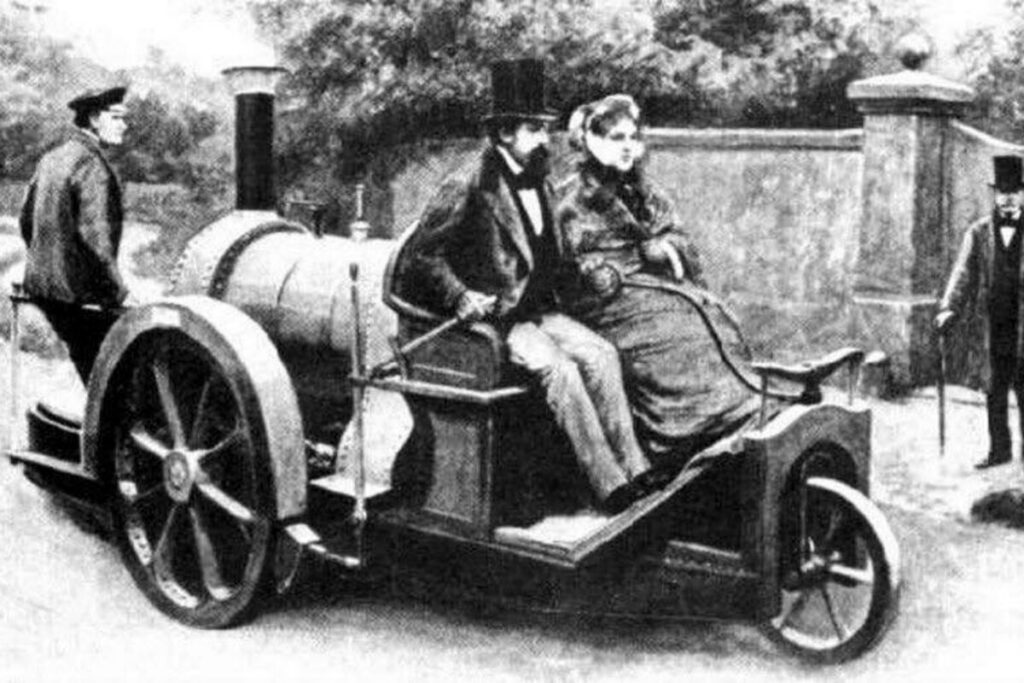
On 12 January 1822, the inventor of the first successful internal combustion engine, Etienne Lenoir, was born in the village of Mussy-la-Ville, in the deep south of Belgium. At the age of 16, he moved to Paris, where he began to experiment with electricity.
In 1859, he created the first viable internal combustion engine which burned a mixture of coal and air, ignited by a spark plug. On 23 January 1860, Lenoir unveiled his new engine in front of 20 guests.
By 1865, more than 400 of Lenoir’s engines were being used in France, and 1,000 in Britain, mainly for pumping and printing.
By 1862, Lenoir had developed the first automobile powered by an internal combustion engine. Known as the Hippomobile, it was basically a converted tricycle powered by a small engine.
In a trial run, the vehicle covered an 11-kilometre route in ninety minutes. But it was the beginning of a revolution in transport.
In his 1863 novel Paris in the Twentieth Century, Jules Verne predicted boulevards crowded with Lenoir’s horseless carriages. How right he was.
Derek Blyth’s hidden secret of the day: Derek Blyth is the author of the bestselling “The 500 Hidden Secrets of Belgium”. He picks out one of his favourite hidden secrets for The Brussels Times every day.
