
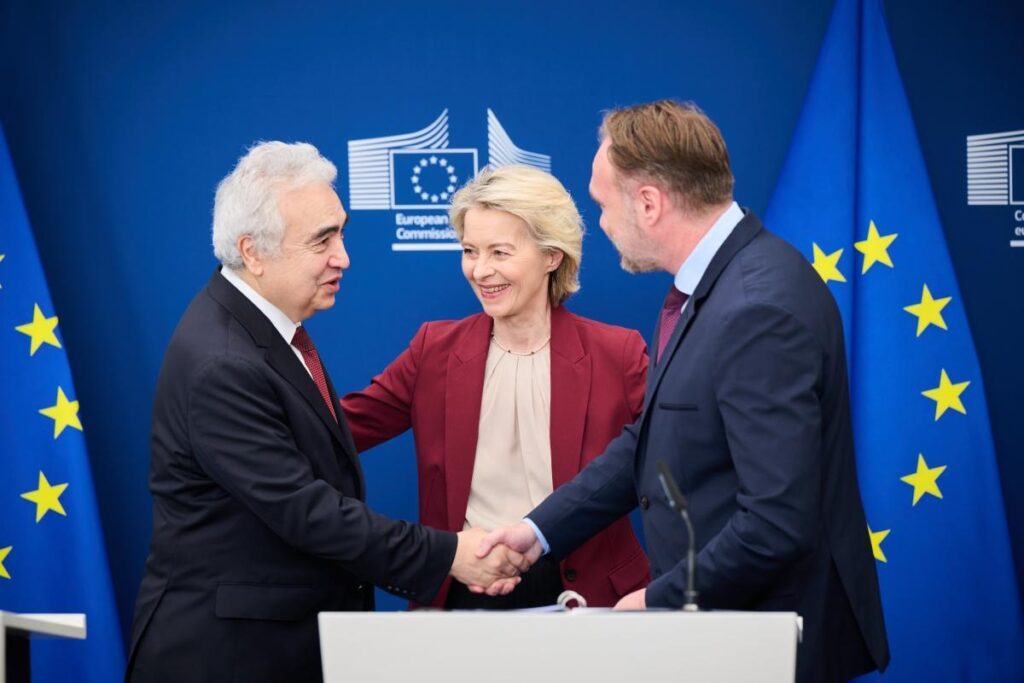
The European Union has formally decided to end its energy dependence on Russia, following an agreement between Member States and the European Parliament to phase out Russian gas imports by the end of 2027.
The agreement includes a gradual ban on the import of liquefied natural gas (LNG) by the end of 2026 and pipeline gas by autumn 2027.
Next year, the European Commission plans to propose legislation to phase out Russian oil imports as well.
European Commission President Ursula von der Leyen stated that the EU has overcome its worst energy crisis since Russia’s invasion in 2022 by diversifying its energy supply towards reliable partners and investing rapidly in nuclear and renewable energy.
She noted that Europe has significantly reduced its reliance on Russian energy: the share of Russian gas has dropped from 45% to 13%, coal from 51% to 0%, and oil from 26% to 2%.
Von der Leyen emphasised that by reducing fossil fuel imports, the EU has cut the revenue Russia uses to fund its invasion of Ukraine. Payments to Russia for fossil fuels have fallen from €12 billion per month at the start of the war to €1.5 billion.
Despite this reduction, Von der Leyen stressed that even €1.5 billion per month is too much and reiterated the EU’s commitment to eliminating these payments entirely.
She described the EU as entering a new era – one of complete energy independence from Russia. In her words, this shift will make the Union more resilient.
Energy Commissioner Dan Jørgensen called it "a good day for Europe and a bad day for Russia," stating that Europe will never return to dangerous dependence, volatile supplies, market manipulation, or energy blackmail.
Kremlin fumes
On Wednesday Russian spokesperson for the Kremlin, Dmitry Peskov, responded with hostility to the decision. He said the agreement meant that the EU is "condemning itself" to "accelerate" its loss of power.
"Europe is condemning itself to more expensive sources of energy, which will inevitably have consequences for the European economy and a reduction in its competitiveness," he declared during his daily press briefing, in response to a question from AFP.
"This will only accelerate the process initiated in recent years of loss by the European economy of its leadership potential", Peskov further judged.
MEPs and European states reached an agreement on Wednesday on the ban on imports of Russian gas into the EU in autumn 2027.
The aim is to deprive Moscow of a considerable windfall which finances the war launched almost four years ago by Russia in Ukraine, a country of which the EU is the most fervent supporter.
