
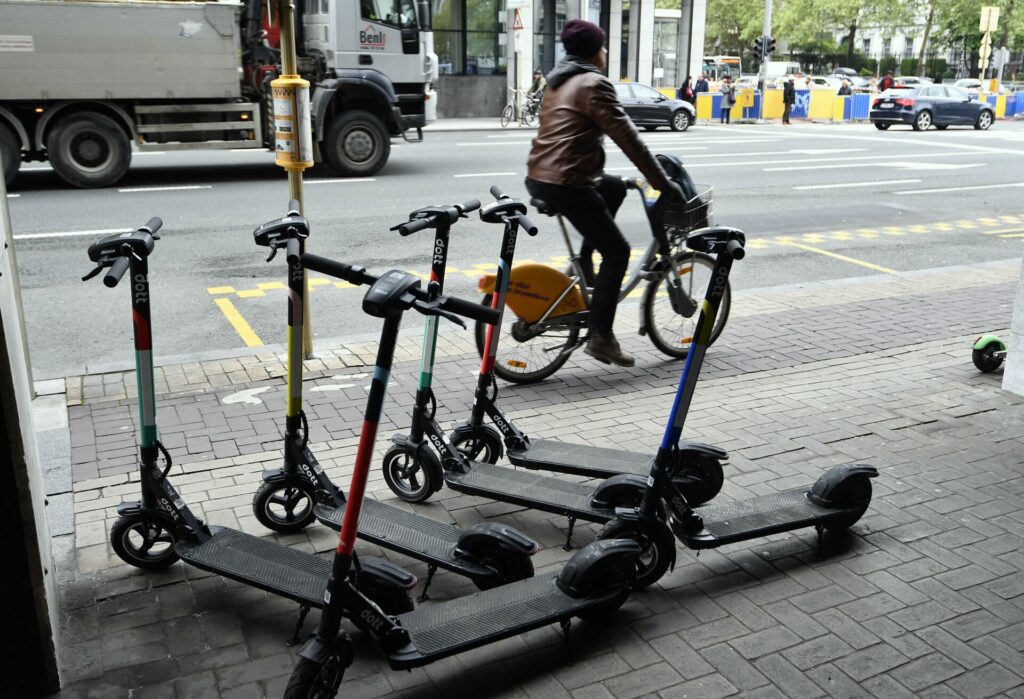
From now on, anyone using a shared e-scooter in the Brussels-Capital Region will first have to complete a mandatory identity verification check, mobility operators Bolt and Dott announced on Wednesday.
The ID checks are aimed at improving safety, and follow the recent public statements made by several Brussels mayors, as well as the request from Brussels Public Prosecutor Julien Moinil; shared scooters are a popular means of transport for drug dealers.
"The measure is part of a broader effort to improve safety and user accountability. Safety is our top priority," Guillaume Burland, spokesperson for Bolt, told The Brussels Times.
While Bolt and Dott's e-scooters are available in cities across Europe, the ID check has only been implemented in Brussels. Additionally, they are only required for e-scooters, not for their bikes.
Selfie checks?
For the time being, riders are only required to complete the ID check. This represents an important additional layer of verification, which "strengthens traceability and allows us to act more effectively in cases of misuse."
In practice, this means that from now on, all users – both new and existing – will be required to scan an identity document (ID card, passport, driving licence or equivalent document) directly in the app to confirm their identity before using an e-scooter.
Once the document has been scanned, the app carries out an automatic verification – a process that is "fully GDPR-compliant" and "only takes a few seconds," according to Bolt.
For a complete rider verification, a so-called "selfie check" would be required before each ride. In that case, riders would have to take a selfie when unlocking a scooter, which would then be compared with the photo on the ID document.
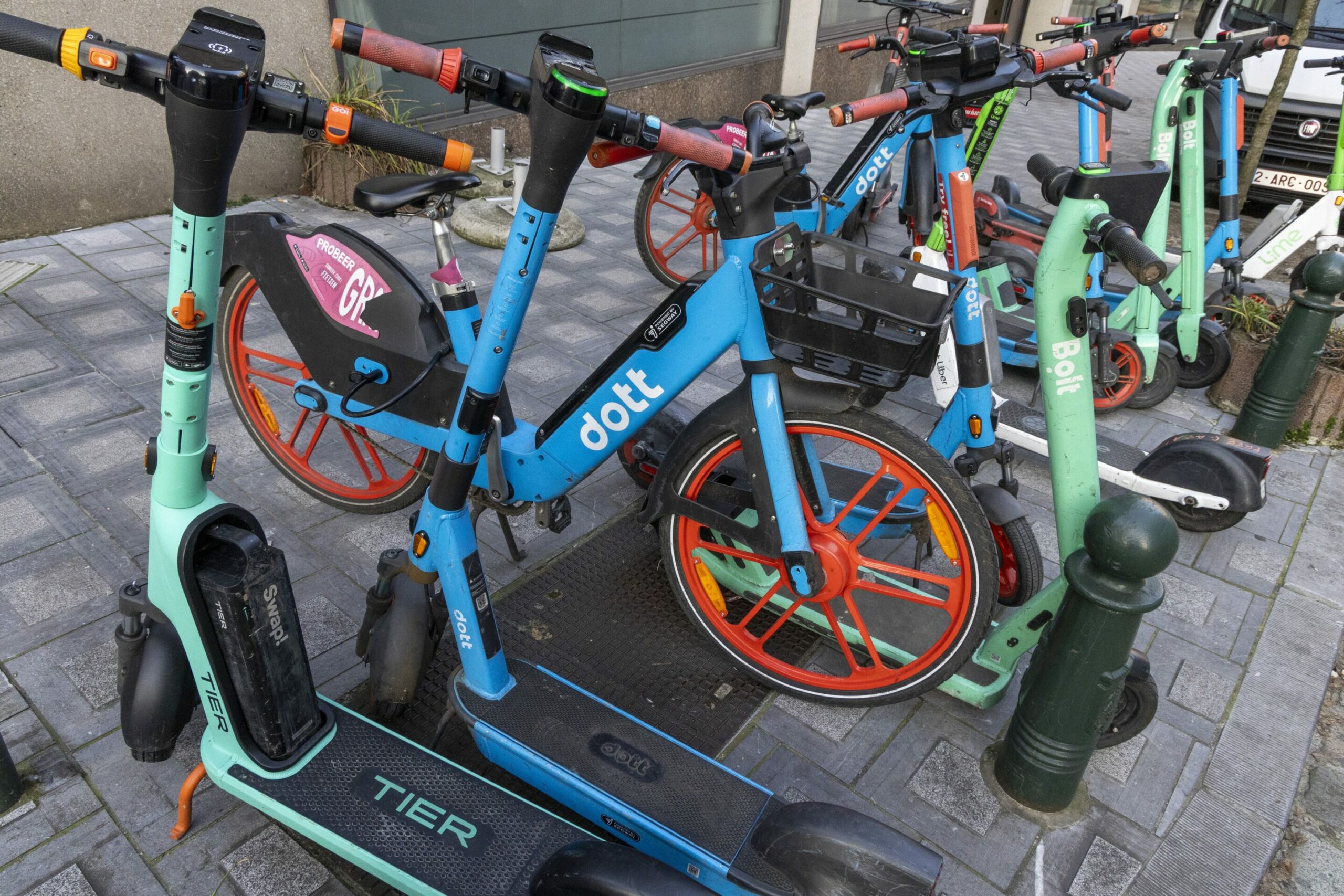
Electric scooters pictured in Brussels on Wednesday 10 January 2024. Credit: Belga / Nicolas Maeterlinck
Bolt and Dott are not implementing these biometric selfie checks yet, but Burland confirmed that the companies are in ongoing discussions with Brussels mayors about this and other measures.
"Implementing selfie verification requires further technological development, which takes more time. We will monitor the effectiveness of the ID check and continue discussions about additional steps," he added.
Burland stressed that shared e-scooters are among the most tightly regulated means of transport in the city, with speed limited to 20 km/h in Belgium (while the legal limit is 25 km/h), permanent geolocation, and designated no-go or reduced-speed zones.
"Contrary to a common misconception, shared vehicles are traceable (identification number and QR code) and geolocatable," Burland said. "Users are also already identifiable, as registration requires the provision of personal details and a bank card or other means of payment."
'An intermediate step'
"Once the identity document has been scanned, the app performs an automatic verification," said Burland. "This process complies with privacy regulations and takes only a few seconds to a few minutes."
"This verification is only requested once per user," he stressed. "This additional step increases the traceability of rides and helps us to act more quickly and efficiently in the event of abuse."
Dott's app shows that it is launching the same ID check procedure.
Meanwhile, Etterbeek mayor Vincent De Wolf (MR) – who previously proposed a ban on e-scooters across Brussels at night in the fight against crime – told Bruzz that the regulations were "an intermediate step" towards the facial identification that the Public Prosecutor's Office is insisting on.
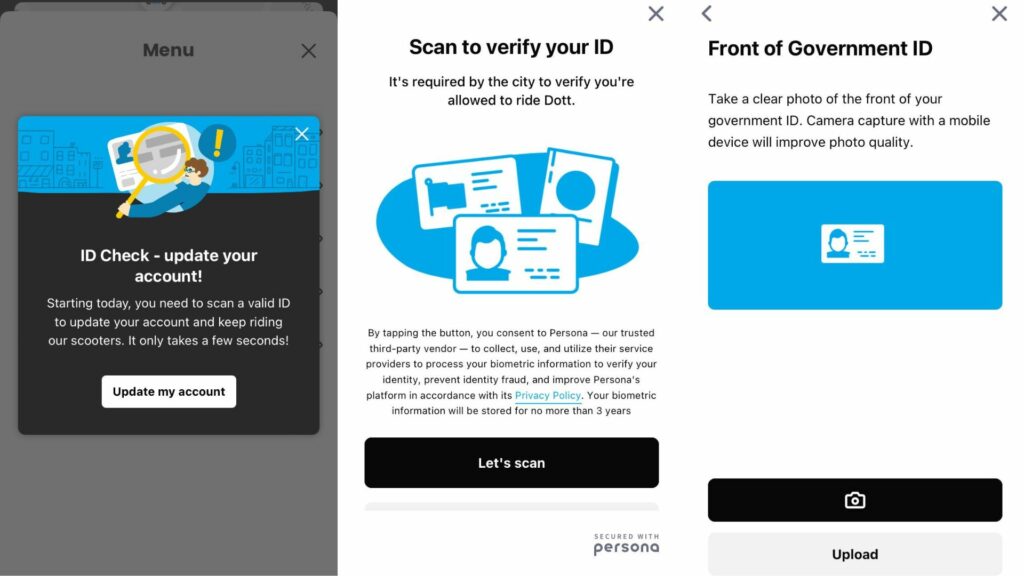
Mandatory ID check for users in the Dott app. Credit: The Brussels Times
However, many wonder if these ID checks on shared scooters will not result in drug couriers switching over to private scooters. While De Wolf acknowledged that such a shift could occur, he is hoping for action at the federal level.
“We will look into this at the next meeting of the Conference of Mayors," he said. "We will call on the Federal Government to make private scooters recognisable, for example, by means of a license plate."
Dott and Bolt stressed that they "work alongside local authorities every day" to ensure the safety of both users and residents. Where necessary, the operators cooperate directly with police services, providing the information needed to identify or trace suspects – upon official request and in full compliance with GDPR, they said.
"At a time when local authorities are stepping up their efforts to improve safety in public spaces, this new feature gives them an additional tool to help prevent antisocial behaviour and tackle risky conduct."
