
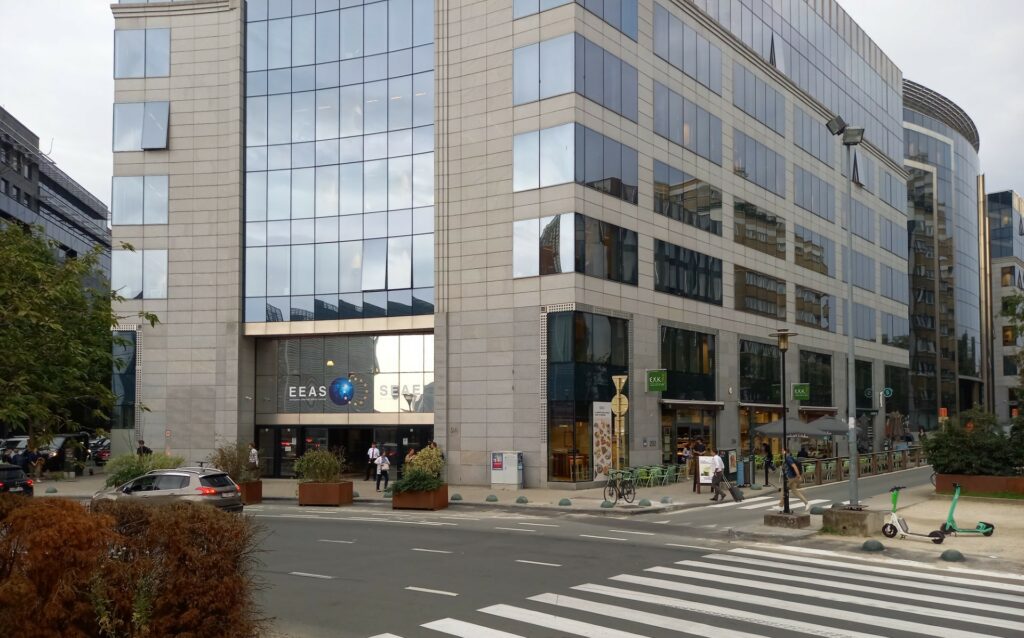
The European Commission and the European External Action Service (EEAS) continue to decline to comment on the on-going investigation of the suspected procurement fraud related to the latter's award of a tender to the College of Europe in Bruges for the establishment of a European Diplomatic Academy headed by its former foreign policy chief Federica Mogherini.
Asked at the press conference today if the tender evaluation report could be disclosed to journalists covering the case, the Commission’s lead spokesperson for foreign affairs told The Brussels Times that access to the report could not be granted.
The rules about public access to documents held by the EU institutions are set in Regulation (EC) No 1049/2001 but no reason was given for the refusal.
Normally access to tender evaluation reports is given after the tender process has been finalized and the contract signed with the tenderer who won the tender. If necessary, information might be redacted to protect sensitive private or business data.
The affair started with a morning raid on 2 December at the premises of EEAS and other buildings in Brussels launched by the European Public Prosecutor's Office (EPPO) and Belgian police.
Mogherini, Sannino, a former Secretary-General of EEAS, and an official at the College are suspected of procurement fraud, corruption, conflict of interest and violation of professional secrecy.
All three were arrested and interrogated but have been released during the continued investigation. Last week Mogherini and Sannino announced that they would step down from their current positions. Mogherini was not forced to resign but apparently did it in the best interest of the College and is convinced that she is innocent of the charges.
Mogherini was appointed as rector of the College of Europe in 2020 after finishing her mandate as High Representative and head of EEAS. Her successor as High Representative was Josep Borrell (2019 – 2024) during which time the alleged procurement fraud took place.
The decision on a pilot project for the establishment a diplomatic academy for young diplomats from EU Member States and candidate countries was taken in phases. The pilot project was initiated by Spanish MEP Nacho Sánchez Amor (S&D), a member of the Foreign Affairs Committee of the European Parliament, in April 2021 and subsequently approved by the Parliament and allocated a budget.
“The aim is a European diplomacy that is selected and trained from the very beginning, rather than relying on staff "on loan" over an extended period. While there are advantages to having diplomats from Member States serving in the EU, there are also drawbacks such as their temporary nature, lack of incentives and the temptation to maintain national agendas” (see opinion article on S&Ds website).
He declined to comment on the case referring to internal rules which require media requests to be addressed by the communication department of the political party group. A spokesperson replied that the management of tenders is a matter of internal procedures in the institution concerned.
The first step in the project was a feasibility study for the establishment of a European Diplomatic Academy. The study, which was commissioned by EEAS, was carried out in May – November 2022 by the European Institute of Public Administration (EIPA) as lead of a consortium with the European University Institute (EUI) and the Centre for European Policy Studies (CEPS).
The study was followed by the launch of a tender in the first quarter of 2022 using a “middle-value negotiated procedure” (€ 60.000 - € 143.000) for the provision of the first pilot academic programme of the European Diplomatic Academy. EEAS awarded the tender to the College of Europe.
The second phase of the pilot programme was tendered in 2023 (deadline 2023-02-20) for the academic year 2023 – 2024, with an estimated tender value is 960,000 euro. Not surprisingly the College of Europe was awarded the service contract after the “successful implementation” of the first phase of the pilot programme.
According to the College, “the objective of this second phase is to continue laying the basis for the establishment of a full-fledged European Diplomatic Academy to train young European diplomats and EU officials.” Two consecutive groups of up to 45 participants in each were trained from September 2023 to June 2024.
They were housed in a residence in Bruges, which “will contribute to foster an esprit de corps and a sense of belonging”. About 80% of the lecturers were practitioners (including senior EEAS officials) and the remaining 20% scholars. Both groups took part in a one-week study trip to the College of Europe in Natolin, Poland, to experience “first-hand the reality of diplomatic work at the EU’s Eastern frontier.”
The award of the contract to the College of Europe has been compared to recent corruption cases such as Qatargate in the European Parliament but these involved external actors (countries or companies) that were accused of bribing MEPs.
