
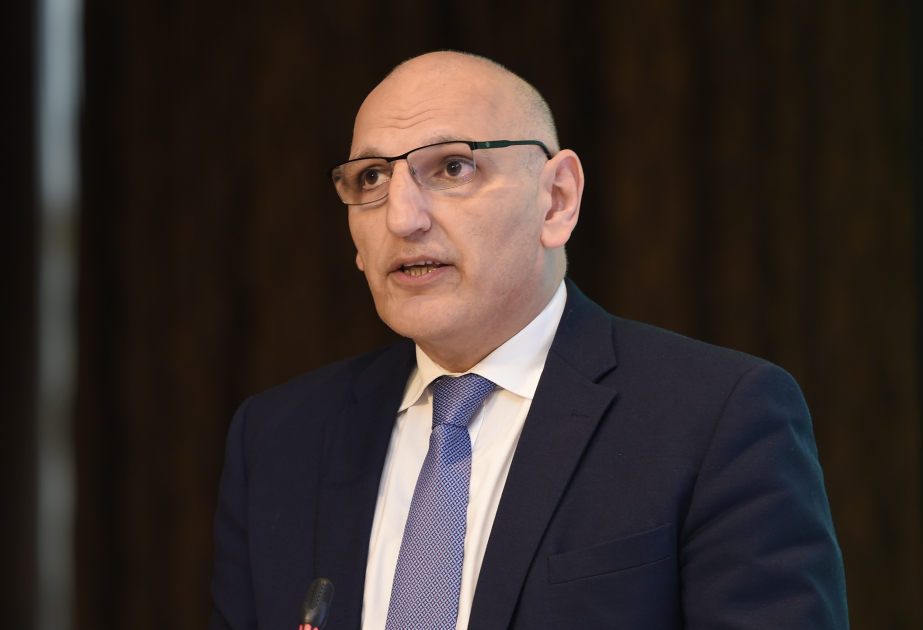
This was clear during a recent briefing in Brussels, where Elchin Amirbayov, Representative of the President of the Republic of Azerbaijan on Special Assignments, outlined the country’s priorities on regional stability, relations with Europe, and ongoing peace talks with Armenia.
His visit to Belgium was part of a wider outreach effort to maintain political dialogue with Brussels, engage with EU institutions and NATO, and share updates on the developments that followed the Washington summit earlier this year.
Azerbaijan–Belgium relations: Stable but underdeveloped economically
Marking 33 years of diplomatic relations, ties between Azerbaijan and Belgium were described as “steady and constructive.” During his visit, Amirbayov met senior officials at the Ministry of Foreign Affairs, the diplomatic adviser to His Majesty the King, and representatives from the Prime Minister’s Office and parliament.
Economic relations, however, remain relatively limited. Trade stood at under $90 million in 2024, a figure both sides acknowledge does not reflect their potential. Around 20 Belgian companies currently operate in Azerbaijan, with opportunities identified in logistics, infrastructure, transportation, renewable energy, port development, and agriculture.
Azerbaijan’s transition towards green energy aligns with Belgian expertise, offering another area for expanded cooperation.
The peace process: A horizon and not a deadline
Much of the discussion focused on the evolving peace process between Armenia and Azerbaijan. After more than three decades of conflict, Amirbayov described the present moment as one offering “a horizon and not a deadline for peace.”
He noted that the Washington summit acted as an opening rather than a conclusion:
“It opened the door. Now we need to build the house,” he said.
Azerbaijan’s expectations for long-term peace revolve around three elements:
- A durable end to hostility that outlasts political cycles and changing governments.
- Open borders and restored regional connectivity as a foundation for predictable relations.
- Economic interdependence, positioning shared economic benefits as a stabilising force.
Beyond official negotiations, track-two exchanges have gradually resumed. Delegations of journalists, academics, and policy experts from both countries have recently travelled to Baku and Yerevan — visits Amirbayov described as early but meaningful steps toward rebuilding communication between societies.
Connectivity projects — including the proposed Zangezur Corridor — were discussed as part of a broader effort to link Europe and Asia through the South Caucasus. Amirbayov pointed out that peacebuilding must follow a “slow but steady” approach, allowing both societies time to adapt and support long-term normalisation.
While trust remains fragile, these exchanges and technical discussions indicate a more constructive dynamic than in previous years.
The Middle Corridor and Azerbaijan’s regional position
Geopolitical shifts and disruptions along traditional trading routes have increased interest in the Middle Corridor, the trans-Caspian route connecting China with Europe. With the war in Ukraine affecting the northern route and instability impacting southern routes, Central Asian countries — notably Kazakhstan — now view the Azerbaijani transit pathway with heightened strategic importance.
Azerbaijan recently joined the C5+1 framework, forming a new C6 structure with Central Asian states. Both the EU and China have shown interest in expanding cargo flows through the Middle Corridor, with projections of 20–25 million tons per year in the coming years.
Harmonising customs procedures, reducing bottlenecks, and improving infrastructure remain key challenges. However, demand for alternative trade routes continues to grow.
EU–Azerbaijan relations: Toward a strategic partnership?
A significant part of the visit focused on Azerbaijan’s ambition to elevate relations with the European Union to the level of strategic partnership — a status it maintains with several countries, including China and the United Kingdom.
While a formal partnership agreement remains under negotiation, political dialogue has intensified in recent years. High-level meetings between President Ilham Aliyev, European Commission President Ursula von der Leyen, and European Council President António Costa reflect growing cooperation on energy, connectivity, and regional stability.
Azerbaijan supplies natural gas to ten European countries, including eight EU member states, and is expanding investments in wind, solar, and hydrogen — areas where EU involvement is expected to deepen.
Amirbayov underlined that although negotiations were previously paused due to the pandemic, both sides acknowledge that relations are already strong in practice. Formalising them, he said, would be a natural next step.
Azerbaijan and NATO: A longstanding partnership
Azerbaijan’s partnership with NATO dates back to 1994, when it joined the Partnership for Peace programme. The relationship, Amirbayov said, has been “positive and predictable,” centred on interoperability, training, exercises, and shared security concerns.
Azerbaijan participated in the ISAF mission in Afghanistan and regularly hosts NATO delegations in Baku. A new Individually Tailored Partnership Programme (ITPP) is being prepared to outline the next phase of cooperation.
He pointed out that the partnership is not directed against any country, but forms part of Azerbaijan’s broader multi-vector foreign policy.
Incremental progress and cautious optimism
The discussion concluded with reflections on the broader challenges of reconciliation. Amirbayov emphasised that the peace process must be owned by both countries, with international actors playing a supportive — but not central — role.
He referenced examples such as Northern Ireland, where reconciliation required time, consistency, and a gradual rebuilding of trust.
Despite the complexities, he expressed cautious optimism that 2025 may be remembered as a turning point in regional relations — and that the current trajectory offers a realistic foundation for progress in 2026 and beyond.
