

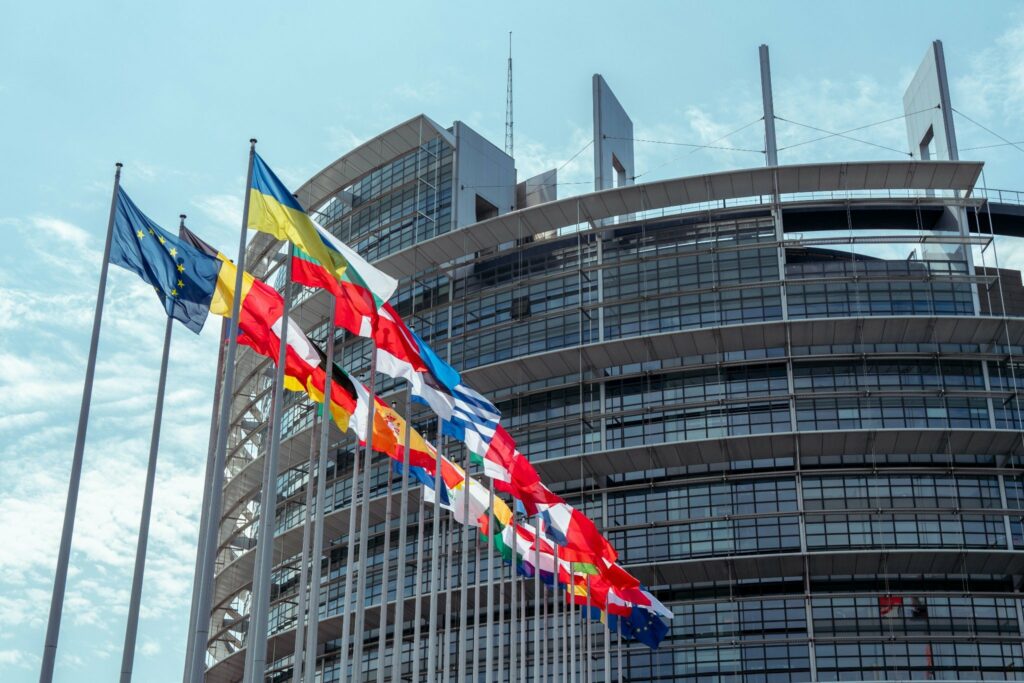
Europhiles often meet national consciousness with incomprehension and disdain. To them, it is a backwards-looking and irrational obstacle on the path toward an enlightened and “inclusive” European order.
A united Europe, they argue, should have at its core the transcendence of national ideas. However noble, this approach is doomed to fail. Europe’s history shows that its sociopolitical structures are deeply intertwined with national identities and that political unification requires a shared sense of belonging.
While many on the left underestimate the power of national identity, supporters of l’Europe des patries live in blissful ignorance of the geopolitical and economic necessity of political unification.
At a time when U.S. corporations wield more power globally than individual European states, and when modern warfare has expanded beyond land, air, and sea to include space and cyberspace, the European nation-state is no longer competitive.
The insistence of many nationalists on petty particularism in the face of great-power conflict threatens precisely the ways of life and traditions they seek to protect.
Reconciling identity and realpolitik
A repositioning of the European idea can resolve this tension between national identity and realpolitik.
In their current form, pro-European narratives appeal primarily to the cool rationality of macroeconomics and security policy and to the universalist ideals of multilateralism and human rights. They lack the emotional force needed to forge a mature continent, capable of defending its interests – with joint European armed forces, democratic European institutions, and a coherent foreign policy.
To develop sufficient political power, the European idea must build on the national attachments of Europeans. For the European identity required for political unification already exists – residing in the love of Europeans for their national communities and traditions.
Our nations are a shared heritage, and our unique relationship to them connects us and makes us European. Nowhere else is national identity practised in this way: huddled together on a small proto-continent, peacefully coexisting, and grounded in a plethora of century-old national traditions and state histories.
National consciousness in Europe is built on two foundational pillars. One is the unconditional attachment to a specific geography, a culturally and historically bound community, and a collective memory. The other – to which the first is usually (and crucially) inextricably linked – is the enlightened desire to live as free citizens in a democratic society. Without the first, a state lacks demos; without the second, despotism looms large.
This unique combination of identity and enlightened citizenry enabled the achievements that still form the social and political foundations of Europe today. The nation and its deeper internal solidarity paved the way for the European social contract.
Intertwined European identity
The secular nature of nationalism and its civic-religious power made possible the separation of church and state. Equality and unity of the people displaced the estates and contributed to the solidification of democracy. In their emancipatory histories, each European nation contributed an indispensable part to this European way of life. In our pride for these national moments, we are also proud of their European significance.
The French Revolution, for example, is part of French national mythology, whose influence on other European revolutionary moments – from 1848 to 1989 – endowed it with world-historical meaning. The same can be said of the strike at the Gdańsk shipyard or anti-Nazi resistance movements across the continent. The Ukrainian struggle against the Russian aggressor will similarly enter Europe’s collective memory.
Historical moments preceding the Enlightenment also serve as European milestones – one need only think of the Battle of Tours in 732 or the Ottoman sieges of Vienna.
The same holds for the wealth of national and regional traditions that together embody Europe’s pagan mythology, its Roman heritage, and its Christian imprint. In the Alpine countries we celebrate the Krampus festival; in Poland, there is the Turon figure; in Greece, he is called Kallikantzaros; and in Finland, Nuuttipukki.
Each nation celebrates the festival on a different date, yet always in winter, and always evoking the spirit of sin and virtue. Here too, Nation and Europe are not mutually exclusive but build upon one another.
Emerging dissonance
The political challenges of our time are an opportunity for the European Idea to gain new strength if it accepts as its foundation the advancement of these shared European achievements and the national particularities of the continent. Fear of loss has become the prevailing political force in Europe and, in its national manifestations, refers to aspects of the same underlying social structure.
Europeans worry about the deterioration of public safety, cultural norms, freedom of expression, and the resilience of their democracies. More important than the much-vilified lack of tolerance is the sense that Europe’s familiar and hard-won normality is fast disintegrating.
In attempting to break with nationalism, many Europhiles have positioned themselves as part of the problem. They deny Europeans their right to love their nations and attempt to force a transcendence of that affection toward a new European identity.
Worse still, some promote a sort of postmodern liberal hyper-individualism, where self-realisation becomes the ultimate and only legitimate practice of identity. When phrases like "protection of the European way of life" provoke public outrage, or "nationalist" is used as a slur in Brussels, one creates an artificial and counterproductive distance between the European idea and the identity of many Europeans.
A moment of redefinition
Instead, a united Europe should be articulated as a means to promote and protect its nations. Only with our collective strength can we preserve our cultural particularities, protect our streets, nightlife, and festivals from terror and crime, and strengthen our democratic community.
In many places where the threat to European life is more tangible, national identity is already inseparably bound with the European Idea. Think Ukraine, Georgia, or Moldova; places where Europe is seen as a haven for national life that strengthens national traditions and protects them from destructive forces.
Present conditions offer the European idea a unique chance to serve as the protector of a shared homeland–a Europe in which free citizens can practice their traditions and identities in peace. This way, the centuries-old bridge between the nation and Europe could become a political reality. National consciousness in Europe would no longer be a threat to European unity but its foundation.
Moreover, the argument of so-called "nationalist" forces would lose its basis – their resistance to European cooperation exposed as not only anti-European but also anti-national. The shared struggle to preserve our homeland could then provide the European idea with the emotional force it so urgently needs.
Unification will require compromise. Some will struggle to integrate national pride into their universalist reading of the European idea. Others will find it painful to separate national identity from the sovereignty of national political institutions.
Yet the price of inaction is higher. The preservation of liberal democratic values and our traditions alike demands a resilient common homeland. Unlike in centuries past, the world no longer waits for the old continent.
