

The top countries with the best-performing internet browsing in 2025 were all European, with Belgium ranking in the top 5.
The study, developed by nPerf, compares the loading time of the five most visited websites in each country. It ranks the speed by percentage, with 100% being instant navigation and 0% no navigation.
The results place Europe firmly at the top of the global leaderboard. Ireland topped the ranking (79,1%), followed by the Netherlands (78,6%), Slovakia (78%), Slovenia (76,9%) and Belgium (76,4%).
It confirms the strong performance of European countries, with the rest of the top 10 also being composed of European countries: Switzerland (76%), France (75,7%), Bulgaria (75,4%), Austria (75,2%) and Hungary (74,8%).
"The countries that deployed 5G first are not necessarily the ones offering the fastest browsing experience," observes Renaud Keradec, CEO of nPerf.
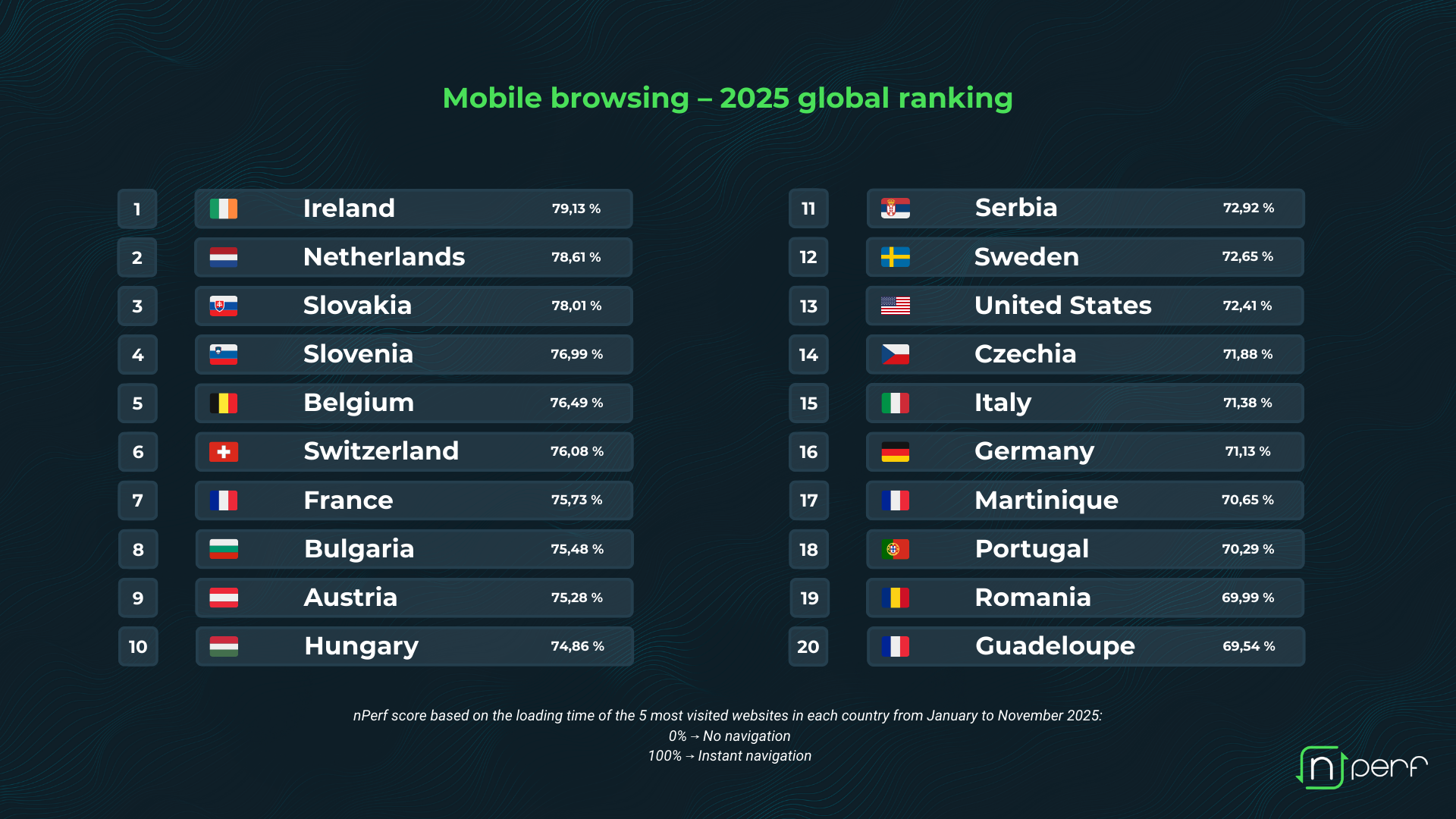
The United States, which was an early deployer of 5G, ranks only 13th in the list, with 72,4%. Alongside French overseas territories, Guadeloupe and Martinique, it is the only country outside the European continent.
This gap can largely be attributed to the size of the US territory, which covers several million square kilometres. This makes it a significantly more complex challenge than upgrading a smaller country such as Ireland or Belgium.
This difference directly influences the quality and consistency of the mobile browsing experience, according to nPerf.
Despite its almost universal availability, the 5G network is still barely used in Belgium.
Earlier this year, a report by the Belgian Institute for Postal Services and Telecommunications (BIPT) revealed that mobile data usage has more than tripled in five years.
Yet, out of this astronomical rise in mobile data use, only 17.9% of mobile network operators' data traffic passes through 5G, the fifth generation of wireless cellular technology.
These low 5G usage figures do not reflect the high coverage of Belgium, which has been further strengthened this year. In February, 99.78% of Belgian households had access to 5G – up from 87.5% of the year before.
Overall, the coverage in Flanders has been much more advanced than in Wallonia. Brussels only signed off on its 5G rollout over a year ago.
